








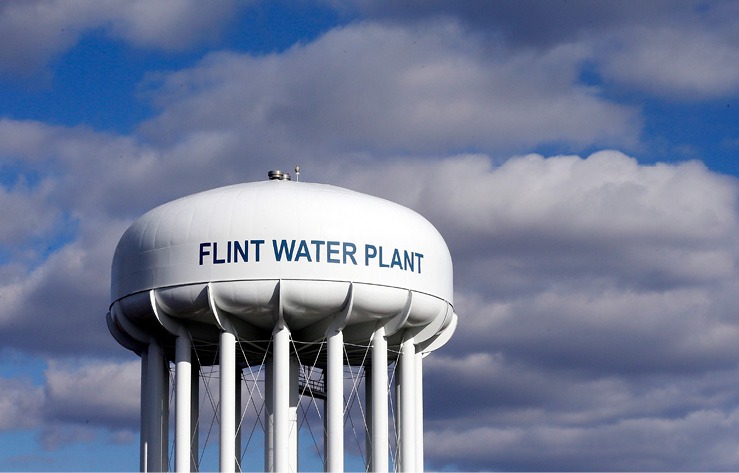

After 11 years of hardship, frustration, and uncertainty over health, environmental concerns, and damaged infrastructure, plaintiffs from the 2014-2016 lead contamination water crisis in Flint, Michigan, have received word that compensation checks from a $626 million lawsuit are now available after attorneys representing nearly 100,000 victims settled with the government.
The contamination originated from state decision-makers switching the city’s water supply from Detroit to the highly toxic Flint River, initially as a cost-cutting measure, but more than a decade later and after millions of dollars spent to correct it, residents remain dissatisfied as the likelihood of other long-term health effects remain uncertain and details surrounding the settlement remain unclear (see The Final Call Vol. 42, No. 3).
With at least 30 settlement categories divided between minors and adults, and for damages to residential and business properties from the time of the switchover, residents, activists and attorneys said challenges remain. Challenges include informing the public about who may or may not be eligible to receive a check, the amount of money they will receive, how paperwork issues hinder residents, and whether additional remedies related to the contaminated water will be available should other maladies arise in the future.
“When the settlement was made several years ago, we kept getting delayed, pushed off, delayed, pushed off for whatever reason,” said Audrey Muhammad, a member of the Nation of Islam, a Flint resident and community activist. “There was an appeal, there were different things. They kept trying to decide how we were going to get the money distributed to us,” she told The Final Call. She was referring to the bureaucratic red tape slowing access to the funds and questions about which settlement category a claimant would fall under regarding compensation.
She spoke of the frustration of trying to stay up to date on the information being released, being required to register and file paperwork more than once, and spending thousands of dollars of her own money to install and maintain a home water filtration system.
She argues that payment amounts still do not compensate fully for the fallout from the water crisis and for residents who suffered and continue to suffer.
“It’s a slap in the face and many residents here are very upset about it and let them know this is a direct slap in our face because this nowhere covers it.”
The contamination is bigger than just lead
Community activist, organizer and Flint resident Arthur Woodson told The Final Call that it was during the campaign of President Joe Biden when then-Senator Kamala Harris first came to Flint as his running-mate that support was given for a cancer cluster study.
“We had a sit-down and she promised me that once they were in office, she would come back to Flint and help get this cancer cluster study started,” Mr. Woodson said. “That’s when things got to rolling and they introduced me to an organization by the name of the National Minority Equality Forum. I had already put together a team of researchers, professors, scientists, and epidemiologists from U of M, Michigan State, and Wayne State. So, after that, I put out a bid to do the cancer cluster study,” he said. “I did three briefings at the White House about the cancer study and right now it’s ongoing.”
Noting that the study is projected to be completed by October 2026, Mr. Woodson said it is not part of the lead contamination settlement and is separate from it. Mr. Woodson alleges there are cases of brain, stomach and throat cancers and that two cancer incident reports found that cancer in the city was up 500% after the water crisis.
According to a June 8 article on flintbeat.com, “Some Flint residents have expressed concerns about possible links between these elevated cancer rates and environmental exposures, including lead, PFAS and trihalomethanes, particularly in the years following the Flint Water Crisis. There is also concern over limited access to reliable, high-quality cancer data specific to the city.”
The article continues, “Recent data from the Michigan Department of Health and Human Services indicates Flint experiences higher-than-expected rates of several cancers compared to Genesee County and the state overall. These include lung and bronchus cancer, larynx cancer, stomach cancer and prostate cancer.”
While the results of the study will take some time, other challenges remain.
Reggie Davidson, of Legal Research One, is a paralegal contracted to manage the Flint office of the law firm Napoli Shkolnik PLLC, from May 2018 until March 2025. He told The Final Call that there has been a problem with getting people to sign up for the settlement because of mistrust or misunderstandings about the rollout of the registration process and confusion after the plaintiffs and more than 104 law firms settled with the State of Michigan, the City of Flint, McLaren Hospital, and one of the engineering firms for $626 million.
“So, in 2020, when the lawsuit was settled, barely 25,000 people had signed up out of a potential pool of 90,000 to 100,000 people and one of the fallacies and tragedies of this lawsuit was at the time of settlement, there was not even a third of the potentially qualified people signed up,” Mr. Davidson said.
“The process of gathering information for the people in support of the claim, people just were not willing to do things like give their social security numbers. They weren’t willing to give birth certificates for their children, or they didn’t have the money to obtain birth certificates of their children if they were misplaced or lost, or things like that,” he said.
Noting that 68% of the city’s residents live in poverty and that it is difficult to inform people of their rights or to educate those most affected on how to receive their payouts, Mr. Davidson said it is necessary for people to check their eligibility. “They need to, at this point, contact their law firm or the Special Court Master,” he said.
“At this stage of the game, the Special Court Master and the claims administrators have the paperwork,” Mr. Davidson said. “In the end game, we’re trying to direct people directly to those two sources because it will be those two sources that will subsequently be able to say, yes, you’re in a category to get some money, or no, you’re not.”
For more information, contact the Flint Water Claims Administrator at 888-893-7470 or online at: officialflintwaterpayments.com.
