









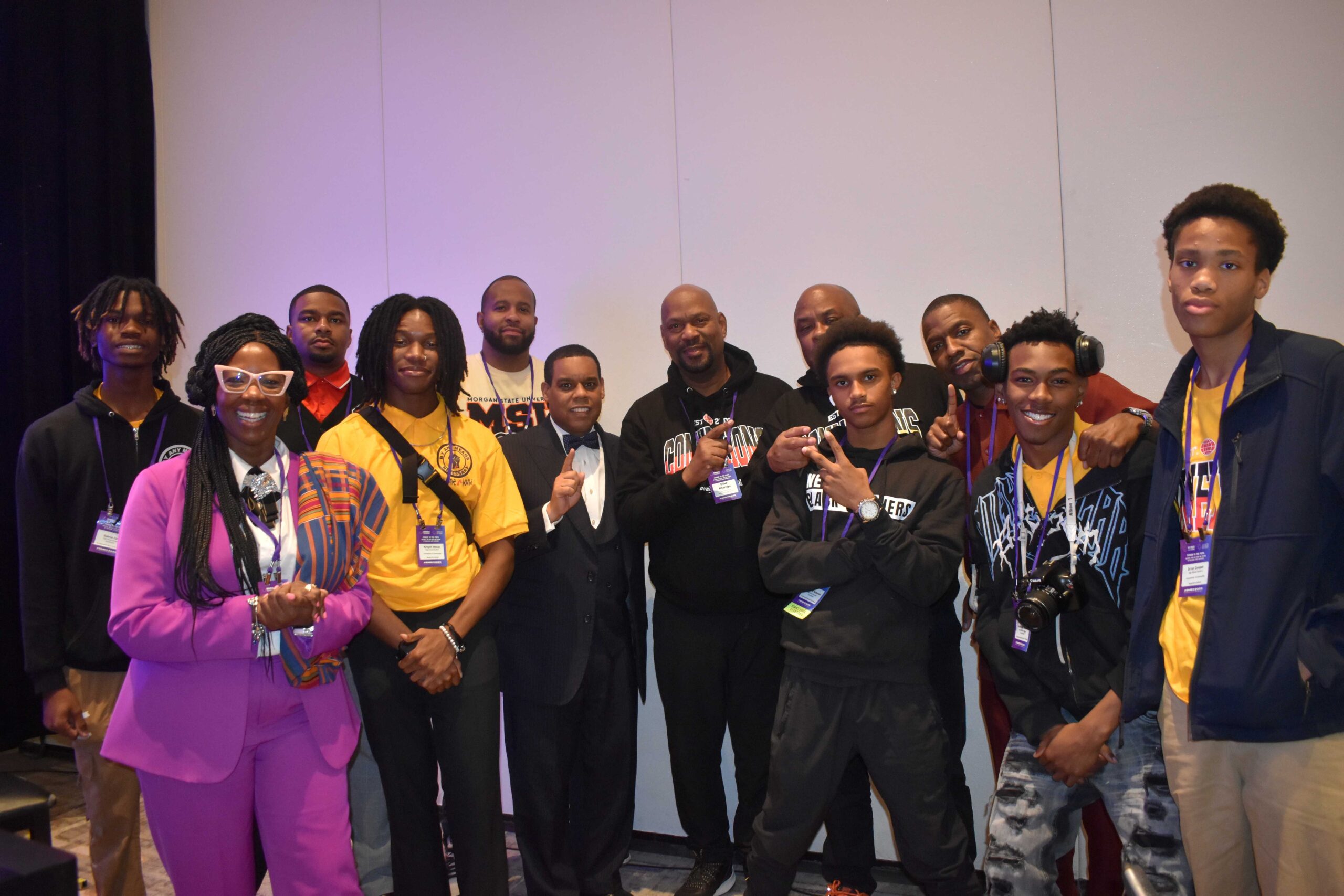

PHILADELPHIA—The future of education was on full display at the 2025 Black Men in Education Convening (BMEC), where students from Baltimore’s Connections Fine Arts Academy joined administrators and community leaders in a powerful gathering dedicated to reimagining schools and uplifting Black voices.
Among the delegation from the academy was Student Minister and Student Imam Abdul Salaam Muhammad, of Mosque No. 6 in Baltimore. He is also a crisis interventionist at Connections Fine Arts Academy.
And he accompanied students and administrators to the three-day convening held November 20–22. His presence, along with others, underscored the event’s focus on both leadership and youth empowerment. (See The Final Call, Vol. 45 No. 9)
For Principal Sidney Brooks, the heart of the work lies in giving students a voice. “The biggest challenge is developing leaders who are equipped to be sound instructional leaders,” Principal Brooks said. “We need to move beyond being seen as just disciplinarians and focus on making change through academics and instruction.”
He explained the importance of keeping students engaged in what interests them. “Our students select an art track in sixth grade and follow it through to graduation,” he explained. “Whether it’s West African drumming, dance, or visual arts, they stay connected to their passion.”
That passion was evident in the voices of students who attended BMEC. Kenyell Jessup, 18, who dreams of a career in music production, said the event lit a fire within him. “Seeing how many Black educators come together as a community to push for change makes me want to do more,” he said.
Seventeen-year-old Anthony Swann, an aspiring photographer, echoed the sentiment. “This conference has shown me a different light on teachers and principals,” he said. “It’s opened my mind to new ways of thinking and problem-solving.”
Both students pledged to bring the lessons of BMEC back to their peers, ensuring the convening’s impact extends beyond Philadelphia.
While students looked ahead, veteran educators reflected on the system they hope to transform. Elijah Etheridge, executive director of the Baltimore Teacher Network and charter operator of Connections, called for nothing less than a complete overhaul.
“The system itself needs to be remade,” he said. “We have Black leaders at every level, yet the system is still failing. It needs to be destroyed and rebuilt.”
Mr. Etheridge’s personal story illustrated the stakes. As a young man, a teacher dismissed his dream of working in the White House. He went on to work in the U.S. Senate and on a presidential campaign. “It’s proof that we can overcome low expectations,” he said, adding that the hope lies in the next generation.
Student Minister Abdul Salaam Muhammad offered a sobering reminder of the systemic barriers Black males face. “Though we are qualified—sometimes overqualified—we have been integrated into a system that was already against us,” he said.
Drawing on the Teachings of the Most Honorable Elijah Muhammad, Eternal Leader of the Nation of Islam, he emphasized self-reliance: “If we are in a burning house, we should get out and do something for self or suffer the consequences,”
Student Min. Abdul Salaam Muhammad stated, repeating the phase from the Most Honorable Elijah Muhammad and His National Representative, the Honorable Minister Louis Farrakhan.
Yet his message was also one of hope, also based on the Teachings of the Most Honorable Elijah Muhammad as exemplified by the Honorable Minister Louis Farrakhan.
“Think about this: ‘racism’ cannot exist in the field of excellence. No man can say that ‘I am better than you are’ if you are manifesting excellence, especially if they are saying it because of color, or because of class, or because of some privilege that one may have.
The manifestation of excellence is the destruction of White supremacy and Black inferiority,” Minister Farrakhan said in a message titled, “ Challenging The Genius In Us All,” delivered September 17, 2005 in Chicago.
“We destroy White supremacy with Black excellence, and that’s what I’m seeing at this conference,” said Student Min. Abdul Salaam Muhammad.. He urged community organizations and churches to adopt schools, stressing that “it takes a village to raise a child, and when the community is involved, success follows.”
For many attendees, BMEC was more than a conference—it was a renewal of purpose. “Seeing hundreds of brothers committed to this work, often undercompensated but dedicated to change, keeps our heartbeat going,” said Principal Brooks.
Mr. Etheridge added that gatherings like BMEC are irreplaceable. “There’s no other convening like this. It’s a reminder that we’re stronger as a community and that we can inspire the next generation to lead.”
Student Min. Muhammad agreed: “The blueprint for success has already been laid. We’ve been given the tools to build successful Black schools run by Black people.”
—Michael Z. Muhammad, Contributing Writer
