







Sudan’s latest conflict between the Rapid Support Force (RSF) led by Mohamed Hamdan Dagalo, also known as Hemedti, and the Sudanese Armed Forces (SAF), headed by General Abdel Fattah al-Burham, has metastasized into a brutal civil war.
Over 12 million people have been displaced, and weekly massacres, like those in the North Darfur capital city El Fasher, where 800 mostly civilians were slaughtered, appear to be increasing.
While the war has been framed as a “civil war” between RSF and SAF, it is instead being shaped by extensive foreign interference that has exacerbated and prolonged the violence and displacement of Sudan’s 44 million population, noted the Atlantic Council.
There are external forces and outside influences fueling the conflict. A recent headline from an op-ed article on the Middle East Monitor website notes, “Sudan crisis not accidental: Rogue regimes UAE (United Arab Emirates) and Israel complicit in the genocide.”
“… if the layers of convoluted information are stripped of propaganda, we find that underpinning this grim scenario, are regional and international actors reshaping the architecture of governance and control.
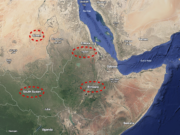
It extends to reshaping the balance of power in the Horn of Africa and not surprisingly involve Israel and the United Arab Emirates (UAE),” the Nov. 4 article stated.
“Haaretz noted in August 2025 that Israel was exploiting Sudan’s war to justify military expansion in the Red Sea under the banner of ‘protecting global shipping lanes from Houthi threats,’’ continued the article, referencing the Israel-based publication.
“The newspaper also reported that Israel has leveraged the crisis to deepen its political footprint in Ethiopia and Eritrea, as part of its broader plan to contain Iranian influence extending from Tehran to Sana’a and Khartoum,” the Middle East Monitor article continued.
According to several media reports on Nov. 6, the RSF agreed to a “ceasefire.” Anadolu Agency, headquartered in Türkiye reported that the RSF “said that it has agreed to a humanitarian truce (while fighting continued near Khartoum) in Sudan proposed by the ‘Quad’ countries.
Which includes the U.S., the UAE, Saudi Arabia, and Egypt.” Details of “the ceasefire’s implementation have not been disclosed, and no immediate reaction came from the Quad or the Sudanese army,” Anadolu Agency reported on its website.
Meanwhile, the toll on the lives of the Sudanese people is at catastrophic levels.
According to aa.com.tr, “There are thousands of civilians in El-Fasher who are still trapped and prevented by the RSF from leaving and facing all forms of abuse,” Sudanese Minister of Human Resources and Social Welfare Mutasim Ahmed Saleh said at a press conference in Port Sudan.
Minister Saleh called the situation in the capital city of Darfur “a humanitarian catastrophe that shakes the conscience, and the chapters of this catastrophe are still ongoing.”
In addition to the intervention in the Sudan conflict by the “Quad,” there is the United Kingdom’s concerning position. The London-based Guardian portrayed the UK government, with its Security Council position, as rejecting “atrocity prevention plans for Sudan despite warning” of impending “genocide.”
Britain “rejected atrocity prevention plans for Sudan despite intelligence warnings that the city of El Fasher would fall amid a wave of ethnic cleansing and possible genocide, according to a report seen by the Guardian,” the outlet reported.
The UK government turned down plans six months into the 18-month siege of El Fasher opting for the “least ambitious” option, or the least expensive option, of the four options presented regarding the conflict.
A report dated October 2025, documenting the (UK) decision, said: “Given resource constraints, (the UK) has opted to take the least ambitious approach to the prevention of atrocities, including CRSV (conflict-related sexual violence),” the Guardian reported.
“Shayna Lewis, a Sudan specialist with the U.S.-based human rights organization Paema (Preventing and Ending Mass Atrocities), said: ‘Atrocities are not natural disasters—they are a political choice that are preventable if there is political will.’”
“The FCDO’s decision (to pursue the least ambitious option for atrocity prevention) clearly shows the lack of priority this government places on atrocity prevention globally, but this has real-life consequences.”
The FCDO is the Foreign, Commonwealth & Development Office, which is the UK government department responsible for international development and foreign affairs.
However, the involvement of Israel and the UAE is most concerning. Haaretz, noted in an August 2025 opinion piece that Israel was exploiting Sudan’s brutal war between RSF and SAF to justify a military expansion in the Red Sea under the guise of “protecting global shipping lanes from Houthi threats.”
Additionally, a recent Tehran Times article titled, “Sudan conflict through the lens of Red Sea strategy,” about Israel’s ambitions in Sudan, the report accuses Israel of shadowing the Sudanese “turmoil.”
“In the shadows of this turmoil, the Zionist regime of Israel is maneuvering within a broader project to control the Red Sea corridors, under the familiar pretext of ‘combating Iranian arms smuggling’ toward Gaza and Yemen,” the article noted.
According to the Tehran Times, “Since Sudan’s signing of the so-called Abraham Accords in 2020, Israel has intensified its political and security footprint in Khartoum and surrounding areas.”
The Human Rights Research Center, a Virginia-based nonprofit organization, noted in its analysis that the ongoing diplomatic relationship between the U.S. and the UAE regarding Sudan is also a factor in the conflict, blaming the former for its.
“Continual allyship with and investment in the United Arab Emirates, the country that has been funneling resources, weapons, and money into Sudan to keep the RSF afloat since the start of the civil war.”
In April, Sudan held hope that the International Court of Justice (ICJ) would make a finding against the UAE, which it accused of being complicit in acts of genocide by arming and aiding the paramilitary RSF.
The case, which was titled “Application of the Convention on the Prevention and Punishment of the Crime of Genocide in Sudan (Sudan v. United Arab Emirates),” was filed when Sudan filed it against the UAE. However, it was dismissed.
“Regrettably, the ICJ rejected the application saying it ‘manifestly lacked’ jurisdiction to rule on the case and threw it out,” reported themiddleeastmonitor.com
Follow Jehron Muhammad @africawatchfcn on X
