









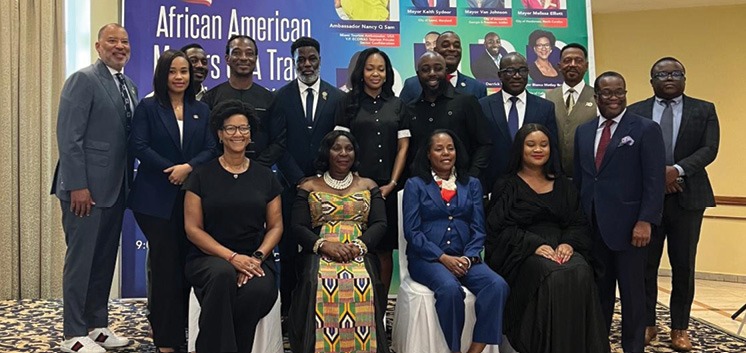

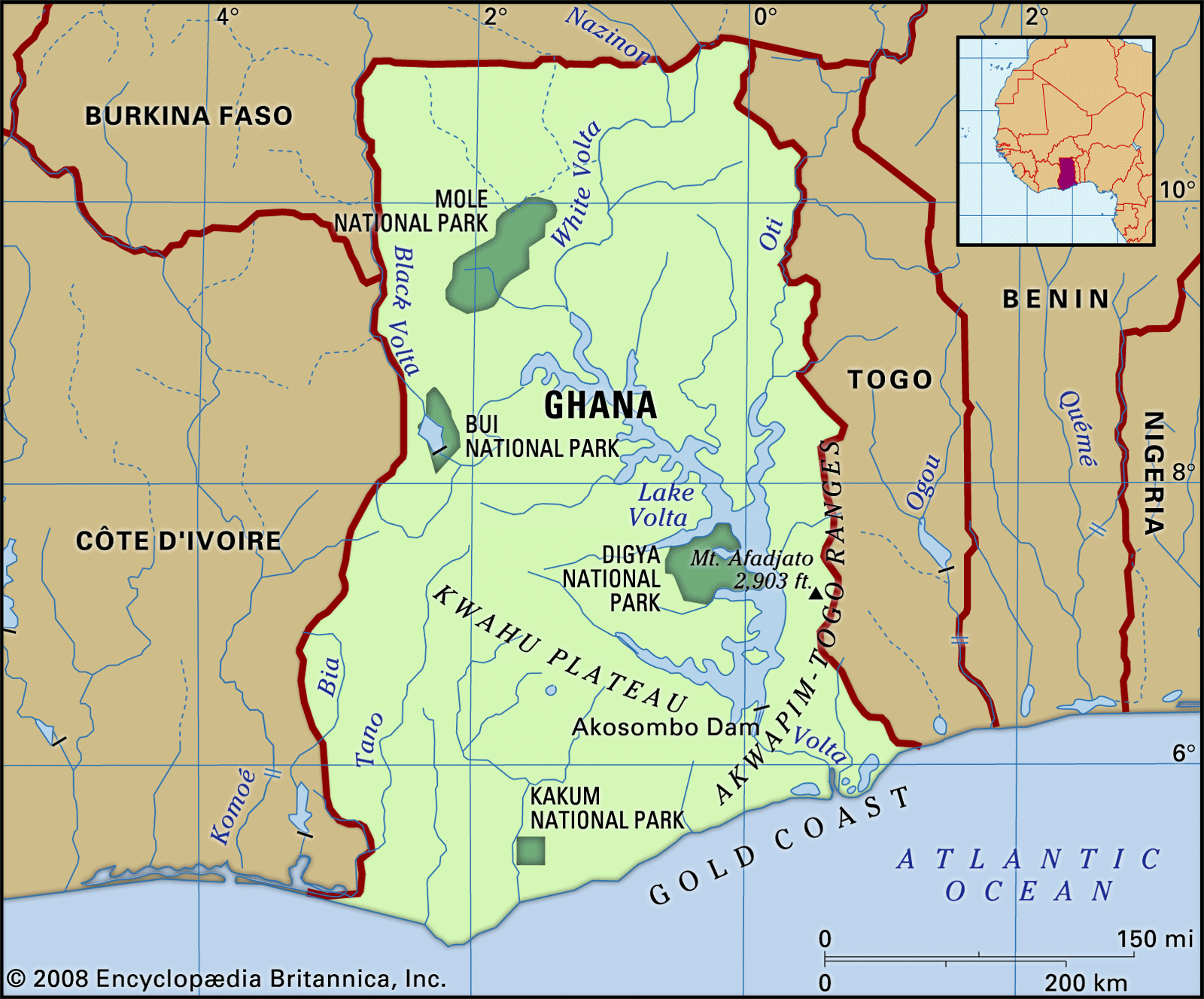
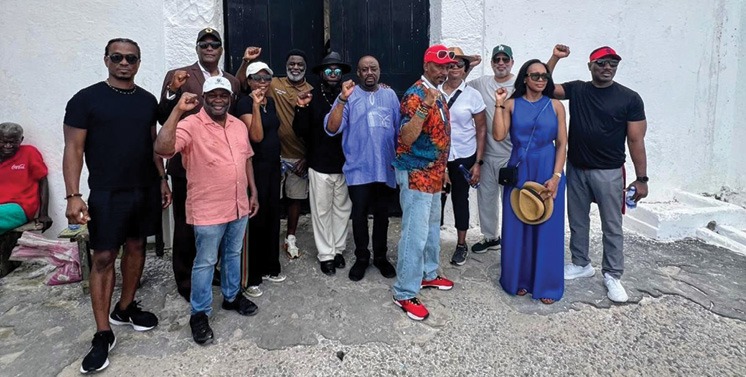
A delegation representing the African American Mayors USA Trade Mission to Ghana recently returned to the United States after a visit to the West African nation.
Members of the delegation said cultural, educational and business opportunities are rapidly evolving in Ghana, for those seeking to participate in international trade and commerce with one of the fastest growing economies on the continent.
The trip took place October 27 through October 30 and was organized by members of the African American Mayors Association (AAMA), which consists of Black mayors from America’s cities.
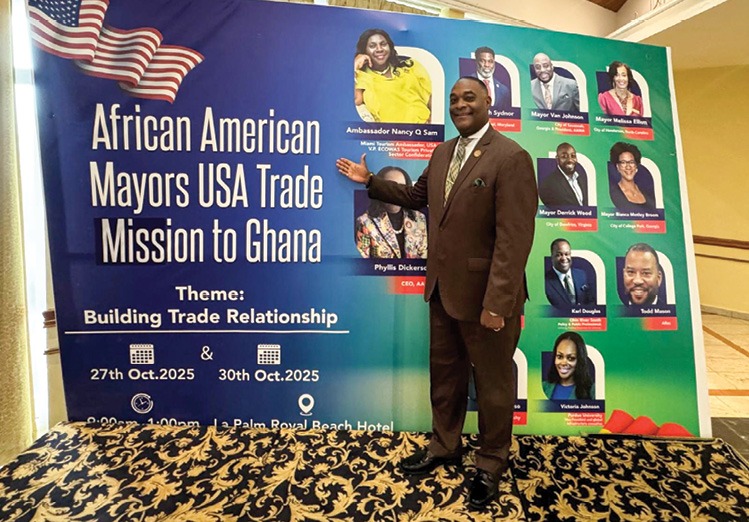
Photo courtesy of AAMA
According to the trade delegation’s communications consultant, Kuae Noel Kelch, the idea to encourage a group of Black mayors from the U.S. to seek out economic, educational and intercultural relationships with Ghana grew out from a preceding business trip to its capital city by the mayor of North Miami, Florida.
“Mayor Alix Desilum of North Miami, went on an economic development trip to Accra, returned to the United States and told AAMA CEO Phyllis Dickerson that he wanted to assist in having a group of Black mayors from the African American Mayors Association (AAMA) to visit Accra to share best practices with Ghanaian mayors and explore trade opportunities between Ghana and the mayors’ cities,” Ms. Noel Kelch said in an e-mail to The Final Call.
“Business council members were also interested in discussing affordable housing, infrastructure, insurance, strategy, and the funding of continuing education,” her statement read further.
Ms. Noel Kelch also said the goals of the AAMA trade delegation included:
- fostering relationships with Ghanaian mayors;
- fostering relationships between the Ghanaian business community and the American business community;
- sharing best practices with mayors and business leaders;
- looking for potential partnerships for economic development;
- hosting fireside chats to better understand shared ideas and opportunities;
- exchanging cultural experiences;
- exploring trade opportunities between cities.
Ms. Dickerson, told The Final Call that her organization evolved from what was previously known as the Southern Conference of Black Mayors, later renamed the African American Mayors Association.
As its membership grew beyond the American South and into multiple cities across the U.S. She also said Ghana, and others with which her organization seeks to connect, include additional countries throughout the Global South.
“Because of those relationships, they, (representatives in Ghana) invited us to come and sit down at the table and collaborate on possible opportunities,”
Ms. Dickerson said of how the City of Savannah, Georgia, the third largest port city in the United States, is now the sister city of Ghana’s capital, Accra. “And so, for next year, we’re talking to Morocco for a possibility to go there and for Rwanda,” Ms. Dickerson explained.
Reclaiming a stolen birthright
Black Americans, and others of the African Diaspora, have long sought out meaningful connections with African countries since the end of the Trans-Atlantic Slave Trade and the subsequent struggle for human and civil rights in the Americas.
As Black people attempted to unite with post-colonial Africa, many efforts were thwarted by the machinations of neo-colonial interests that feared the awakening of Africans and their claiming of sovereignty over their own resources.
Dr. Van R. Johnson II, AAMA president, and mayor of Savannah, Ga., told The Final Call that he agreed that consistent efforts to unite Black Americans with Africans on the continent were both useful and relevant in the struggle for a real and meaningful unity.
He also said that in trade and commerce, the works of the late Dr. Leon Sullivan, organizer of the African-African American Leadership Summits, were helpful in preparing the foundation of mutual cooperation and economic development on both sides of the Atlantic.
“We now have over 500 Black mayors in this country,” Mayor Johnson said of Black America’s growing presence in local politics across the U.S. “We recognize more and more, particularly as the climate (favors engaging in business) and people become more aware of our obligation to connect with Africa in a much more significant way beyond its cultural aspects.
So, this was important for us to be able to really start talking about connecting with them in an economic way,” he said. Mayor Johnson explained that pursuing opportunities in Africa also requires a change in perceptions and an understanding of culture within the proper context.
“My city of Savannah has entered into a formal partner city relationship with Accra, which is the capital city,” Mayor Johnson said of his trips to Ghana on behalf of AAMA.
“These are people who look like us, people who are very proud of us, who want to engage with us and for us to be able to recognize their history because some of this history has never been taught,” he said of how knowledge and controlling one’s own narrative helps people to make more informed decisions.
“So, when we walk through the door of no return, for us it’s a door of return where we are now able to close the circle and make available not only the knowledge and expertise that we have gained, but also to create full circles of commerce, farming, infrastructure and all of these things that they need while helping us provide the things that we need,”
Mayor Johnson said of his meetings with government and business leaders along with the impact of entering the dungeons of Elmina and Cape Coast castles from which the ancestors were sent into slavery.
Regarding his analysis of the importance and impact of the African American Mayors USA Trade Mission to Ghana, Dr. Linwood Tauheed Ph.D.—an associate professor in economics at the University of Missouri-Kansas City—
Told The Final Call that he agreed that the cultural aspects of the Ghana trade mission preceding the business aspects of the trip was a positive development and said it is necessary for those doing business in Ghana, or Africa in general, to have respect for their histories and cultures.
“That has not been the case with American business or European businesses in Africa, exactly the opposite,” Dr. Tauheed said of the continent’s long history of suffering exploitation, depopulation, colonial and post-colonial meddling by Europe and the U.S.
“American businesspersons, particularly large businesspersons, have denigrated African culture and looked upon them as just a place to earn a dollar as opposed to wanting to have respectful relationships. That hasn’t been the case in the past, but Africans are now demanding that their culture be respected,” he said.
Noting that the emergence of BRICS countries (Brazil, Russia, India, China and South Africa) and those aligning with them have options and alternatives to the Western economic system and the U.S. dollar, Dr. Tauheed said that Africa’s emerging economies and growing markets, give countries such as Ghana opportunities that were previously restricted.
“They have other choices as opposed to in the past, having to do business with Western businesses, Dr. Tauheed explained of trade relationships where African governments were relegated to exporting raw materials while being forced to import finished or refined products at exorbitant prices.
“Africans are no longer looking simply to be consumers, they are wanting to be (and) are in fact becoming producers, which means they’re not only wanting to buy things from American businesses, but also to sell things in the U.S. as well,” Dr. Tauheed stated.
“The relationship that Fortune 500 companies have had with Africa has been very, very disrespectful and very one-sided and these companies have not intended to create a win-win in their relations. Africans are well aware of that, and they are not wanting to continue that.”
Regarding doors opening to the AAMA for those seeking business opportunities in Ghana, and the increasing numbers of Black businesspersons and entrepreneurs traveling to Africa in general, Benton Harbor, Michigan, Mayor Marcus Muhammad, a member of the trade delegation.
Told The Final Call that with Black America’s annual spending power being more than $1.2 trillion, by harnessing a portion of that money in the way of international trade and commerce, then Africans in the diaspora and Africans on the continent could together become a superpower farther into the 21st century.
“If you study the history of Ghana’s first president, Dr. Kwame Nkrumah, who studied at Lincoln University, an historically Black college, then going on to the Ivy League University of Pennsylvania, his vision was to create a United States of Africa,”
Mayor Muhammad said of Africa’s revolutionary thinkers and leaders such as Patrice Lumumba of Congo, Sékou Touré of Guinea, Muammar Gaddafi of Libya and Ibrahim Traoré of Burkina Faso.
“He (Nkrumah) understood the great value of incorporating the Black man and woman of America, or Africans in the diaspora, and connecting them to the rise of Africa by us contributing our business, financial, educational, administrative, agricultural and our overall expertise that we acquired growing up in the United States of America. So, we have an opportunity to contribute to the rise of Africa financially, economically and educationally,” Mayor Muhammad explained.
Currently, there’s over 4,000 alumni in Ghana and throughout the Diaspora that have graduated from American schools,” Mayor Muhammad said.
“One of the greatest opportunities that I saw was that our students need to go and study at the universities in Africa just as students are going to study in China and Japan. I can see a shift and a tilt toward where power is going to be later into this 21st century,” he said.
From the efforts of the Honorable Marcus Mosiah Garvey’s UNIA movement to the works of the Nation of Islam, under its Eternal Leader, the Most Honorable Elijah Muhammad, including the labor of His students such as Malcolm X, Muhammad Ali, Imam Warith Deen Mohammed and the Honorable Minister Louis Farrakhan.
To Pan-African leaders and revolutionaries such as Kwame Turé (formerly Stokely Carmichael), unity between Diaspora Africans and Blacks in the Diaspora continues to evolve.
