









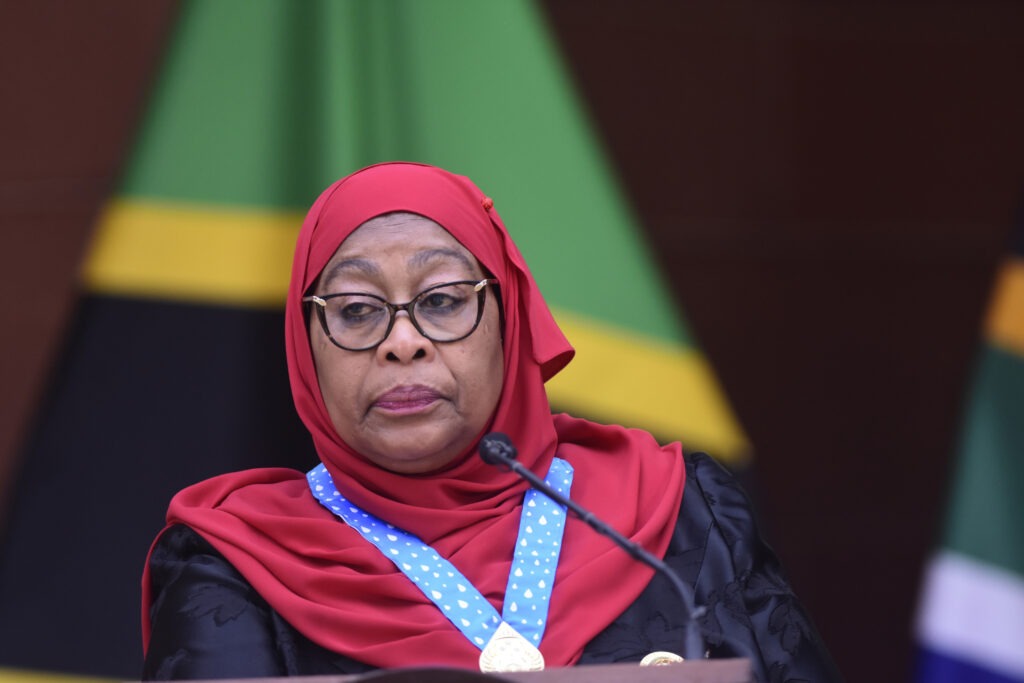
Seen as one of Africa’s most progressive leaders, Tanzania’s President Samia Suluhu Hassan has not only, in the four years since being elected, been instrumental in the growth of the country’s tourism, but her administration, via its prime minister.

Officially launched the construction of a modern railway linking Tanzania and Burundi. In addition to the railway, the East African country is on the way to becoming one of the region’s leading trading hubs.
According to Forbes Africa, “Tanzania’s recent infrastructure investments are both significant and strategic. They reflect a national commitment to developing maritime capacity and regional trade integration,” noted Saugata Mittra, policy economist at the International Growth Center (IGC), which works with policymakers in developing countries to promote inclusive and sustainable growth.
President Hassan does little to hide her determination in positioning Tanzania as an economic force in the region. “Bagamoyo Port’s refurbishment is set to increase capacity to 20 million containers per year.
Aided by the construction of a 40.4-mile railway connecting Tanzania and Zambia, while the Mtwara Port, which handles all of the nation’s cashew exports, received investment in 2020 for operational purposes,” noted Forbes Africa.
The International Monetary Fund (IMF) reported that the country’s Gross Domestic Product (GDP) is $85.98 billion and is predicted to reach $134.55 billion by 2030. “Tanzania certainly seems to be positioning itself as a leading, modern hub for regional and international trade in East Africa,” noted the Forbes Africa article by Mittra.
“Dar es Salaam is a fast-growing urban area and already the largest in East Africa. Couple this with the rapid growth of Tanzania’s economy and population … (it) currently stands as the only regional port ready to rise to the occasion,” the article noted.
Brother Earl Reddix is a businessman who lives in Tanzania.
He told Africa Watch that he had nothing but praise for President Hassan and her efforts. “The railway project, the cross-border railway, is a great step forward.
It not only improves regional trade and mobility, but it also shows Tanzania’s commitment to modern infrastructure that benefits the entire East African community,” he said in an interview with this writer.
In addition to helping her country become a regional hub for trade, President Hassan narrates the globally viewed documentary, “The Tanzania Royal Tour,” which may be responsible for making the country one of the world’s popular tourist destinations. During the documentary, she personally showcases Tanzania’s cultural, ecological, and investment potential to the world.
“Hot on the heels of 50 nominations at the 2025 World Travel Awards—the most of any African destination—and with Dar es Salaam playing host to this year’s travel industry gala, this East African hotspot is capturing global attention,” reported Gateway Magazine on its website, gateway.co.za.
Meaningful reforms in Tanzania have followed. These included “smarter infrastructure, professionalized tourism services, and a renewed commitment to conservation.
Even Tanzania’s recent currency reform—requiring all local payments to be made in Tanzanian shillings—is part of a broader push toward economic sustainability that benefits local communities,” explained Gateway.
Some of these reforms have faced some pushback. Tanzania has made it against the law for foreign nationals to own and operate certain small-scale businesses.
“The new directive prohibits them from 15 sectors, including mobile money transfers, tour guiding, small-scale mining, on-farm crop buying, beauty salons, curio shops and establishing radio and TV operations, reported the BBC in an article titled.
“Tanzania’s ban on foreigners operating small businesses sparks Kenyan backlash.” At first glance, it appears as a possible impediment to the Hassan administration’s seemingly unhindered development.
Bro. Earl Reddix said some of the concern is “understandable,” but that this move by Tanzania is in line with several other African countries.
“Ghana, for example, has certain sectors, including beauty salons, reserved for locals. The goal isn’t to discourage foreign direct investment, but rather to protect small-scale businesses that are the backbone of the local economy,” he said.
“What’s happening in Tanzania reflects a broader trend across the continent. Ghana is advancing digital reforms, Rwanda has built a reputation for tech and service efficiency, Kenya continues to lead in fintech and now Tanzania is carving its own path, especially through regional transport connectivity and infrastructure projects like the cross-border railway with Burundi,” Bro. Earl Reddix added.
What makes Tanzania unique is that these developments are paired with political stability, a welcoming environment for visitors and investors and a clear push toward local self-sustainability. That vision echoes what founding Pan African leaders like Julius Nyerere, Kwame Nkrumah and others imagined, said Bro. Earl Reddix.
“This includes nation-building capacity, protecting local industry, and empowering citizens while engaging strategically in global trade,” he said.
Follow Jehron Muhammad @africawatchfcn on X
