






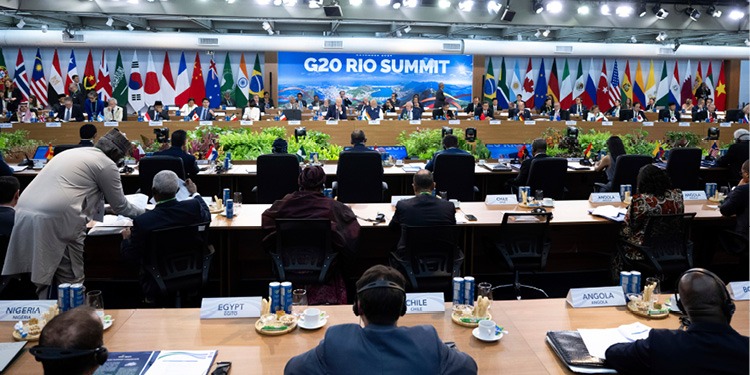

South Africa is scheduled to host the G20 Heads of Government Summit in Johannesburg in 2025. This will be the first time the G20 summit will be held on the continent of Africa.
South Africa assumed the G20 presidency on December 1, 2024, and its term lasts through November 2025. What is the G20? It consists of the world’s largest economies and meets regularly to discuss the globe’s most pressing economic issues.
According to the World Economic Forum, the G20 “consists of 19 countries and two regional bodies. The current members are Argentina, Australia, Brazil, Canada, China, France, Germany, India, Indonesia, Italy, Japan, South Korea, Mexico, Russia, Saudi Arabia, South Africa, Turkey, the United Kingdom and the United States, plus the African Union and European Union.”
U.S. President Donald Trump said he’d skip this year’s summit and send a representative. This year’s G20 Summit will be chaired by South Africa President Cyril Ramaphosa.
During the G20, there is the T20 (Think 20) Summit, which according to g20.org, “produces, discusses, consolidates and presents ideas on how to face current and emerging challenges that may be addressed by the Group of 20. The T20 brings together think tanks, G20 research institutes and countries invited by the rotating presidency.”
Redge Nkosi is an economist and the Pretoria-based founder and executive director of First Source Money and Public Banking of South Africa and is attending the T20.
In response to President Trump deciding not to attend the upcoming G20, Nkosi told Africa Watch, “It’s becoming commonplace to see the U.S. act unilaterally and distance itself from foreign engagements outside of Israel.”
“Time has come for the Global South to fully stand up against the decaying economies of Europe and the U.S.,” he said. In this writer’s view and the view of many Africans, he is right. “Everyone appears to agree, [that] these (U.S. and Europe) are dying economies and there is absolutely nothing we can do.”
He explained that this is evident especially because of their history of exploitation, which includes saddling Africa with unpayable debt, prohibitively high interest rates, and “austerity” programs where price supports or subsidies on foodstuffs, healthcare, and education are relinquished in favor of debt-payment.
“This is more than enough to prove they don’t want to be part of global deliberations that seek to improve the lives of global citizens,” Nkosi said. “So yes, there is a lot of disquiet about Europe and the U.S., mostly America, since Trump came into office,” he continued.
Nkosi also told Africa Watch that in June, the U.S. pulled out of the United Nations Conference for Development, aimed at combating poverty.
Concerning Africa’s much-discussed, Europe and U.S.-engineered debt crisis, Ndongo Samba Sylla, Africa Regional Director for Research and Policy at the International Development Economics Associates (IDEAs), said:
“The debt crisis in Africa and in many countries across the Global South is a product of a dysfunctional international monetary and financial system,” reported allafrica.com in 2024.
“On the one hand, African countries are deprived of good returns on their commodity exports because foreign corporations successfully evade and avoid paying the taxes owed to African governments, resulting in high levels of licit and illicit financial flows, i.e. tax income that could have reduced the need for African governments to issue debts in foreign currency.
On the other hand, exorbitant interest rates increase the debt burden of African countries and when they face an adverse economic cycle, the IMF imposes harsh austerity measures on them.
It’s time for the G20 to push for major reforms that will help to address the fundamental inequality that is now baked into the global economic system. Only by focusing on public good as the main goal can we achieve development and climate goals.”
In 2017, Ndongo was asked by the Rosa-Luxemburg-Stiftung Foundation, “Why does foreign direct investment not help to develop the internal market in Africa?” His answer then still resonates in 2025, leading up to the G20.
Ndongo responded: “Because invention is located in extractive sectors. You take for example the case of Equatorial Guinea. It’s the richest country in Africa in terms of GDP per capita.
But you will see a half of the GDP is controlled by multinationals and half of the GDP is conferred each year to the rest of the world. This is that kind of the so-called development we have with foreign tech investment.”
He was then asked: “What would you demand from the G20 governments with regard to Africa?”
“It’s difficult to have demands adversely to the G20 because ordinarily their production is not focused on African development but for strategic interests, for capitalist interest.
Because if you want to have a current policy towards Africa we have to go against the logic of free trade, free enterprise and what is so-called the gut governance.
Things like this is the theoretical framework under which those countries of the G20 work. And (under) this framework could not help Africa develop,” Ndongo said. Follow Jehron Muhammad @Africawatchfcn on X.
