

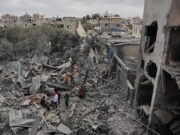
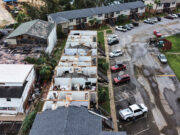





MEMPHIS—More than 8,000 residents in Memphis experienced power outages after heavy rain, flash floods, and gusty winds swept through the city on July 17. As of July 20, hundreds were still without power while the city was in the throes of a grueling heatwave.
In the weeks preceding, areas in North Carolina, New Mexico, New York, Texas and Kansas received torrential downpours resulting in 500- and 1,000-year rain events in some areas.
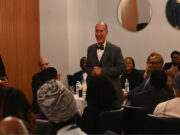
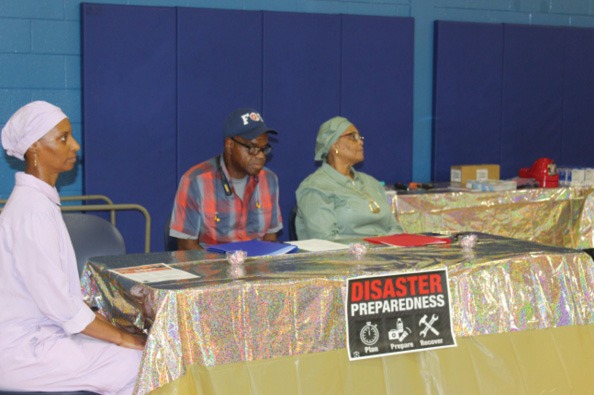
Amidst the increasing calamities, the M.G.T and G.C.C. (Muslim Girls Training and General Civilization Class, the women of the Nation of Islam) of Mosque No. 55 recently hosted a disaster preparedness workshop at the MacFarland Community Center in Southeast Memphis. The M.G.T. who hosted consisted of a special squad of senior sisters over the age of 60.
“We need to understand that the weather has changed. God is present and the weather has changed,” said presenter Brother William Muhammad, a 24-year veteran of the Memphis Fire Department.
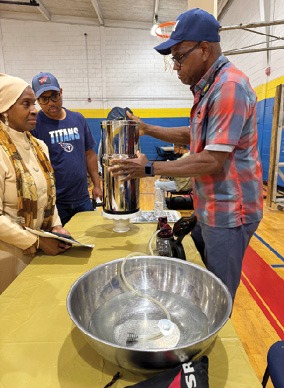
He explained to participants that “help is not coming, it’s just not coming, so we are going to have to help each other in our own neighborhoods. We’ve been told to prepare, so that’s what this is all about, to be able to survive.”
Presenters provided practical information for situations ranging from fire safety, preparation for evacuating your home and surviving power outages.
Panelist Sister Detria Muhammad emphasized the importance of always having a “to-go bag” ready in case you must evacuate your home on short notice.
“If you have all your essentials with you, it won’t be everything you pack in a suitcase, but it will be everything that you need to get out, even if you have to go to a hotel for one night to get yourself situated and figure out what you can do,” she shared.
“You already know there is always something happening on our highways and if you get stuck in traffic at that time, you can get sick, you can have to go to the bathroom, so you want to always have whatever you need to survive at that moment and a ‘go bag’ is one thing you should have. You can keep it in your car, in your closet in your home. Prepare them for your children also,” she shared.
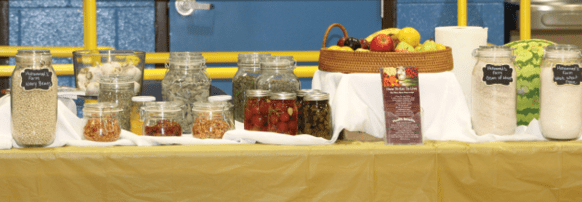
There was also an array of displays and information tables featuring food preservation techniques such as canning and dehydration, growing your own food, water purification methods in survival situations when fresh water is not available, first aid, go-bag instructions and more.
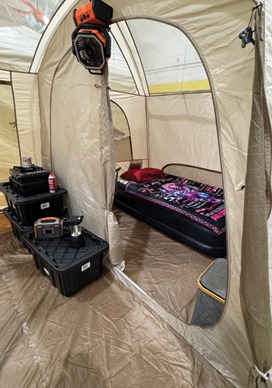
One display that drew the most attention was a full-outdoor set up by urban farmer Sister Janette Muhammad, which included a two-room tent featuring a “dining/entertaining area”
And a bedroom, an additional “kitchen” tent equipped with lights, portable electric cooler/refrigerator, a camp stove all operated by solar panels and a portable solar generator.
There was also a small, privacy tent featuring a compost toilet. The set-up demonstrated that surviving away from your home, if even in the backyard, can be made more comfortable and a little less stressful if you take the time to prepare.
A set-up like this also allows you to take in others who are displaced in an emergency situation if you do not have adequate room in your home.
On page 5 of the book, “Closing the Gap: Inner Views of the Heart, Mind & Soul of the Honorable Minister Louis Farrakhan,” by Minister Jabril Muhammad (May Allah be pleased), Minister Farrakhan emphasized the importance of assisting one another.
“At the 10th Anniversary of the Million Man March, which we call the birth of the Millions More Movement, we said that we can no longer depend on government to look after us, but we must set up those instrumentalities that would allow us to look out for ourselves,” Minister Farrakhan stated.
“We, as suffering people in America and the poor of America, must be prepared to save ourselves and our people,” he said.
Minister Farrakhan was referring to a Nation of Islam delegation sent to Cuba in 2006 to study the island nation’s disaster preparedness process.
“So what we learned, we want to share it through churches and organizations to Black, Native American and Chicano families.
We also want to work with city, state and federal government so that when these disasters strike, as they will, we can make sure that there is not the loss of life, that tremendous loss of property and dislocation that we saw with Hurricane Katrina.”
Workshop attendee Felicia Williams shared with The Final Call that after seeing the presentation, she has decided that she is going to start making a to-go kit, even though she considers herself not an “outdoors person.”
“We need to get prepared for tragedy because we see it every day and I think we are too comfortable in our lifestyle. We’re too comfortable,” said Ms. Williams. “I’m glad to be here.”
