

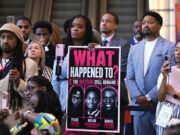
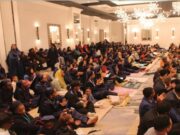


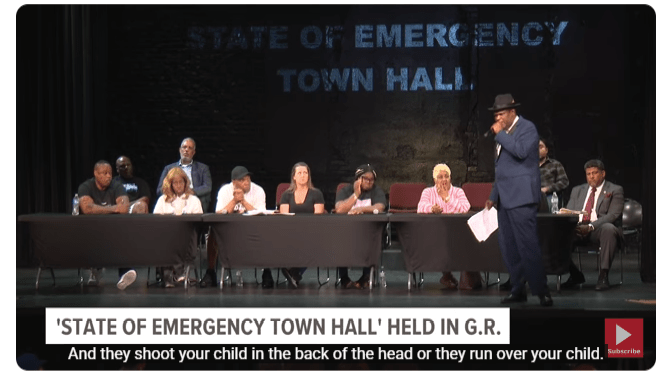

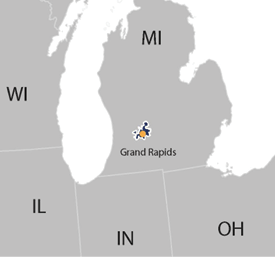
Local Black leaders, justice advocates, and others concerned with what they called overaggressive policing in Grand Rapids, Michigan, convened June 2, after a legal process failed to deliver justice for families demanding accountability after the killings of two young Black men in two separate incidents.
One case resulted in a hung jury May 8 regarding an officer shooting an unarmed African immigrant in 2022. In another case, charges were dropped May 28 against a Michigan State Police Sergeant who ran down an unarmed Black man in 2024. Each case has raised serious contention in the local Black community and a deeper mistrust of local policing.
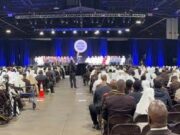
Robert S. Womack, Kent County Commissioner for District 17 and the city’s Third Ward, called for and moderated a townhall meeting titled: “State of Emergency: Where do we go from here?”
To encourage residents to demand transparency and accountability from local government and for the Grand Rapids Police Department (GRPD) to respect the human rights of the city’s Black, working class, and poor populations.
Graphic: USGS.gov
The town hall meeting, featuring a panel of local organizations demanding substantive change, also called for resources to educate people about their rights and how to interact with police effectively.
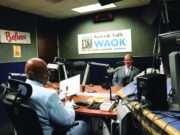
“When I took a look at the carnage and bloodshed of our brothers and sisters around the country, I knew their families had found no justice,” Commissioner Womack told The Final Call in a telephone interview as to why a town hall meeting was necessary for addressing local grievances.
“I also took a look at the fact that we had two historical cases here in Grand Rapids involving officer-related homicides of our Black residents,” Commissioner Womack said.
“The first one, Patrick Lyoya, which ended in a mistrial, and the second one, where the case was dismissed at the federal level, for the killing of Samuel Sterling.
I also knew they had run those two cases concurrently so that we couldn’t bring our people to support both of them at the same time,” he said. (See The Final Call Vol. 42 No. 18 and Vol. 43 No. 35 regarding both cases)
After a traffic stop on the morning of April 4, 2022, GRPD Officer Christopher Schurr shot an unarmed Patrick Lyoya in the back of his head as the officer attempted to subdue him following an alleged license tag infraction.
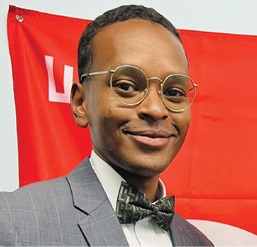
Photo: Sultan Z. Muhammad/ Facebook
Activists said the shooting brought additional scrutiny to police killing unarmed Black men across the country, inflaming tensions already high in a city with a history of aggressive policing in Black neighborhoods.
“The trial (regarding) Patrick Lyoya and the appeals of Michigan State Police (MSP) Detective Sergeant Brian Keely (in Sterling’s death) began the same day,” Commissioner Womack explained. “I knew that my community was feeling hopeless, lost, emotional, with tensions that might be misguided.
A lot of times when people are angry, and they can’t strike out at the oppressor, they strike out at each other domestically, so I called for a state of emergency meeting to bring my people together so whatever we would do next, we would do it united,” he said.
Stating that he believes the majority of the city’s Black leadership is in denial over the nature of race relations in Grand Rapids, how resources are allocated to local constituencies, and how policy decisions regarding Black people are formed, Commissioner Womack said a transformation must first start within the Black community before any tangible changes will come.
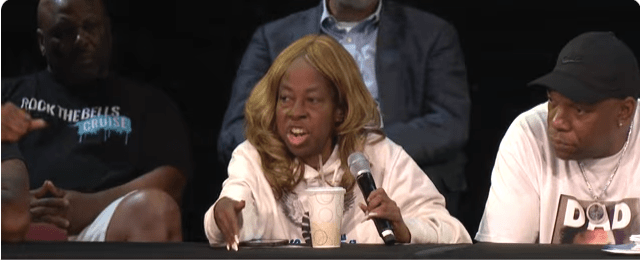
The town hall opened with remarks from various local leaders, including the Lyoya family’s interpreter, Israel Siku, the parents and family members of Samuel Sterling, and Becky Wilbert, the mother of Riley Doggett, a 17-year-old Caucasian male who died from head injuries after being run over by a police vehicle in April 2024.
The program also featured representatives from the NAACP, the Urban League, community activists, residents from the Latino community, and Detroit-based civil attorney Ven Johnson.
“Nobody before trial gets three and four appeals that they wait for the appellate courts to rule and delay the case,” Atty. Johnson said during the meeting held at the Wealthy Street Theater. Johnson is the lead attorney for the team representing the Lyoya family, the Sterling family, and the mother of Riley Doggett.
Grand Rapids. Photo: Youtube/@13OnYourSide
“In the Patrick Lyoya case (it’s been) over three years since that young man’s death,” Atty. Johnson said of the delays slowing the case against Lyoya’s alleged killer in 2022.
“Before we had these tragedies in Grand Rapids, Michigan, and there still was no movement, a lot of times we were working in different silos and we weren’t working together, but we were all working hard,” Commissioner Womack said during opening statements as the town hall’s moderator.
“Like I said, we have to give it up to these families because they had to actually lose a child on these streets of Grand Rapids in Kent County before we finally realized we not only have to unite amongst leaders, nonprofits, activists, and elected officials, (but) we have to unite you, the community, and we’re going to get some change,” he insisted.
Panelists agreed that the militarization of police forces and inflammatory political rhetoric are dangerous. “There are two different systems,” Atty. Johnson told the audience. “Criminal, for jail time, and civil, which is not just for money, but it’s for justice.”
Stating that the criminal cases for the deaths of Lyoya and Sterling are officially over and that neither the federal government nor the Michigan Attorney General will reopen them, Atty. Johnson said the only hope for some form of justice now lies in civil court.
“The best thing that we as a community can do is accountability or nothing. … If I’m asking you a question, I deserve an answer, period, point blank. Accountability or nothing,” said Erykai Cage, cousin of Samuel Sterling, to the audience during the town hall.
True justice for Black people in America has been elusive during our over 400-year sojourn in this country. The Most Honorable Elijah Muhammad, the Eternal Leader of the Nation of Islam, in referencing the historical treatment of White people toward Black people in America, addressed this point in His book, “Message to the Blackman in America,” in the chapter titled, “Not Your Brother.”
“Who has been our aggressors and murderers ever since we have been in America? Who, by nature, was made quick to shed blood—even his own?” the Most Honorable Elijah Muhammad wrote.
“And how much easier it is for them to shed our blood. They are heartless, merciless, when it comes to you and me we all know the true answer, whether you wish to bear witness with your tongues or with your hands, we know that the white man is our aggressor—the hater of good, justice and equality for you and me.
Do not expect your former slave-master’s children to give you the privileges to do as you desire in his own house. According to the Emancipation Proclamation, we as a people were proclaimed free to go for ourselves. In other words, we were on our own to build a nation of our own regardless of our hardships and barriers.”
During a live webcast from Mosque Maryam on October 28, 2007, the National Representative of the Most Honorable Elijah Muhammad, the Honorable Minister Louis Farrakhan, said that the 1865 end of chattel enslavement in the United States never resolved the positioning of Black men and women from being viewed as property and that the concept of Black liberation has been viewed as a threat ever since.
In his lecture, “Justifiable Homicide: Black Youth in Peril,” part 1, Minister Farrakhan said that: “Under this so-called emancipation, the freed slaves then had to be made to be afraid to make a free step.
Those freed slaves who would want to make a free step; those that would challenge their former slave master by wanting to vote, purchase land, pursue education or striving to do anything but plantation labor—these kinds of Black brothers and sisters would be dealt with harshly by the former slave-masters, and there was no deliberative body that would judge our affairs with justice.
“Therefore, every killing of a Black man or woman; every lynching of a Black man or woman was excusable. No matter what was done by White people to set the Black man at naught was excusable, because anything that was done to us to maintain White supremacy was in fact an unwritten law.
The killing of every Black human being during the 300 years of chattel slavery and even now, 150 years up from slavery, at the hands of White people is generally considered ‘excusable.’”
Student Minister Sultan Z. Muhammad of the Nation of Islam’s Mosque No. 61 in Grand Rapids, Michigan, told The Final Call that it is of vital importance to heed right guidance during these times.
“If we can hear the voice of Minister Farrakhan and read the words of the Honorable Elijah Muhammad, then we’ll be able to stay in the right state of mind to overcome this hour and become the ones who will benefit from the fall of one world as it makes way for a new world.”
