


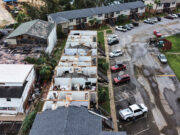
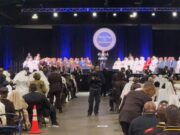




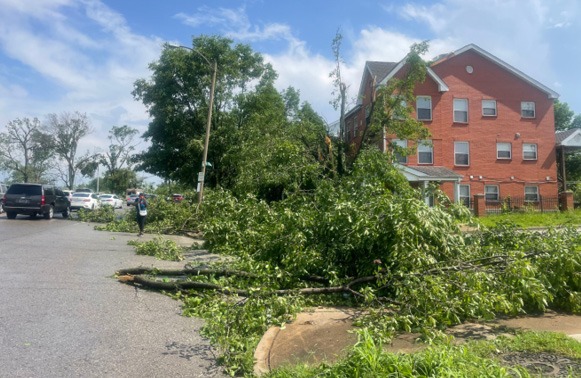

ST. LOUIS—In a nearly full house at St. Luke’s Memorial Missionary Baptist Church, community residents gathered on May 27, just 11 days after a powerful EF3, or possibly stronger, tornado tore through the city on May 16.
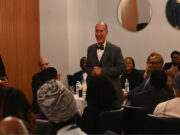
St. Louis Mayor Cara Spencer was visibly moved as she approached the podium to a standing ovation. The welcome set the tone for an evening filled with concern and calls for accountability.
Community members asked pressing questions about the recovery process and the delay in financial assistance from the Federal Emergency Management Agency (FEMA). Mayor Spencer assured the crowd that her administration was doing everything in its power to address the crisis.
According to the mayor, the initial funds sought from FEMA are from the Individuals and Households Program (IHP). This program provides direct assistance to individuals affected by disasters.
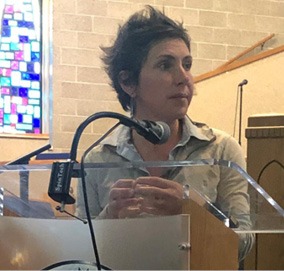
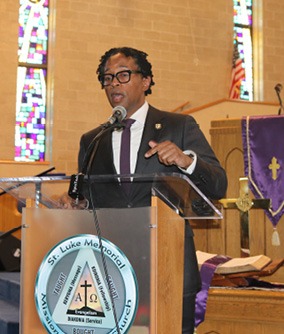
at a recent public forum to give updates
after a tornado severely damaged the
city. Photos: J.A. Salaam
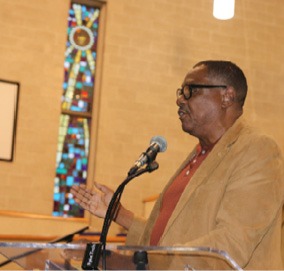
Aldolphus M. Pruitt
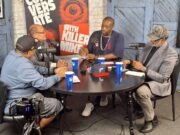
The open forum, moderated by Rev. Darryl Gray, a community activist, allowed residents to ask questions directly to Mayor Spencer, the police chief, and other city officials. Some significant concerns raised were, where will those without housing go? And how long will it take for funds to be distributed in the predominantly Black area of the city in North St. Louis.
Mayor Spencer stated that she was in a helicopter the day after the tornado assessing damages. “The average tornado stays on the ground for about 2 to 3 miles. But the duration of this one was on the ground for 23 miles and got stronger, but the classification was not changed from an EF3, but I argued this was an EF4,” she told the audience.
“We must have a long-range plan to house people. Our shelters have been able to house about 250 people and that’s a fraction of what is needed,” she said.
Despite party differences, Mayor Spencer, a Democrat, acknowledged the quick response of Missouri’s Republican Governor Mike Kehoe. “At 8:30 a.m. the next morning, Governor Mike Kehoe was on the grounds and went with me to assess the damages,” she said.
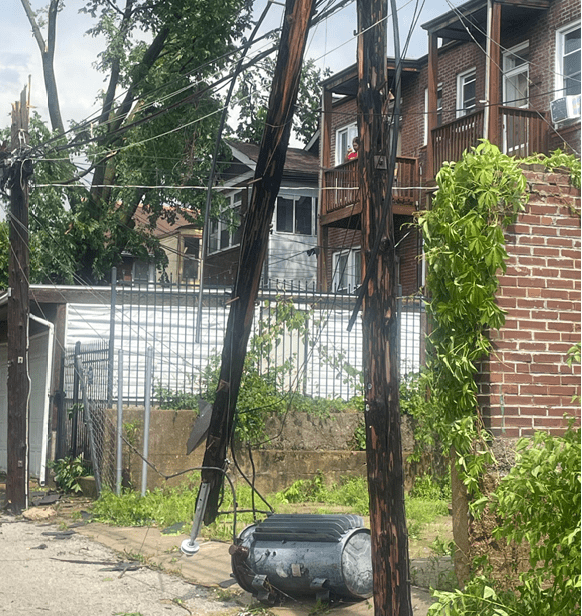
One of the hardest-hit areas in St. Louis was the historic Ville neighborhood, home to many notable figures of the past, including Arthur Ashe, Chuck Berry, and Tina Turner. It was also where Homer G. Phillips Hospital, the only hospital for Blacks from 1937 to 1955, was located, along with Sumner High, the oldest Black High school west of the Mississippi River.
“When the governor and I went to the Ville neighborhood, we walked into the destroyed Harlem Tap room, which had three stories a day before. The governor shook the owner’s hand and promised to do everything he can to help him rebuild,” Mayor Spencer said
The consistent sentiments from each speaker who addressed the community meeting were the acknowledgment of the collective efforts from everyone to support one another during the recovery and rebuilding process.
U.S. Congressman Wesley Bell, a Democrat, who represents Missouri’s 1st Congressional District, talked about the National Disaster Declaration submitted to the White House to secure federal assistance for St. Louis.
“I won’t be happy until the checks are cashed, and those resources are in this community,” said Congressman Bell. “Even after the national media is gone, the work will continue. We must be in this for the long haul, because this is not a quick fix,” he said.
The day before the community meeting, Rep. Bell and a bipartisan Missouri delegation sent a letter to the White House requesting federal assistance.
“A major disaster declaration would unlock vital federal assistance to support these operations, including Public Assistance for emergency protective measures and infrastructure repair,
Individual Assistance for displaced and impacted residents, and Hazard Mitigation assistance to help reduce the risk of future disasters. These resources are essential to stabilizing affected communities and safeguarding public health and safety,” the letter stated in part.
Even though Mayor Spencer was scheduled to leave the meeting early, she opted to stay. “I cannot leave and will not go until all of your questions are answered. I’ll get someone else to cover for me,” said Mayor Spencer, as some in the audience applauded.
To date, the estimated cost of the damage is over $1.6 billion. Over 5,000 homes were reportedly damaged. There were 5 reported deaths and 38 people were injured.
The mayor explained that the priority is clearing debris. “We are deploying all of our departments, all hands on deck, forestry, parks working 12-hour days, prioritizing clearing roads to make sure people can get in and out of areas. Our city workers work their tails off,” she said.
Despite some of the applause the mayor received, some residents were not impressed.
Lisa L. was not happy with the outcome of the meeting with Mayor Spencer. “I feel that they are trying to backdoor us and setting us up to take our property. I heard a lot of what they are planning to do for us, but people need help now,” she told The Final Call.
Amir Brandy, a community activist and homeowner, also attended the forum. Mr. Brandy was also not pleased. “This meeting was a dog and pony show. … Many of these homes are in such bad shape and some are still falling down.
Look at Hurricane Katrina and other natural disasters. Whenever they want to gentrify a city, these disasters create the perfect scenario to justify coming in and taking over. They didn’t offer solutions, but just a lot of talk. People are in great need now,” he said.
