

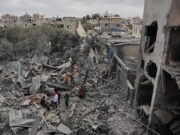
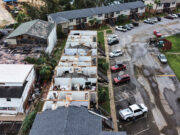






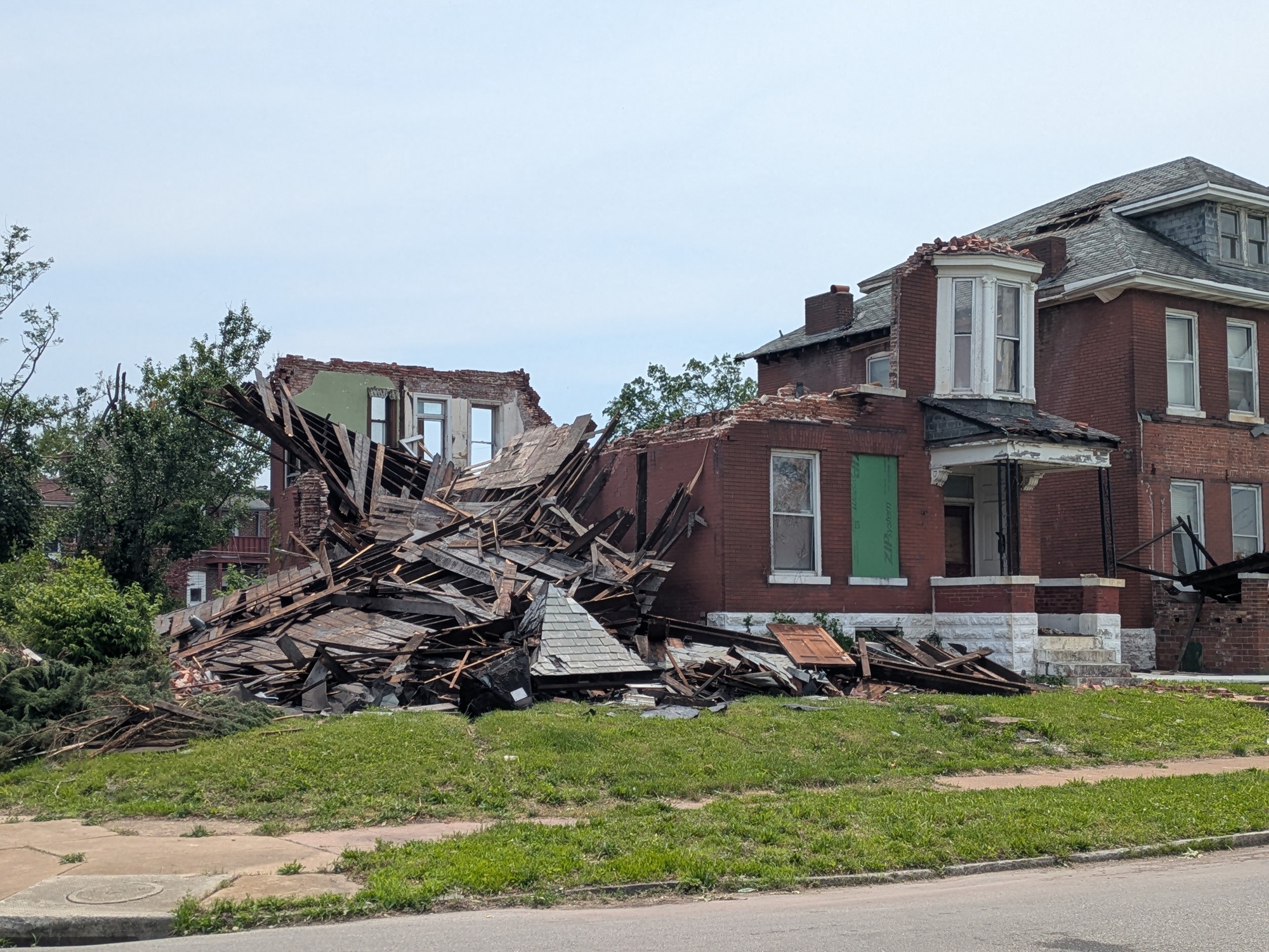

ST. LOUIS—Residents in St. Louis are still in shock amid cleanup and recovery efforts after a monstrous, unusual EF3 tornado ripped through the heart of the city on May 16, leaving behind a path of destruction that has left the city and even seasoned storm watchers stunned. Early estimates have damages costing at least $1.3 billion.
With wind speeds reaching 152 mph and hail the size of tennis balls, the storm carved a path up to one mile wide. Most tornadoes are 100-400 yards wide and often impact suburban or rural areas.
This tornado traveled northeast for about 23 miles. It struck from Clayton, Missouri—the county seat and financial center of St. Louis—and impacted both affluent and historically under-resourced neighborhoods.
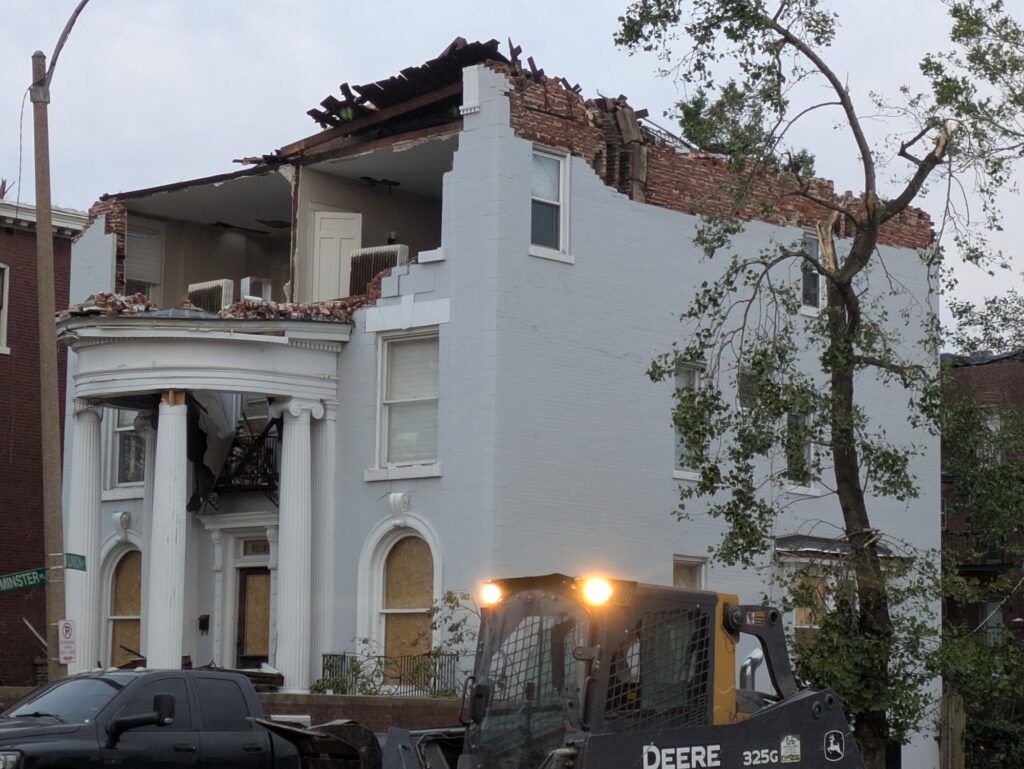
The devastation was shocking to see as solid brick buildings, some nearly a century old, crumbled as if they were made of wood. So far, five fatalities have been reported. The historic Centennial Christian Church suffered severe damage, including the collapse of its steeple.
Tragically, Patricia Ann Pendleton, a long-time church volunteer, was killed when part of the church’s roof caved in. The church stood in the Fountain Park neighborhood just across the street from where a statue of Dr. Martin Luther King Jr. once stood.
Despite the storm’s severity, as of May 21, no official state of emergency had been declared for St. Louis. When asked by a reporter if she had heard from President Donald Trump or from anyone in Washington.
Newly elected St. Louis Mayor Cara Spencer said that the city was still waiting to hear back from the White House and that FEMA (Federal Emergency Management Agency) had yet to arrive, five days after the tornado struck.
In a May 21 letter from Missouri, U.S. Senators Josh Hawley and Eric Schmitt, both Republicans, wrote that they “support Missouri Governor Mike Kehoe’s May 19 request for an emergency disaster declaration, pursuant to the Stafford Act, following devastating tornadoes and storms in the St. Louis region.”
“The city looks like a war zone. You can’t tell if this is St. Louis or the Ukraine,” said Jihad Khayyam, a community organizer. Entire blocks appeared decimated, with debris covering once-vibrant streets.
The tornado didn’t discriminate, tearing through both well-established neighborhoods and struggling communities with equal force. But as recovery efforts begin, it’s clear that the impact is far from equal.
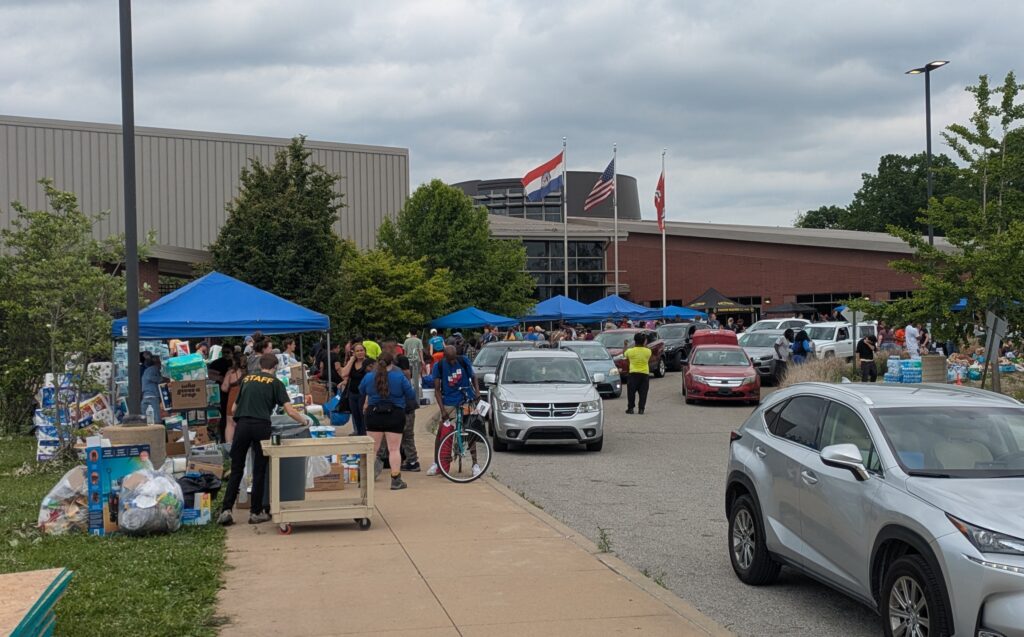
In the absence of any federal or state response so far, grassroots organizations and former public officials have stepped up to fill the void. Action St. Louis, led by executive director Kayla Reed, was on the ground almost immediately, setting up operations at the O’Fallon Park YMCA to distribute supplies, food, and support to residents.
She was joined by former Mayor Tishaura Jones and former Missouri Congresswoman Cori Bush, who worked alongside volunteers. “I’ve seen them here, serving, helping, being present,” said Debbie Milton, one of the volunteers. “That means something.”
When Ms. Reed was asked if she had seen Mayor Spencer during the recovery, Reed replied candidly: “I’ve not seen the current mayor at this place. I have seen one of her staff come here. I’ve gone to other places, and that’s been consistent.
There was a press conference, but everywhere I’ve gone, they have not seen the current mayor at this hub since we’ve been open on Saturday.” She did acknowledge the presence of Dan Guenther, a former alderman and current member of the new mayor’s administration, saying he had been on-site “every day” to support the recovery efforts.
Mayor Spencer did place CEMA (City Emergency Management Agency) Commissioner Sarah Russell on paid administrative leave as an investigation begins into the actions of the agency leading up to the tornado.
Allegations include that the warning sirens failed to activate. According to a May 20 news release from the mayor’s office, there were many complaints from city residents who argued they had never heard warning sirens before the tornado hit.
Ms. Reed, known in the city for her community advocacy, pointed to the broader issue that looms over this tragedy: inequality. “The tornado is the same no matter where it goes, but the impact is different because it’s sitting on top of a history of investment or lack of investment,”
She said. “When a natural disaster hits, it’s a structural disaster, and the implications are serious. We need to have an equitable approach to that.”
“In communities like North St. Louis, where decades of disinvestment have left residents vulnerable, recovery is not just about clean-up, it’s about survival. Many families do not have the ability to access home equity loans, unlike residents in areas such as the Central West End. As a result, rebuilding will be slower, harder, and far more uncertain,” said Ms. Reed.
“We’re watching a natural disaster collide with political decisions made over the last 50 years that have shaped inequality in St. Louis,” she continued. “We are aware of that, which is why our focus was here from the beginning.”
The last major tornado to hit St. Louis was on April 22, 2011, an EF4 that left a trail of destruction, but also brought swift state and federal support. In contrast, this year’s EF3 has yet to trigger the same level of response.
Developers are already eyeing areas hardest hit by the storm, raising fears that disaster capitalism could push out long-standing residents in favor of new high-end developments.
“Bricks are a developer’s paradise,” said Amir Brandy, whose property was damaged by the tornado in the Fountain Park community. He referenced the city’s unique architecture and its historical reputation for reportedly having the best bricks in America.
But now many of those brick buildings are reduced to rubble in many neighborhoods, and developers can purchase these homes for pennies on the dollar, he said.
“I have lived here all my life and have never seen anything like this. It is like a war zone. I hope they declare this as a state of emergency because a tornado did come through here and not just strong winds,” said Sister Carolyn Muhammad, a member of the Nation of Islam who attends Mosque 28 in St. Louis.
Local organizations like BFL (Better Family Life) and Action St. Louis continue to rally volunteers and push for equity in the recovery process. But without official recognition of the crisis at the federal level, the burden of rebuilding falls mainly on the shoulders of community groups and the people they serve.
“People are just sitting on their porch, don’t have insurance and don’t know what to do. It brings tears to your eyes to see people forced to pack up and leave their homes. And most of them don’t have nowhere to go.
The sheriff of St. Louis, Alfred Montgomery, has been out here every day, night and day knocking on doors with us,” said Jihad Khayyam, director of community engagement and development for BFL.
As the city works to dig out from the debris, one thing remains clear: St. Louis is not just facing the aftermath of a weather crisis; it’s facing a moral one. The decisions made now could either heal or deepen the wounds that have long plagued its most vulnerable neighborhoods.
—J.A. Salaam, Contributing Writer
