








“Until we learn to love and protect our woman, we will never be a fit and recognized people on the earth.” —The Most Honorable Elijah Muhammad, “Message to the Blackman in America,” from the chapter, “The Black Woman”
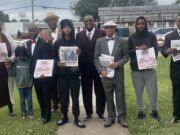
MILWAUKEE—A cross-section of Black organizations, religious groups and community residents recently came together at the Wisconsin Black Historical Museum to voice their concerns about domestic violence.
Area advocates, activists and speakers dedicated to halting the violence against Black women spoke to attendees about awareness, education, and promoted the importance of stopping the violence and killing of Black women.
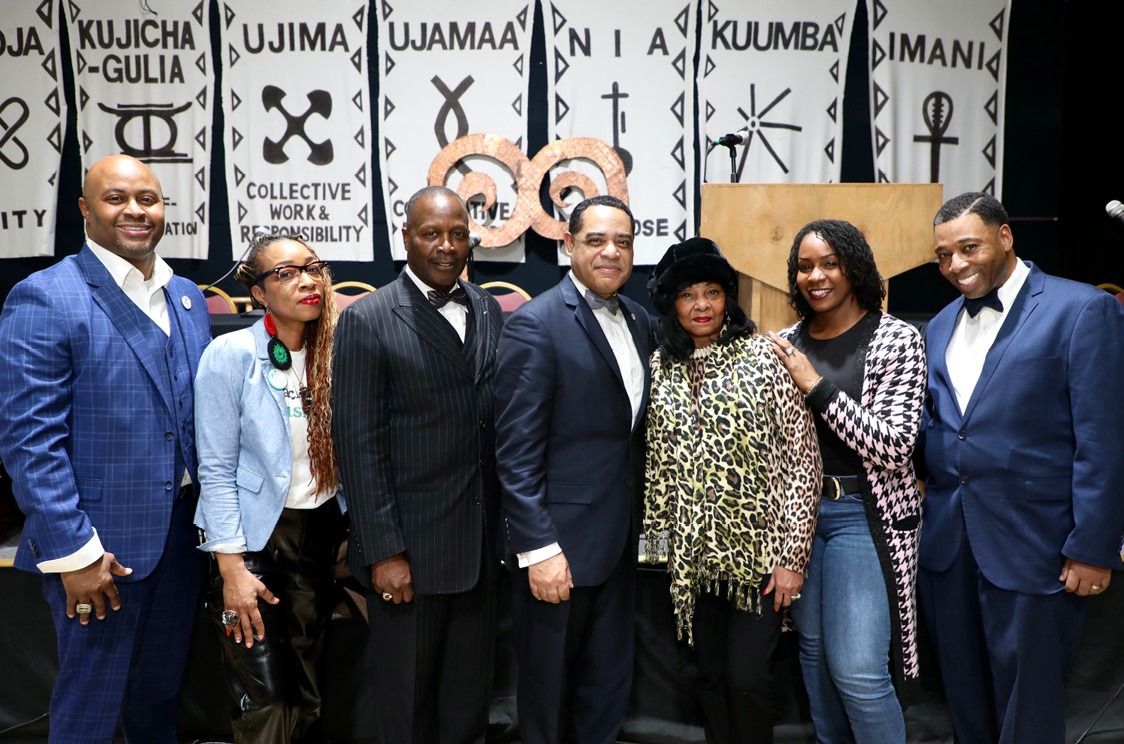
The Feb. 1 event was organized in part by The Asha Project and members of the Nation of Islam’s Muhammad Mosque No. 3. The event was themed, “Why Are We Killing Our Women: The Root Cause of Domestic Violence,” featured a panel discussion.
The panel was moderated by Shawn Muhammad, an associate director for The Asha Project and concluded with remarks by guest speaker, Student Minister Dr. Wesley Muhammad, a member of the Nation of Islam Shura Executive Council, who is also an author and researcher.
Several community advocates described some of the challenges, concerns and solutions regarding domestic violence.
Antonia Drew Norton is the founder and director of the Asha Project. She told The Final Call that their success lies in working to address intimate partner violence with a needs-specific methodology.
This technique considers socioeconomic policies, cultural norms, and demographic factors instead of a one-size-fits-all approach that often allows too many people to fall through the cracks, she explained.
“Asha was founded in 1988 in Milwaukee and it always looked at working with the Black family,” Ms. Norton said.
“The challenges have been because we’re African American, we’re the least funded, the least supported for access to resources, because of how we do our work in the community is based on our love and value of our community, (and) we do have the greatest need,” she added.
Panelist and presenter Samantha Collier, founder of a non-profit program that supports survivors of domestic violence and sexual assault.
She told The Final Call that finding sufficient shelter and conducting follow-up home visits are significant challenges after addressing the immediate safety needs of victims. She noted that social and political environments can influence access to local assistance.
“It’s always difficult when people don’t want to answer their door in fear of (abusers) being there or their children being detained or being taken because they are in a domestic violence situation,” Ms. Collier explained.
“Specifically, for young men, understand that being vulnerable and letting us know about what is going on inside of these homes is important, but what’s even better is being connected with another Black man. It is important to get a mentorship and a ‘big brothership,’” she added.
“One of the biggest ways that older and young men can help is being part of our ally team and really being a force of being next to us as Black people,” she said. “We need to stand together so they can see the healthiness of Black men and Black women and not let it be a separation.”
Rosalind McClain, from the holistic health clinic Healing Starts Today, told The Final Call that her organization collaborates with the Asha Project to help victims of human trafficking and survivors of domestic violence. Her clinic offers certified peer support, mental health and substance abuse assistance, and other services.
“Many of the challenges that I’m noticing while dealing with victims, survivors, and their family members is the aftermath of the trauma that is caused by its impact,” Ms. McClain said.
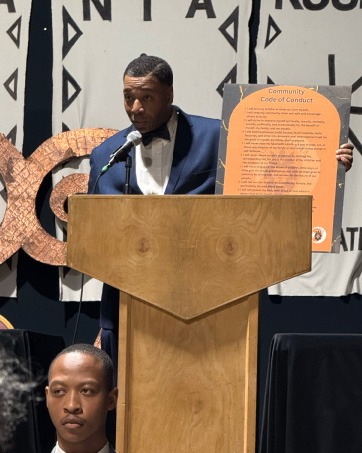
Shawn Muhammad told The Final Call that the subject matter of domestic violence requires an all-hands-on-deck response from the community and the development of a new narrative around the concept of atonement, reconciliation and responsibility which were principles given by the Honorable Minister Louis Farrakhan in 1995 at the historic Million Man March.
Shawn Muhammad noted that special emphasis should be given to repentance and the development of a new community code of conduct. “This code of conduct is not something I developed. It is actually part of the pledge that the men took at the end of the Million Man March on October 16, 1995, given to the crowd by the Honorable Minister Louis Farrakhan,” Shawn Muhammad explained.
As part of the pledge that nearly two million Black men took that day included promises never to abuse their wives by “striking” or “disrespecting” her, never engaging in the abuse of children and never using the “B” word to describe any woman, particularly a Black woman.
Panelist and psychologist Dr. Kweku Amoasi, agreed and told The Final Call that it is time for Black men to step up and change what is and is not acceptable in the Black community and that the time to start being the protectors of Black girls and women is long overdue.
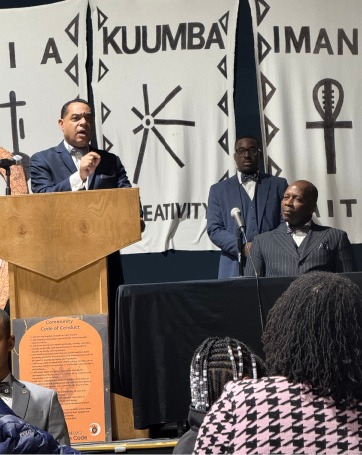
“We talk about the social engineering of America, we talk about the chemical imbalances that there are, so I tell people what we have to do is look at everything we consume, not just what we consume physically, but what we consume mentally and emotionally, then also, who are we around?” Dr. Amoasi asked.
“What are the issues, and who are the people that we talk to that are uplifting us?” he continued. Dr. Amoasi recounted the time he worked at a youth correctional facility in Racine, Wisconsin.
“Most of the young men there did not graduate from high school, but once they got there, they began to graduate because they saw their peers do good, so what we want to do is increase the positive peer support group,” Dr. Amoasi noted. “It’s about putting ourselves in a healthy environment to help maximize that genetic predisposition that’s innately in us,” he said.
Keynote guest speaker, Student Min. Dr. Wesley Muhammad, identified what he described as a targeted attack on Black America’s future. These attacks, he explained, consist of social engineering, miseducation through the indoctrination of self-hatred, the promotion of lawlessness in popular culture, and through a toxic bio-chemical assault on Black masculinity, the intentional lowering of testosterone levels in the Black male.
“Black women are being killed, and way too often, the murderer is someone in their household or in their close vicinity,” Student Min. Dr. Wesley Muhammad said. “We don’t want to get to the root cause to just intellectualize on it, we want to get to the root cause so we can solve it because, as it was said, we’ve had this discussion over and over and over again,” he said.
Student Min. Dr. Wesley Muhammad described how heroin neutralized Black men in urban areas in the 60s and 70s, as synthetically engineered, “legal marijuana” and that a lead-contaminated water supply is causing invitro and developmental brain disorders throughout too many Black population centers in cities like Milwaukee today.
“One very important thing that testosterone does, in the prefrontal cortex, this is the area of the brain that controls two very important functions, one is executive decisions for those complex matters and problem-solving, the other is for impulse control,” he explained to the audience.
“That’s what you call an absence of impulse control,” Student Min. Wesley Muhammad added. “If you and I have a functioning prefrontal cortex, then we don’t respond impulsively to triggers, but there’s a reason why our women are killed in a crime of passion, there’s reasons why the jails are filled with Black men.”
Student Minister, William Muhammad of Mosque No. 3, told The Final Call that he had been working to organize the “Why Are We Killing Our Women: The Root Cause of Domestic Violence” community forum for quite a while because of Milwaukee County’s saddening problem of intimate partner violence, particularly in the Black community.
According to a May 2024 article on wpr.org, “There were 16 domestic violence-related deaths in Milwaukee County in 2018. That number rose to 49 in 2022 and declined to 38 last year,” referring to 2023. The article, titled, “‘Very concerning’:
Milwaukee leaders worried about recent domestic violence-related deaths” stated that there are concerns among advocates and activists that the numbers could be trending upward.
“Even before the gruesome murder of Sade Robinson at the hands of a White man, (see The Final Call Vol. 43 No. 44), there was an uptick in Black women being shot and killed by their spouse or boyfriends,” Student Min. William Muhammad said.
“There was a situation where a young man literally poured gasoline on his wife and children and burned her up. It’s the extreme abuse, the extreme actions,” he said. “It’s not just the escalation of domestic violence; it’s also the type of violence being perpetrated on our women.”
