

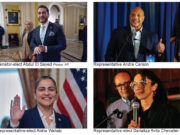






Eight Muslims will be in the next Congress. The historic expansion brings new expectations around healthcare, civil rights, and U.S. policy toward Israel. It also raises questions including: how much collective influence will these lawmakers have, and can they pressure their party’s leadership to deliver?
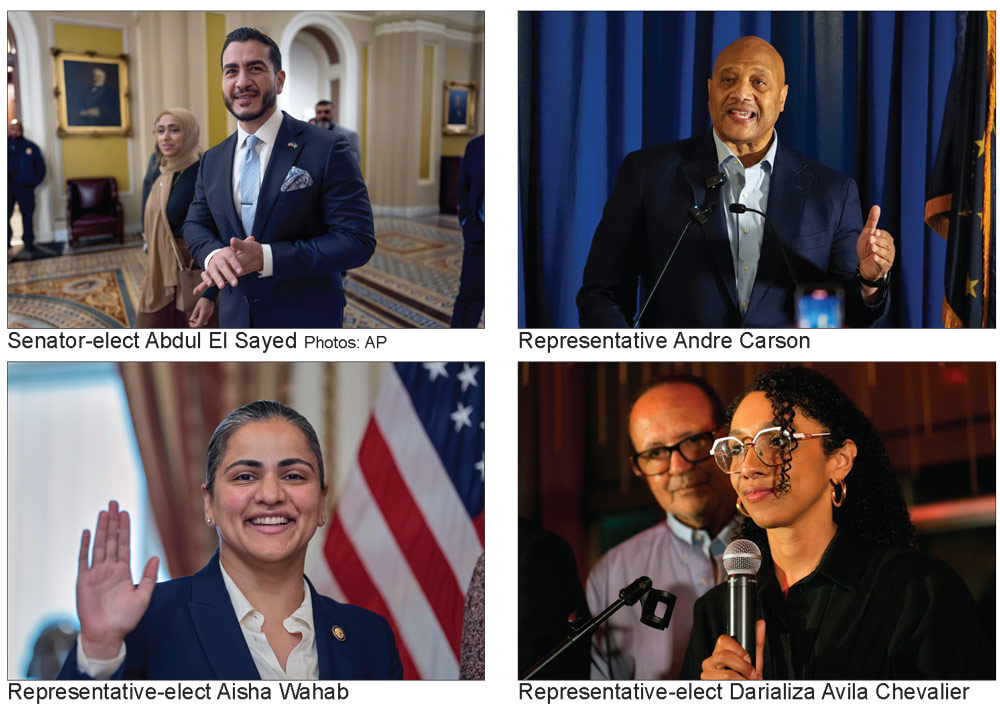
Senator-elect Dr. Abdul El-Sayed is the first Muslim to be elected to the U.S. Senate. He is joined by seven Muslim members of the House of Representatives who were either elected or re-elected in the November 3 midterm elections.
The caucus includes Rep. Andre Carson (IN), Rep. Ilhan Omar (MN), Rep. Rashida Tlaib (MI), Rep. Lateefah Simon and Rep.-elect Aisha Wahab (CA), Rep.elect Adam Hamawy (NJ) and Rep.-elect Darializa Avila Chevalier (NY). All are Democrats.
The number of Muslims is now double the four Muslim members who took office when the current Congress began in January 2025. A fifth arrived prior to the midterms (Ms. Wahab won an August special election to complete the term of the late Rep. Eric Swalwell). Her victory in the Nov. 3 election for a full term brought the total to eight.
So far, no formal Muslim caucus has been announced to unite the eight. Some alignment exists on progressive issues, but there is no common legislative agenda or coherent strategy for voting as a bloc.
However, there’s already some evidence of co-operation. Dr. Hamawy backed Dr. El-Sayed during the midterm campaign, emphasizing “Medicare For All” and the need to get money out of politics. Dr. El-Sayed’s campaign also had the endorsements of Reps. Tlaib, Omar, and Simon.
Their foreign policy views overlap. According to his official record, Rep. Carson co-led the Ceasefire Now Resolution, which called for President Donald Trump to immediately call for and to facilitate de-escalation and a ceasefire in Israel and the Palestinian Territories.
Senator-elect El-Sayed has said he opposes unconditional U.S. military aid to any country, Israel included. Rep.-elect Avila Chevalier campaigned to shift re-sources from foreign wars to domestic needs.
Common ground can be the basis for joint legislation and wider alliances. The hard part is turning that into power. That requires decisions about what to prioritize, the skill of negotiation and compromise, and a plan for when Democratic leadership resists.
In a Baltimore Sun op-ed, Zainab Chaudry, director of CAIR’s (Council on American–Islamic Relations) Maryland office, put the onus on incoming Democratic leadership. She called for action on health care, working families and immigration, and for a restriction on the use of American resources regarding Israeli human rights abuses. She also took issue with the party leadership’s relationship with AIPAC (The American Israel Public Affairs Committee).
“Voters handed Democratic leaders another opportunity to govern, and they must not squander it,” she wrote.
California showed AIPAC’s electoral reach. Bloomberg Government reported that an AIPAC-funded super PAC opposed Ms. Wahab in her August special election, and Reuters reported that AIPAC’s super PAC spent nearly $2.5 million to boost her opponent. The influential lobbying group also spent millions opposing Dr. El-Sayed’s campaign. Despite AIPAC’s efforts, Wahab and El-Sayed emerged victorious.
The ongoing genocide in Gaza perpetrated by Israel was an important issue in the midterms and the newly-elected Muslim members of Congress have been outspoken about the atrocities.
A recent exit survey by CAIR and CAIR Action revealed that Gaza is still an important issue. Of those who answered the issue questions, 76% cited Gaza and Palestinian human rights as their top issues, and 66% cited the economy and inflation. Eighty percent said the genocide in Gaza was a major factor in their decision to vote, the same proportion as said the economy was. The U.S.-Israel war on Iran was also a major factor for 76%.
Community Pulse ran the text-message survey Nov. 2–4 among 522 Muslim registered voters, drawing on a stratified random sample, previous CAIR respondents, and panel members. Results were weighted, and respondent numbers varied by question. The report states a margin of error of ±6.6 percentage points.
Muslim advocacy groups were very pleased with the wins. The campaigns also highlighted the level of hostility these candidates faced.
Reuters reported that President Donald Trump repeatedly branded Dr. El-Sayed with unflattering names and that campaign materials suggested unsubstantiated terrorist connections.
Some far-right and conservative outlets skipped policy debate altogether. In August, the Geller Report branded Rep. Tlaib, the only Palestinian American in Congress and Dr. El-Sayed, who is of Egyptian descent, a “Jihad Caucus.” A Voz.us column warned of what it called “the quiet Islamic colonization of America,” and a June headline in The Daily Signal claimed “radical” Islam was “infiltrating the Democratic Party.” After the Nov. 3 results, The Federalist described the Muslim winners as part of a rising “Red-Green Alliance.”
An analysis in Modern Treatise found that these caricatures let critics attack progressive Muslims’ policy positions, including their opposition to unconditional military aid to Israel, while “weaponizing their identity.”
Opposition to anti-Muslim politics has already brought lawmakers together across the religious spectrum. In June, Rep. Carson led 119 Democratic members of the House and Senate in a letter to the Committee Chair opposing the anti-Muslim “Sharia-Free America Caucus” and its legislation. The letter called on the leadership of Congress to oppose any legislation that would seek to stigmatize a religious community.
The drive for Muslim political influence did not just start this year.
In 2008, The Final Call reported on the American Muslim Democratic Caucus’s first appearance at the DNC, in an article titled, “American Muslims want seat at political table.” The organizers raised issues around civil rights, jobs, healthcare, and U.S. wars abroad. At the time, Rep. Carson called for greater Muslim involvement in local government.
The Daily Caller reported in a January 2019 article that Rep. Carson was envisioning as many as 35 Muslims in Congress by 2030 and a Muslim caucus that would be “sizable” and “formidable.
Nearly eight years after Rep. Carson’s statement, the number is eight. The recent congressional gains are part of a broader picture. CAIR and CAIR Action’s preliminary count from Nov. 5 showed 97 Muslim victories across 21 states (including 38 state legislative wins). Some races were still undecided when the count was released.
The total exceeds the 82 victories CAIR and the Jetpac Resource Center tallied in the 2022 midterms. Some races were still undecided when the count was released.
