










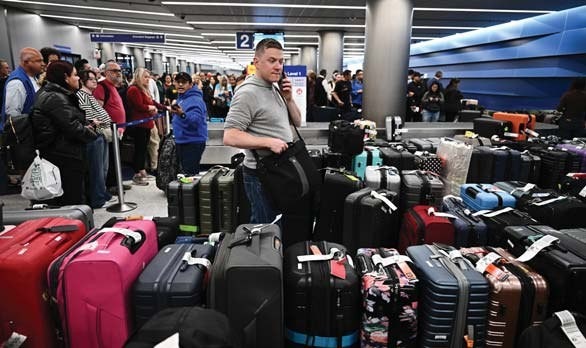

Thousands of travelers were still stranded, and many flights were still canceled or delayed as the Federal Aviation Administration (FAA) investigated a nationwide ground stop. At Final Call presstime, authorities were still scrambling for answers as airlines tried to get back to business as usual.
The nationwide ground stop ended at 8:15 p.m. on Friday, Nov. 13, after more than four hours. On Nov. 13, over 9,100 flights were canceled and over 7,100 were delayed. The next day, thousands more were canceled or delayed. It marked the longest nationwide ground stop in decades.
Officials blamed aging equipment. Some experts say the deeper problem is how the system is run. Transportation Secretary Sean Duffy told media outlets that the outage began when a contractor updated old FAA telecommunication lines.
However, reopening the skies afterward did not mean planes were ready to take off . Planes and crews were out of position, and thousands of flights had already been canceled. Sec. Duffy warned that getting back to normal would be “slow,” though he said he expected flights to be “back up and operational” in time for Thanksgiving.
Sec. Duffy also called on Congress to provide $50 billion to fix the outdated system. That raised the administration’s formal request of $30.1 billion, recently sent to lawmakers, on top of the $12.5 billion Congress approved in July 2025.
Who was stuck, and who could still fly
The FAA initially halted departures nationwide at 3:54 p.m. EDT on Nov. 13, Sec. Duffy said at a White House briefing. By 8 p.m., fewer than 400 flights were still in the air.
A few flights still moved. San Francisco International Airport said Pacifi c-bound flights, including to Hawaii and Asia, were cleared to leave, NBC News reported. Some flights also departed from Los Angeles International Airport, KNX News reported. Airports strained to absorb stranded planes and passengers. In Chicago, where the trouble first surfaced, the FAA had already halted flights at O’Hare International and Midway International airports because of an “equipment outage” before the nationwide stop. More than 700 flights were canceled at O’Hare on Nov. 13, ABC7 Chicago reported. Tulsa International Airport CEO Alexis Higgins said crews closed a taxiway to make room for diverted aircraft.
Root cause?
Sec. Duffy said radar and communications at control centers nationwide began showing “instability” at 3:36 p.m. He blamed aging equipment. “We have old switches, old routers; we use 1980s little copper lines,” he said. “It’s an old system that went down. It went down everywhere. It got overloaded.”
Homeland Security Secretary Markwayne Mullin said at the White House briefing that there was no evidence of a cyberattack. Sec. Duffy stated, “Was this a cyberattack? Did some foreign nation attack this network? And the answer to that is we don’t believe so.”
In a post on X shortly after 10 p.m., the X account of the FAA posted that “before clearing flights to resume, we thoroughly tested our systems to confirm they were stable and that operations remain reliable.” But no FAA leader spoke at the briefing, and the agency has not said which equipment failed or why backup systems did not hold. Senator Tammy Duckworth (D-Ill.), said the outage “will warrant a thorough and complete investigation.”
Beyond the tarmac
For many travelers, the hardest part came after they gave up on flying.
At O’Hare, some passengers abandoned their plans, rented cars or went home, ABC7 Chicago re-ported. Denver’s airport set out cots and blankets and kept concessions open so families could buy formula and diapers.
The stop also upended a busy sports weekend. Multiple NBA, NHL and college teams were left stranded, The Associated Press reported. NFL teams, which typically travel the day before Sunday games, were expected to fly as planned on Saturday.
Under federal rules, passengers whose flights were canceled are owed a full refund, regardless of the reason, if they choose not to fly, according to the U.S. Department of Transportation. Hotels and meals are another matter: airlines’ commitments to cover them apply only to disruptions within the airline’s control, the department says.
A governance problem?
Analysts say system upgrades, while crucial, are not enough, and the country could find itself in the same situation soon. The solution is institutional change, critics point out.
Sec. Duffy warned that the legacy equipment will continue to fail.
Marc Scribner, a senior transportation policy analyst at the Reason Foundation, told ABC News shortly after the stop was lifted that “this type of event is predictable given the current state of air traffi c control in the U.S.” The communication systems, he said, “are decades old. I mean, they’re stuck in the 20th century.”
“I think the core problem is governance,” Mr. Scribner said. Most countries run air traffi c control as a utility that charges user fees and can borrow to pay for upgrades, he noted. “Under our current system, we need to beg the Congress … and there’s just never enough money to go around.”
—Charlene Muhammad,
National Correspondent
