










Student Minister Ishmael Muhammad, National Assistant to the Honorable Minister Louis Farrakhan, connects the Million Man March to biblical prophecy and challenges us to change our thinking
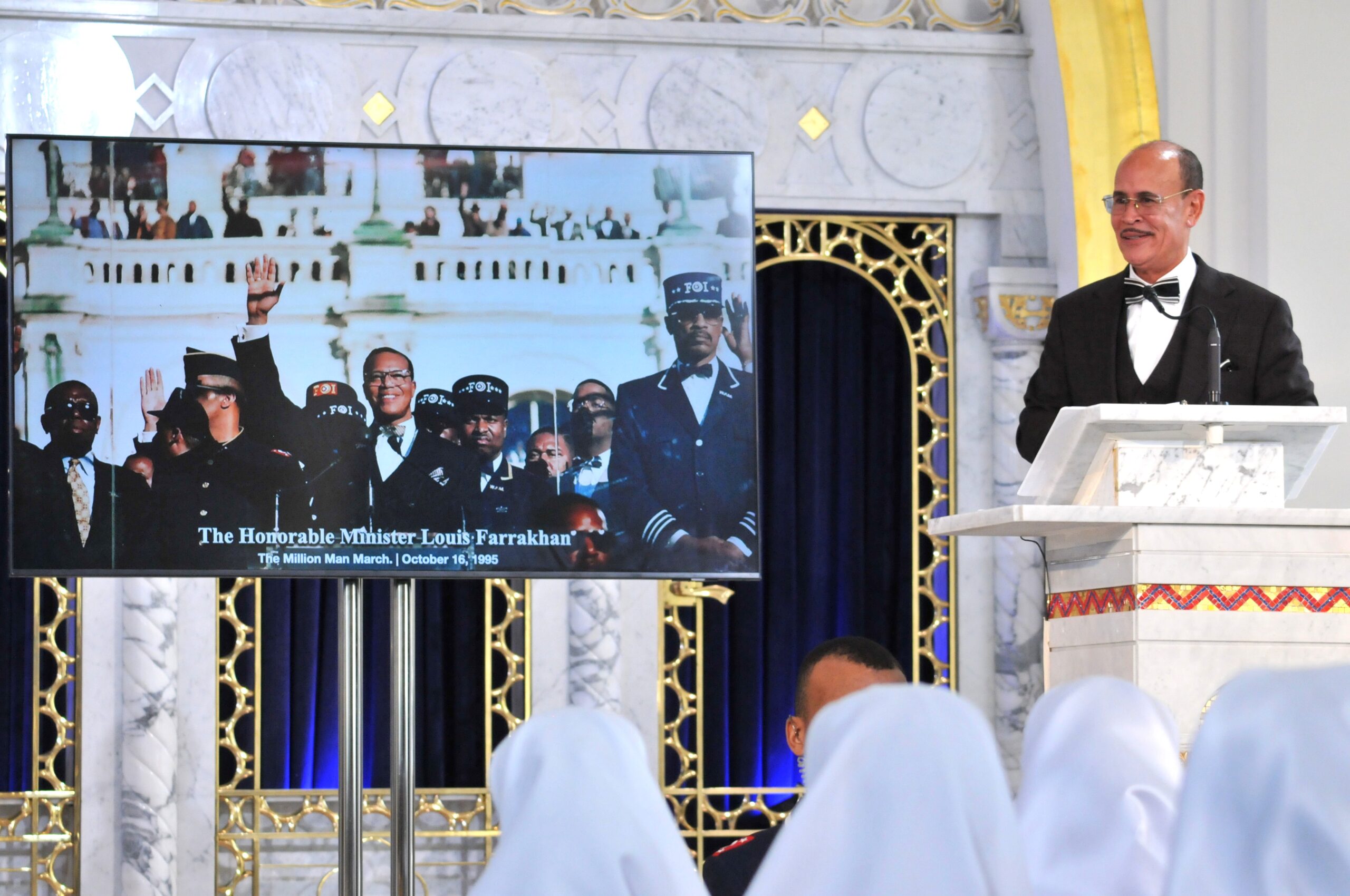
CHICAGO—Beneath the gold-trimmed arches of Mosque Maryam, the image of the Honorable Minister Louis Farrakhan appeared on a large screen overlooking the sanctuary. His words, projected above the congregation, carried a challenge first issued to Black men more than three decades earlier.
“Atonement. Reconciliation. Responsibility. There isn’t anyone who is going to do something for us. We’re going to have to do it for ourselves.”
On October 18, at the Nation of Islam’s National Center, Student Minister Ishmael Muhammad, National Assistant to the Honorable Minister Louis Farrakhan, delivered part 2 of the Holy Day of Atonement message commemorating the 31st Anniversary of the Million Man March.
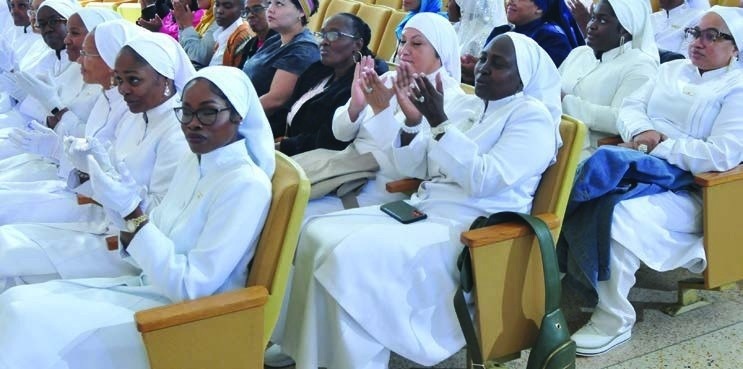
The Fruit of Islam (F.O.I., the men of the N.O.I.), in their blue uniforms, and Muslim Girls Training and General Civilization Class (M.G.T. and G.C.C., the women of the N.O.I.) in white reflected the occasion’s dignity and discipline. The message was broadcast internationally through NOI.org and Final Call Radio (radio.final-call.com).
The day’s theme, “Our unity is more powerful than an atomic or hydrogen bomb,” connected the historic October 16, 1995, gathering in Washington, D.C., to biblical prophecy, the Mission of the Most Honorable Elijah Muhammad and the Honorable Minister Louis Farrakhan and the responsibility of Black men to transform themselves and their communities.
Student Min. Ishmael explained the spiritual significance of the Million Man March and the prophetic call to repentance.
A key message conveyed by Student
Min. Ishmael was the need to recognize the power of a transformed mind. Drawing from the Teachings of the Most Honorable Elijah Muhammad, the Eternal Leader of the N.O.I., he declared that human beings possess the ability to write their history in advance and then walk into what they have written.
Remembering a day
unlike any other The program opened with reflections on the Million Man March and the conditions confronting Black men during the early 1990s. Student Minister Abel Muhammad, who attended the March as a 20-year-old Mexican brother, described it as one of the greatest days of his life.
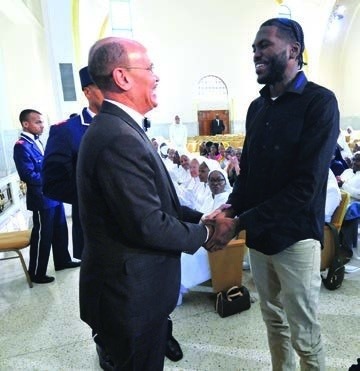
“I remember the atmosphere. I remember the peace, the love. I remember brothers embracing brothers that we had never met before,” he said. He recalled standing shoulder-to-shoulder with men from different nations and backgrounds, united by Minister Farrakhan’s call to atonement, reconciliation and responsibility.
Sister Tairah Muhammad, a student in the Ministry Class at Mosque Maryam, emphasized the importance of overcoming personal weaknesses to develop the divine qualities within human beings. “Sometimes the greatest thing that we must overcome is ourselves,” she said.
Her remarks and others prepared the audience for Student Min. Ishmael’s message, which connected personal transformation to the historic Mission of the Nation of Islam.
Unity is God’s gift Taking the rostrum, Student Min. Ishmael expressed gratitude for the opportunity to represent the Honorable Minister Louis Farrakhan, then turned to Psalm
133: “Behold, how good and pleasant it is when brothers dwell in unity.” The passage compares unity to precious oil poured upon Aaron, the brother and chief helper of Moses, flowing from his head to his beard and garments.
Student Min. Ishmael explained that Aaron was anointed as Israel’s first high priest and that the oil symbolized divine blessing, holiness and consecration.
“Unity was God’s gift,” he emphasized. He explained that the oil flowing downward illustrated how divine blessings reach a people through one whom God has anointed. “True unity and spiritual blessing do not start from the bottom,” he said. “They originate intrinsically from God and flow down from God through one that He anoints from the people for the entire community.”
He also connected Aaron’s role in the Day of Atonement, described in Leviticus 16, to the historic October 16 gathering. Student Min. Ishmael argued that Black men’s unity on the National Mall could not be explained solely by human organization.
“We know unity’s the key. We know unity is the answer. We know that in unity there is power. But that unity cannot come about without God.” He described the nearly two million Black men, standing shoulder-to-shoulder in Washington, D.C., demonstrating peace, sobriety, love and brotherhood. The gathering remains the most significant demonstration of Black male unity in American history.
“We made history that day in more than one way,” Student Min. Ishmael declared. But he expressed concern that discussions of the March often celebrate its peaceful atmosphere while overlooking the individual whose call made it possible.
“The one thing they don’t talk about is the man and the message that made that day,” he said. “There would not have been a Million Man March without the Honorable Minister Louis Farrakhan.” His statement drew enthusiastic affirming responses from the audience. “You cannot separate the message from the messenger and the messenger from God,” he continued.
Student Min. Ishmael emphasized that the March demonstrated the power of collective sacrifice and independence. Rather than relying upon corporate sponsorship, participants contributed their own resources to attend. “We don’t need the enemy. We need one another,” he said.
Using an analogy drawn from music, that Minister Farrakhan highlighted during his historic address that day at the Million Man March, he compared the men who attended the March to different instruments tuned to a common pitch. Each produces a distinct sound, but together they can create harmony under the direction of a conductor.
“Each of us are a different instrument with a different sound, and each of us are uniquely made by the Creator,” Student Min. Ishmael explained. The analogy reinforced his central message: Unity requires divine guidance and a purpose greater than individual differences.
The scriptures and the mission of
Minister Farrakhan Student Min. Ishmael then made one of his strongest theological assertions: “The Million Man March was the clearest sign of the work of the Messiah. It was the clearest sign that a man of God is among us in the Honorable Minister Louis Farrakhan.”
Student Min. Ishmael explained that throughout the scriptures, God raises prophets and messengers to warn people of the consequences of wrongdoing and call them to repentance.
“A prophet or a messenger is the mercy of God,” he said. He connected this divine mission to the biblical accounts of Isaiah, Jeremiah, Ezekiel, Jonah, John the Baptist and Jesus, emphasizing that each called people toward righteousness and renewed obedience to God.
Particular attention was given to Jonah, who warned the people of Nineveh that destruction awaited them unless they repented. According to the biblical account, the people heeded the warning, and God spared the city.
Student Min. Ishmael connected the account to Matthew 12:39, where Jesus refers to the sign of the prophet Jonah. He cited the Most Honorable Elijah Muhammad’s instruction to examine a prophet’s work when determining whether another individual fulfills a scriptural description.
“Fulfill means to do what another one does,” Student Min. Ishmael explained. He described Minister Farrakhan’s call to the Million Man March as a modern manifestation of that prophetic pattern.
Student Min. Ishmael also recalled Minister Farrakhan’s Saviours’ Day 2020 warning to American leadership, calling upon the United States to repent for its conduct toward other nations.
He extended that warning to the present, criticizing war, exploitation and moral deterioration while connecting the nation’s condition to biblical accounts of divine judgment. However, he cautioned against claiming to understand every detail of prophecy.
“It’s very important to not stand before the people and act like you know everything,” he said. “I don’t know everything. And I don’t know how prophecy will ultimately unfold.” His remarks underscored the importance of humility and patience when considering God’s plan.
The balm that heals
the wounded soul Moving from the condition of nations to the condition of individuals, Student Min. Ishmael challenged listeners to examine unresolved conflicts within their families.
“We are fractured people. A divided community. Divided homes,” he said.
He described marriages burdened by resentment, relationships affected by unhealed emotional wounds and individuals who carry pain from childhood into adulthood. For this condition, he turned to Jeremiah 8:22. “Is there no balm in Gilead?”
Student Min. Ishmael explained, Allah (God) raised the Most Honorable Elijah Muhammad as a Divinely Guided teacher whose wisdom provides healing for the spiritual and moral condition of Black people.
“Part of the balm from God is what His anointed one, (the Honorable Minister) Louis Farrakhan, gave 31 years ago,” he said. That remedy was the process of atonement.
A quotation from Minister Farrakhan appeared above the congregation on the screen, explaining that the Holy Day of Atonement is not confined to 24 hours, but begins a period of grace, mercy, repentance, forgiveness and reconciliation.
Student Min. Ishmael emphasized that genuine atonement requires people to confront their wrongdoing. “The hardest part of the atonement process is step one,” he explained, referring to pointing out the wrong. “Because nobody likes to be wrong.”
He challenged individuals to acknowledge mistakes made against spouses, children, relatives and friends. “If you can humble yourself to listen to somebody who wants to correct something in you, then you have to have a good ear,” he said. Student Min. Ishmael stressed that hearing a righteous message without acting upon it cannot produce transformation.
“When you and I hear the word, and the word touches you, and you act on the word… it’s only when we act on the word that you and I can become a changed person.”
He encouraged believers to pray for the removal of arrogance, pride, envy, jealousy and vanity rather than seeking God only when facing difficulties. “God, help me to see the errors of my way,” he said, offering an example of sincere prayer.
Writing history before it happens As the message approached its conclusion, Student Min. Ishmael compared human life to a book, with each chapter representing experiences, choices and opportunities for growth.
Some chapters contain pain and disappointment, he explained, but finishing one chapter provides an opportunity to begin another. “The book is still being written. Books have chapters,” he said. “And when you finish one chapter, and you’re the author—I’m the author—I’m writing my life, my next steps.”
He described the power of ending a painful chapter and beginning again.
“I can start this chapter, a new beginning. Genesis. For me. For my life. For my family. For my community.” Then came one of the message’s defining lessons. “The Honorable Elijah Muhammad said that we write history in advance. Then, we walk right into it.”
Student Min. Ishmael emphasized that changing the direction of one’s life requires changing the thinking that produces behavior. “Repentance is a complete change in the thinking of the man and the woman,” he said.
“And when the thought pattern changes, then the behavior changes. The conduct changes. The lifestyle is altered. Because everything starts with a thought.” He warned that entering a new chapter may require abandoning destructive habits and relationships that prevent spiritual progress.
“A new mind has to come in,” he explained, emphasizing that old thinking will continue producing old behavior unless individuals make deliberate changes. He cautioned that healing requires patience and consistent effort. “Healing takes time. And most of us are impatient.”
Student Min. Ishmael challenged listeners to begin writing the history they want to experience rather than relying upon temporary promises or annual resolutions. “Let’s write a new history for ourselves,” he said. “Let’s accept the medicine, the guidance and the direction that Allah has given to us through the Honorable Minister Louis Farrakhan.”
A call to begin again Closing his presentation, Student Min. Ishmael returned to the words of Minister Farrakhan: “Atonement. Reconciliation. Responsibility. There isn’t anyone who is going to do something for us. We’re going to have to do it for ourselves.”
Minister Farrakhan’s charge continued: “I ask you to accept responsibility for your life: Go home, atone with your wife, your children, your fathers, your mothers. Sit down and iron it out, and come away stronger!”
After concluding with the greeting of peace, Student Min. Ishmael welcomed first-time visitors and invited those inspired by the Teachings to learn more about the Nation of Islam.
To view this message in its entirety, visit watch.noi.org. To order this message, see the back page of The Final Call.
