










As war spreads across the globe—straining economies, including that of the United States, and deepening hardship for the world’s most vulnerable—one sector continues to thrive: weapons manufacturers.
At the same time, proposed cuts to healthcare, education support, childcare, and homelessness programs sharply contrast with elevated military spending. While people and nations suffer the costs of conflict, corporations tied to war are reaping gains from death and destruction.
The U.S. has been admonished by voices of reason about her contradiction. The Most Honorable Elijah Muhammad, Eternal Leader of the Nation of Islam, and His National Representative, the Honorable Minister Louis Farrakhan, have long warned America about its actions.
“This is America, the glory of the world in wealth, sport and play, with her merchant ships ploughing the high seas carrying her costly merchandise throughout the population of the nations of the earth,” wrote the Most Honorable Elijah Muhammad on page 124 of His pivotal book, “The Fall of America,” a book of guidance and warning.
“The ships of America can be seen everywhere … in every port of the nations of earth. Her great navy is built to command the high seas. Her decks are mounted with great bristling rifle-barreled guns. The decks of her ships are covered with planes with which to carry deadly bomb-shells to pour on other nations who dare now to reject her entrance into their waters,” He continued.
In reference to scriptures, the Most Honorable Elijah Muhammad said America was foreseen as “threatening and daring” the nations to disobey her order to allow her entrance. America’s Navy planes fly high with deadly bombs ready to drop on the cities of other nations that dare to attack her.
He further explained that the sky over America is shadowed with thousands of planes, a sign of unmatched military power, yet looming destruction remains. America launches aircraft and rockets into space with the most advanced technology ever developed, while at home, its forces stand prepared to confront internal unrest.
“The prophet who foresaw all of this readiness and preparation for the world showdown of military might, says, ‘Woe to the land shadowing with wings …’(Bible Is. 18:1),” the Most Honorable Elijah Muhammad continued.
In his enlightening book, “A Torchlight for America,” Minister Farrakhan, echoing his teacher’s guidance, explained that the root cause of the disparity between the world’s marginalized and the wealthy profiteers of death is greed.
“The fundamental motivation in this society is greed and the preying upon the weak of the country and the weak of the world, versus sharing wealth in cooperation with the weak and the poor,” said Minister Farrakhan on Page 29.
“There is a certain arrogance and false pride among the leadership that encourages the wrath of God,” Minister Farrakhan further said on page 35. “The leadership would like to keep up a reputation in the world that is not supported by its people,” he said.
“America gives away billions to other countries while she is suffering at home. What is the basis for this spending? It’s the lust for power and the maintenance of imperialism. America gives $4 billion in aid to Israel, whose population is just 6 million [now 9.6 million],” said Minister Farrakhan at the time of his 1993 writing.
According to the National News Desk, “Israel is the largest cumulative recipient of U.S. foreign aid since World War II. According to the Council on Foreign Relations, the United States has provided more than $300 billion in total economic and military assistance to Israel since 1948, when adjusted for inflation.”
Military and monetary support flows to Israel while only a fraction of annual aid ($7-8 billion) goes to sub-Saharan Africa, which has more than 1.3 billion people.
The U.S. government chose to maintain the global posture while neglecting suffering at home. Billions were spent abroad—even as millions of Americans, including former workers, taxpayers, and soldiers, were left living under bridges, in cardboard shelters, or on the streets. In its pursuit of power and image as a global superpower, America turned a deaf ear to the needs of its own people.
Longtime political activist Sara Flounders of the International Action Center argues “the U.S. empire faces an untenable situation” with relentless wars that have failed but made billions for the military industries.
“So, even if there are disastrous losses in U.S. terms, either driven out of Afghanistan, the poorest country, out of Iraq. Even if they can’t succeed all the way back to Vietnam, the military industries made big, huge profits,” explained Ms. Flounders. “But now the script has flipped, you could say, because they face an untenable problem in their war on Iran,” she reasoned.
Barry Landendorf, a past president and board member of Veterans For Peace, told The Final Call that going into Iran was an unnecessary, unconstitutional war. “Iran was not an imminent threat to the United States, and it hasn’t been,” he said. “I think, frankly, Israel is behind this part of it. Because as [Benjamin]Netanyahu said, for 40 years, he’s been trying to get an American president to join with Israel to attack Iran. And he finally found somebody in Donald Trump,” said Mr. Landendorf.
Meanwhile, America is still paying for past wars, he said. “For the Vietnam War, just think about that, the Vietnam War and these other wars, we’re going to be paying into 2050 and beyond for the veterans who have been wounded and who are suffering,” said Mr. Landendorf. “Some of them will get 50 to 100% disability because of that,” he added. “We’ll be paying through the health care system for a long time for the Veterans Administration,” he said.
Mr. Landendorf argues that there is anger among the American people because the military-industrial complex has a stranglehold on Congress.
“We’ve cut back on health care. We’ve cut back on food stamps… the USAID,” he said. “We were helping people overseas, and it was actually helping the farmers here, because the government would pay farmers in this country a lot of money for using the corn, soybeans and all that we would send overseas,” from our surplus,” he said.
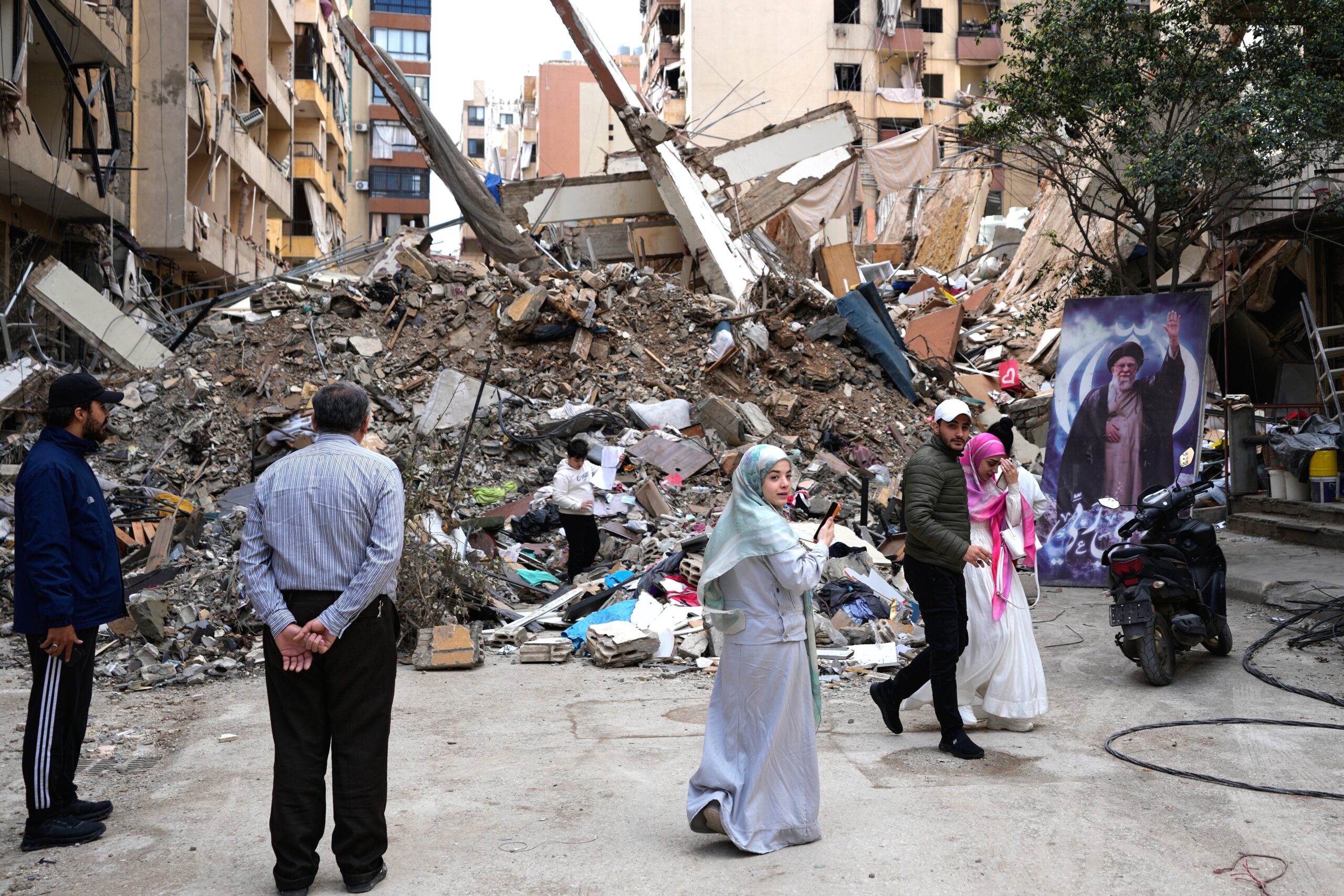
Major U.S. defense contractors have posted billions in revenue, driven by sustained conflicts and increased demand for weapons systems, missiles, and military technology. The Russia-Ukraine war raging since 2022, along with the U.S.-Israel war on Iran and ongoing tensions in the Middle East, have fueled increased arms production and international weapons sales.
According to a July 2025 brief issued by the Quincy Institute called “Profits of War: Top Beneficiaries of Pentagon Spending, 2020 – 2024,” private firms received $2.4 trillion in contracts from the Pentagon, approximately 54% of the department’s discretionary spending of $4.4 trillion over that period.
During those five years, $771 billion in Pentagon contracts went to just five firms: Lockheed Martin ($313 billion), RTX (formerly Raytheon, $145 billion), Boeing ($115 billion), General Dynamics ($116 billion), and Northrop Grumman ($81 billion). The authors wrote by comparison, the total diplomacy, development, and humanitarian aid budget, excluding military aid, was $356 billion. In other words, the U.S. government invested over twice as much money in five weapons companies as in diplomacy and international assistance.
Meanwhile, congressional hearings are underway on the Trump administration’s $1.5 trillion budget request. Defense contractors are experiencing strong profits. For example, according to its website, in the third quarter of 2025, Lockheed Martin brought in $18.6 billion in sales, up from $17.1 billion the year before. It made $1.6 billion in profit and saw a sharp rise in cash coming in—clear signs of profiteering as global conflicts continue.
These figures came amidst a record $179 billion backlog—orders already locked in but not yet delivered—giving Lockheed Martin a pipeline of guaranteed future business. For defense contractors, backlogs often indicate ongoing or anticipated military activity. And while active war exists with daily costs mounting, it is a win-win scenario for the makers of war-fare, drones, missiles and related material. When stockpiles are diminished, they must be replaced.
According to vestedfinance.com, an investment adviser website based in California, which indicates it gathers its information from sources such as the Financial Times, Bloomberg and other reputed media houses, “Wars consume weapons at a terrifying rate. In just the first 16 days of the conflict, the U.S. and coalition forces burned through more than 11,200 munitions, at an estimated cost of $26 billion. Among these were over 1,200 Patriot missile-defense systems made by RTX, hundreds of Tomahawk cruise missiles, and more than 300 Thaad interceptors built by Lockheed Martin.”
Vested Finance explained why that number matters. “A single Patriot missile costs more than $3 million. And it takes months to build one. You cannot just order more and have them show up next week. Replacing what was used in the first two weeks alone will require years of sustained production. Which means years of sustained revenue for the companies that make them.”
It is not just the large corporations waxing rich off of the death and destruction of war in the Middle East. Vested Finance also explained that smaller firms in the U.S. and abroad are getting in on the moneymaking action.
“Arizona-based SpektreWorks built low-cost attack drones by literally reverse-engineering captured Iranian Shahed drones. The U.S. started using them within the first 24 hours of the conflict. Los Angeles-based Neros, which had previously supplied attack drones to Ukraine, saw Pentagon demand spike rapidly. Its CEO noted they’d never seen the need for having systems on the shelf ready to go for urgent demands. at this scale before,” noted vestedfinance.com.
People are growing tired of wars with no clear purpose or end. Even as leaders promised to avoid prolonged conflicts, new ones emerge with shifting goals—from regime change to nuclear threats to control of key routes like the Strait of Hormuz. At home, rising costs for food, fuel, and basic goods add pressure. Globally, disruptions to critical supplies such as fertilizer threaten agriculture and food production, increasing the risk of hunger in developing nations.
Advocates for social programs warn that reduced funding for domestic needs risks widening inequality at a time when many communities are already struggling with housing instability, access to care, and economic uncertainty.
“Every time Trump says, ‘Oh, we have unlimited oil and gas.’ The prices are set globally. So the average person here, on electricity… gas…food products, is paying more and more,” said Ms. Flounders.
These are the hardships paid for with U.S. tax dollars, “And throughout West Asia, they pay with their lives,” she said. Final Call staff contributed to this report.
