













Reports, studies and news accounts from the past few years have documented this ongoing problem plaguing Black neighborhoods, stemming from corporate greed at the expense of human life.
Predatory corporate landlords and institutional investors are buying single-family homes in Black neighborhoods across the country, driving up rent and aiding in Black eviction and homelessness rates.
In his 1993 book, “A Torchlight for America,” the Honorable Minister Louis Farrakhan, National Representative of the Most Honorable Elijah Muhammad, critiqued the greed that permeates every aspect of American society.
“America also throws away the taxpayer’s money by commissioning valuable studies, yet the government never really uses the results for the purpose of doing good. Though many of these studies are unpopular, they provide solutions that America could perhaps use to stop the ship of state from sinking.
But this mindset of greed has permeated every aspect of society, blinding the rulership to the results of studies that they themselves have commissioned,” Minister Farrakhan wrote.

“Greed was in the very genesis of this country. Greed was at the root of the founding of this country. Greed was at the root of slavery, and it persists as a central problem to this date,” he added.
“The business community is so filled with greed that the bottom line means more to corporate America than the lives of the people and America’s well-being as a nation.”
The state of predatory landlords
Dr. Kesha Moore, research manager at The Thurgood Marshall Institute, an internal social science think tank for the NAACP’s Legal Defense Fund, has helped document the issue of corporate predatory landlords.
“This is something that has grown exponentially after the housing bubble crash in 2008, and it was a slight decline in 2020 with the pandemic, but then it rose after that,” she said to The Final Call.
The U.S. Government Accountability Office released a report in May 2024 on “Institutional Investment in Single-Family Homes.” The office found that no institutional investor owned more than 1,000 single-family rental homes as of late 2011, but by 2015, institutional investors collectively owned between 170,000 to 300,000 homes.
“As of June 2022, institutional investors of varying sizes made up a large portion of the single-family rental market in many cities, particularly in Sun Belt states,” the report said.
The Sun Belt states are states in the southeast and southwest of the U.S., stretching from Florida to California. Though nationally, large institutional and corporate investors own just 2-3% of single-family rental homes.
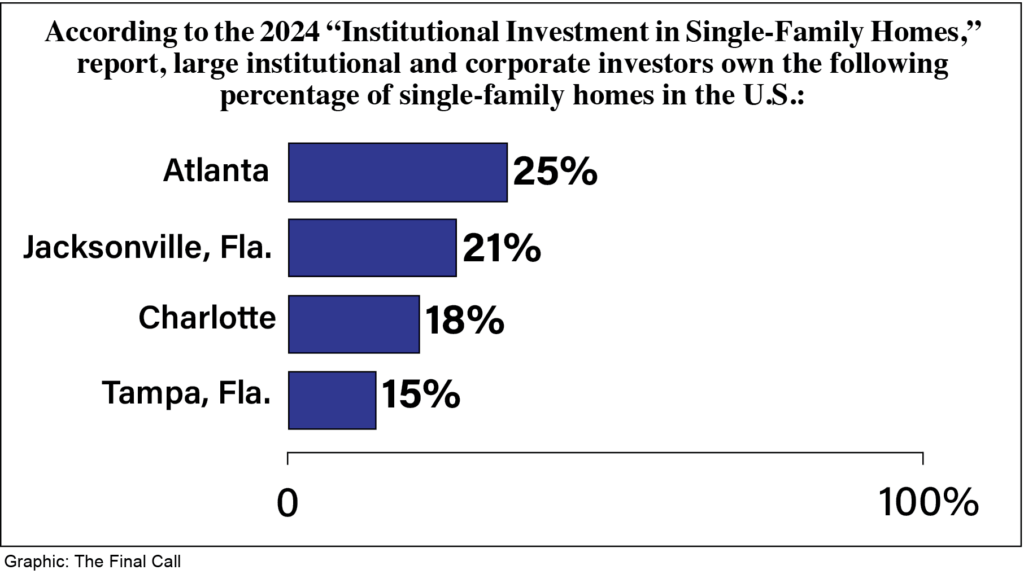
They own 25% of shares in the single-family rental home market in Atlanta, 21% in Jacksonville, Florida, 18% in Charlotte, North Carolina, and 15% in Tampa, Fla., according to the 2024 report.
They own between 10% to 14% in Las Vegas; Phoenix; Indianapolis; Memphis, Tennessee; Nashville, Tenn.; Raleigh, N.C.; Birmingham, Alabama and Orlando, Fla.
Dr. Moore explained that now, because it is less expensive to acquire property in the Sun Belt region, corporate landlords are not only buying existing single-family homes to rent, but they are also building single-family homes to rent.
“That becomes a really attractive way to invest in building single-family homes that are never intended to be purchased by a homeowner. They’re intended to be rental properties,” Dr. Moore said “Why target Black communities?
Some people are debating whether they are targeting Black communities or Black communities just happen to be the places where they buy lots of property. I think it is both.”
Homes in Black communities have lower market values due to lower rates of appreciation, Dr. Moore explained, adding that the same house in a Black community would be cheaper than in a White community.
The depreciation in value can be traced back to redlining and Black homeowners being locked out of credit access, which made potential homeowners vulnerable to predatory lending practices, leading up to the 2008 housing crash.
“When the housing bubble crashed, it drained a lot of wealth from Black communities, because Black communities were the ones that were disproportionately vulnerable to this kind of predatory lending. So, they’re also the ones whose houses are going into foreclosure, and these are the houses that then the corporate landlords are able to snap up and have ‘on sale,’” Dr. Moore said.
She explained that the crash caused an abundance of homes to go on sale, and corporate investors bought as many homes as they could. Today, predatory investors are still hyper-localized in vulnerable Black communities.
“What we realized is that these corporate rent landlords don’t actually function like regular landlords. They actually raise rents faster. When they dominate such a large share of the rental housing market, they actually increase the rent in that housing market.
And that’s true not just for the properties that they own, but they have this spillover effect that actually is linked to increasing rent for just smaller, local, single-family homes in that same market,” Dr. Moore said.
She linked the actions of corporate landlords to Black displacement and lower rates of Black homeownership, due to people’s inability to keep up with increasing rents and with landlords who can outbid individuals trying to buy homes.
“You can’t out compete and outbid these corporate landlords. So, it not only suppresses Black homeownership rates, but it also has this impact of actually draining wealth from Black communities and increasing rent and housing insecurity in those same communities,” Dr. Moore said.
Atlanta’s predatory landlords
The 2024 Government Accountability Office report points to Atlanta as having the highest percentage of any city when it comes to the power of corporate landlords in the single-family rental home market.
In another 2024 study, published in the journal “Annals of the American Association of Geographers,” researchers from Georgia State University and Rutgers University found that three major corporate landlords own more than 19,000 single-family rental homes in the Atlanta metropolitan area, representing nearly 11% of the single-family rental housing stock in five core counties of metro-Atlanta.
The researchers accused them of “using an extensive network of more than 190 corporate aliases—registered to seventy-four different addresses across ten states and one territory—to hide their holdings behind a veil of secrecy and insulate themselves from liability.” This was only one case study of a practice far more widespread than metro-Atlanta.
“Because of the structure of LLCs (limited liability companies), a lot of times it’s even hard to know who owns a property, and that makes it harder to regulate.
And there are some of these private corporate landlords that are known for really bad practices, but it’s harder to identify those patterns and to sanction them as a way to get them to operate in a more just and fair way,” Dr. Moore said.
A 2023 analysis by a Georgia Institute of Technology researcher found that between 2007 to 2016, corporate investor purchases of single-family homes accounted for roughly three-quarters of the decline in Black homeownership in the Atlanta metropolitan area, resulting in approximately $4 billion in potential home equity lost from Black households in a 10-year period.
“In Atlanta, we have this transfer of loss of Black wealth, loss of Black homeownership that starts but continues through that time period. We also see that corporate landlords in Atlanta are operating differently than smaller or more private landlords.
They file more evictions than these smaller landlords in terms of number, and they also charge more of these junk fees or erroneous charges that they charge their renters that actually leads to them being evicted at higher rates,” Dr. Moore said. “Not only is it blocking homeownership, but it’s also increasing evictions.”
According to a June 2025 article by Capital B News, a Black-owned news organization, 47% of Atlanta’s residents are Black, but 80% of the city’s homeless population is Black. It traced this disparity to ongoing economic challenges and the affordable housing crisis.
Nationally, though Black people made up just 12% of the U.S. population and 21% of those living in poverty, they made up 32% of all people experiencing homelessness, according to the U.S. Department of Housing and Urban Development’s 2024 annual homelessness assessment report to Congress.
In a 2025 “State of Homelessness” report, the National Alliance to End Homelessness described the problem as a racial justice issue that stems from years of exclusion from housing, education, employment and wealth-building.
More than 55% of Black households are renter households, according to the report. About 26% of Black renter households paid more than 50% of their incomes on housing in 2023.
Black renters especially “experience higher eviction rates than White renters,” the report says. “Research from the Eviction Lab and the U.S. Census Bureau shows that more than half of all eviction filings are against Black renters despite the group representing only 18% of renters.”
The broader picture
Other cities experiencing the hyperlocal effects of corporate landlords in Black neighborhoods include Charlotte, N.C., and Milwaukee.
In Mecklenburg County, N.C., with county seat Charlotte, researchers found that more than 75% of transactions involving institutional investors converting single-family homes into rental properties occurred in majority Black neighborhoods.
In addition, the transactions lowered homeownership rates for existing homes by two percentage points in the county overall and four percentage points in Black neighborhoods specifically.
“What these large-scale corporate landlords are doing is disrupting not just individual renters and homeowners, but also disrupting the communities around them in terms of their access to homeownership and their ability to have increases in their property value from their homeownership,” Dr. Moore said.
In Milwaukee, out-of-state landlords owned more than 14% of rental houses in majority-Black wards in 2018, a percentage that jumped to about 24% by the end of 2022, according to a 2023 report on Milwaukee housing trends. Yet, during the same time period, the number of out-of-state-owned houses in majority White neighborhoods fell by nearly 100, the report said.
“In places where there is a strong concentration of corporate landlords, what they’re able to do is to raise rents not just in their properties, but because they control such a large share of the single-family rental market, smaller individual landlords also raise their rent. And so that quick increase in rent can be associated with increased displacement, even without gentrification,” Dr. Moore said.
Challenging predatory landlords
Dr. Moore outlined several things local jurisdictions can do to combat predatory landlords, including greater transparency on property owners, publishing violation histories to see what companies are engaging in bad practices and “just cause” eviction protections that prevent evictions without good reason.
She also suggested jurisdictions ensure that renters have a right to counsel, enforce anti-harassment violations and code compliance through penalties and lawsuits and create opportunities for renters to purchase the properties they live in when they become available for sale.
She said states could issue more policies around identifying and discouraging predatory lending practices, make evictions more expensive for corporate landlords, prohibit junk fees, require reports on investor purchases and create a dashboard of corporate evictions.
The Most Honorable Elijah Muham-mad, Eternal Leader of the Nation of Is-lam, advised Black people to unite and do for themselves and said unity would solve most of the problems Black people face.For years, His National Representative, the Honorable Minister Louis Farrakhan, has encouraged Black people to unite and “rebuild the wasted cities.”
“There is a scripture in the Book of Isaiah that reads: ‘And they will rebuild the wasted cities.’ Who is the they? And who [are the ones that] live in the wasted part of America’s cities? It is we.
And if we come up with the constructive plan and put together some of the money that we throw away, and then get some of the stimulus money that we hope to bring back into our communities.
We can rebuild—or help to rebuild—the wasted cities,” the Honorable Minister Louis Farrakhan said in a 2009 interview with Cliff Kelley on Chicago’s WVON 1690 AM talk radio.
In a series titled “Justifiable Homicide,” Minister Farrakhan brought up the skills that can be taught to Black people, Black youth in particular, to rebuild the inner cities.
“Take the craftsmen—those who know plumbing, roofing, brick masons, electricians—and let us take our skilled people and teach the young people a trade. It’s so simple, but it can be done,” he said.
“Look at all of the vacant lots (in) our cities; we should go to our city council leaders and say, ‘We want to put our young people to work. Give us the lot and we’ll go to work building low cost housing units, selling it to our people,
Putting the money in a treasury that belongs to the youth,’” he added. “When the young people develop enough money, they can start buying property in the community where they live.”
