













WASHINGTON, D.C.—For people who missed the fine print in the landmark “One Big Beautiful Bill Act” (OBBBA), unanimously opposed by the Congressional Black Caucus, signed into law in July 2025, there are concerns on the horizon. With the July 1, 2026, deadline just six months away, a rising financial panic is spreading among graduate and professional students nationwide. The OBBBA is moving from legislation to an actual implementation, enforcing strict federal borrowing limits and significantly changing eligibility for higher student aid.
The Department of Education (ED) recently completed its negotiated rulemaking process, which explained who can receive federal loans large enough to cover expensive degrees. This latest regulatory clarification has made current students rush to secure existing, more flexible loan eligibility before it runs out. This popular program used to let graduate students borrow up to the full cost of attendance, which was a big safety net for degrees with high tuition.
“What we’re most concerned about in terms of limiting or putting caps on those loans or this tool is that that may not necessarily change the amount that students, and then, by definition, their families, need to borrow to go to college, right?” said Roxanne Garza, director of higher education policy at EdTrust, a college-access nonprofit in a statement.
“It’s likely going to mean that those students and their families are either going to forgo college, because they can’t borrow the additional funds they need to go to college, or what you might see as well is these students and families being pushed to the private sector (for loans).”
The immediate end of the Graduate PLUS Loan Program for all new borrowers starts July 1, 2026.
“Grad PLUS Loans are paying for my graduate program,” D.C.’s Malika Thompson told The Final Call. “This news was totally confusing when it first came out. I wasn’t sure what I was going to do. I’m glad they gave those in the middle of programs time to complete before the new regs (regulations) affect us. However, my sister is right behind me, and this affects her school and program choices. For some students, this may mean the end of their higher education journey.”
A two-tiered system: new vs. continuing borrowers
The new rule has created two distinct groups of students:
Current Borrowers (The Grandfathered): Students who receive their first federal Direct Loan disbursement, including a Grad PLUS loan, before July 1, 2026, for their current program are considered “grandfathered in.” They maintain eligibility to borrow under the old, unlimited Grad PLUS terms for either three additional academic years or the remaining duration of their program, whichever is less.
New Borrowers (starting July 1, 2026): These students lose access to Grad PLUS entirely and face rigid new caps on federal Direct Unsubsidized Loans.
Standard Graduate Students (Master’s/Most Doctoral Programs): Limited to $20,500 annually with a $100,000 aggregate lifetime cap.
Professional Students: Eligible for higher limits of $50,000 annually and a $200,000 aggregate lifetime cap.
Further, the bill imposes limits on Parent PLUS Loans for undergraduates, capping annual borrowing at $20,000 per student and lifetime borrowing at $65,000 per dependent.
“This is a curse and a blessing,” Maryland’s Sharon Tolliver told The Final Call. “I spent so much on my son’s education. I was happy to help; that’s the blessing. Had there been a cap on what I could spend, that might have forced him to seek other sources of funds besides my bank account. It would have felt like a curse at the time, but we would have worked it out.”
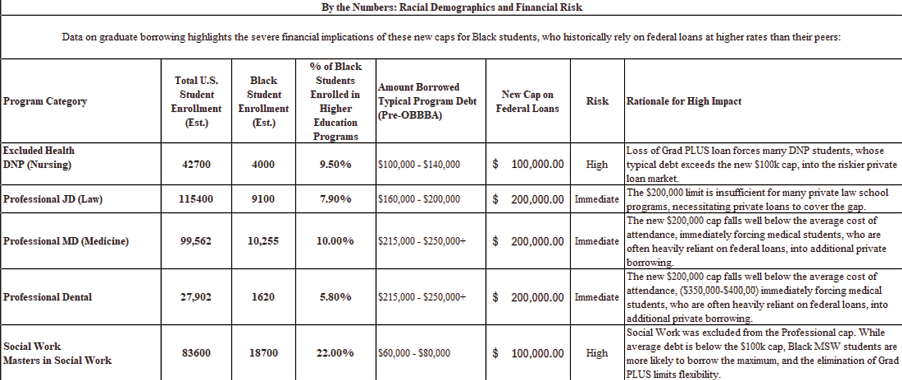
The controversial professional degree definition
The ED has also finished rewriting the official definition of a “professional degree.” This decides if a student has a lifetime limit of $100,000 or $200,000. This definition confirms a narrow reading of what a professional degree is. Degrees that will continue to qualify for the higher ($200,000) professional loan cap are in medicine, law, dentistry, veterinary medicine, pharmacy, optometry, podiatry, chiropractic, theology, and clinical psychology. However, this new narrow definition excludes primary health professions like nursing, physician assistant, nurse practitioner, physical therapy, occupational therapy, public health, audiology, speech pathology, counseling, social work, and health administration. These students are classified as “standard graduate students” with a $100,000 lifetime cap.
Experts across fields oppose the new definition, warning of impacts on healthcare sectors. The Association of Schools and Programs of Public Health led a coalition letter to the Education Department’s RISE (Reimagining and Improving Student Education) Committee, joined by groups representing nurses, pharmacists, veterinarians, therapists, dentists, public health workers, and other healthcare professionals.
“A broad, consistent definition of ‘professional degree’ is essential to sustaining the nation’s multidisciplinary health workforce and protecting the health of all Americans,” they wrote.
The capping of Parent PLUS and the elimination of Grad PLUS loan programs directly impact the pipeline for high-cost professional fields like medicine and law, where Black students often borrow more to cover the cost of attendance.
“Caps on student loans put graduate school and post-graduate degrees, such as medical and law degrees, out of reach for anyone but the wealthy or those willing to risk taking out private loans, which can be predatory and do not typically offer income-based repayment options like some federal government options. This means that educational opportunities for Black people will become more limited, affecting potential earning power,” explained the NAACP Legal Defense Fund.
While there is anxiety about higher education funding sources, the Honorable Minister Louis Farrakhan encourages people to reconsider the purpose of education in Study Guide 21.
“You have an educational system that has an elite at the top, then a lesser elite and a lesser elite, then the mass who work for the elite. You look at your life—you work if you have a job, but that is not what you are born to do. You do it out of necessity because there is a salary at the end of the week that allows you to pay the car note, the mortgage, go to the grocery store and feed yourself,” he writes.
“Everything that God creates is found trying to fulfill its purpose. And if it fulfills its purpose, it is equal to everything else in creation. The flea is equal to the Sun. How could the flea be equal to the Sun? Because the Sun is fulfilling its purpose and the flea is fulfilling its purpose. Look at the millions and billions of human beings on our planet under this system of education who don’t even know—have not even given it a thought—that there is a higher purpose for your presence on God’s Earth.”
