










Court documents and whistleblower claims point to a pattern of retaliation against Black educators
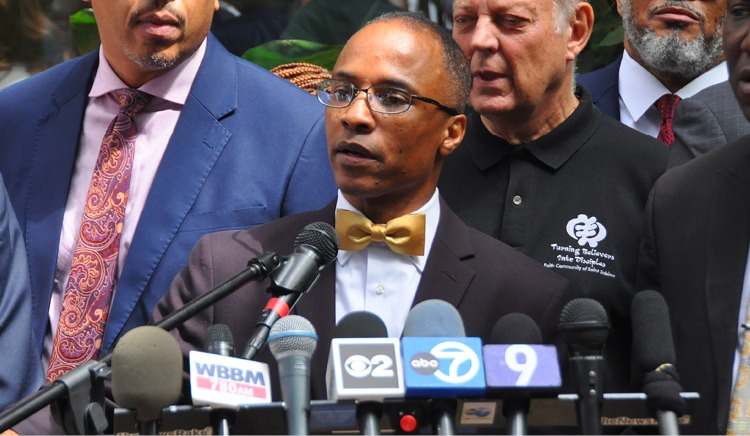
CHICAGO—The story of Mr. Abdul K. Muhammad, a respected Chicago Public Schools (CPS) principal known for transforming struggling schools into safer and thriving environments, has become a powerful case study in how race, politics, and power collide in public education.

At Lindblom Math and Science Academy, one of CPS’s most celebrated selective-enrollment institutions, Mr. Muhammad’s short tenure was marked by measurable improvements in school climate, community partnerships, and student morale.
Within months of his 2022 appointment, he relaunched mentoring programs, revitalized the school’s culture team, reduced hallway conflicts, and strengthened ties with parents, community leaders, and elected officials. Students and staff remember his energy and his ability to connect. “He gave us the best pep rally ever,” one student said.
Yet while he worked to build bridges in Englewood, others inside the district were allegedly building a case to take him down.
According to interviews and multiple accounts, resistance to Mr. Muhammad’s leadership began months before he officially became principal. Between February and July 2022, while the Local School Council (LSC) conducted its principal voting process, he encountered repeated interference and bias.
District administrators and insiders, according to Lynn White, the principal selection committee chair, attempted to reopen the search even after Mr. Muhammad received the highest evaluation scores from the council.
Ms. White described the atmosphere as “tainted from the beginning,” alleging that some officials “seemed determined to block him no matter how qualified he was.” She said she witnessed outside pressure being applied on the LSC to reconsider its vote after Mr. Muhammad emerged as the clear choice.
Ms. White described the environment as politically charged and racially fraught, marked by quiet opposition to Mr. Muhammad’s leadership style and discomfort with his membership in the Nation of Islam.
When he assumed the position in August 2022, Mr. Muhammad said he found the school in disarray. According to internal reports and witness statements, payroll inconsistencies, misuse of athletic funds, outdated safety protocols, and incomplete student compliance files were among the problems uncovered within his first four months.
He also identified serious concerns about child safety. According to a lawsuit and contemporaneous school records, when Mr. Muhammad learned of an incident involving alleged misconduct toward a student.
He immediately directed his assistant principal to contact the Office of Student Protections and Title IX, ensured the student received follow-up care, and documented every step. Ironically, that same incident would later be used against him—a move his attorneys describe as “a deliberate inversion of truth.”
Targeted for investigation
By December 2022, the reforms Mr. Muhammad initiated had triggered resistance from the nearly all-White staff aligned with individuals in district leadership, according to his lawsuit. On December 19, 2022, CPS investigator Kelly Tarrant, then a senior official in the district’s Law Department, formally opened an investigation against him for “mismanagement.”
According to legal filings and due-process analyses, Mr. Muhammad was never informed of the specific allegations before his March 16, 2023, interview, and more than 30 witnesses who could have supported his defense were excluded. The investigative report, completed in just three days, accused him of policy violations but contained no substantiating evidence.
In her own 2025 whistleblower lawsuit, Ms. Tarrant alleged that CPS officials improperly interfered with investigations and pressured her to produce findings favorable to district leadership.
She claims she was retaliated against after raising concerns about ethical and procedural misconduct in politically sensitive cases—including the case against Mr. Muhammad. Ms. Tarrant was eventually suspended and terminated, actions she asserts were in direct response to her objections to top-level interference.
Her allegations, now part of a pending lawsuit, have intensified calls for independent oversight of CPS investigations. Civil-rights advocates say the claims expose a pattern of collusion between the CPS Law Department, FOIA office, and top administrators—a system designed, they argue, to silence dissent and protect the politically connected.
Despite the lack of due process, CPS issued Mr. Muhammad a five-day suspension on May 17, 2023. Nearly two years later, on March 5, 2025, he finally received written confirmation that he had been exonerated of all major allegations. “By that point,” Ms. White said, “the damage had been done—his name, career, and reputation had already been dragged through the mud.”
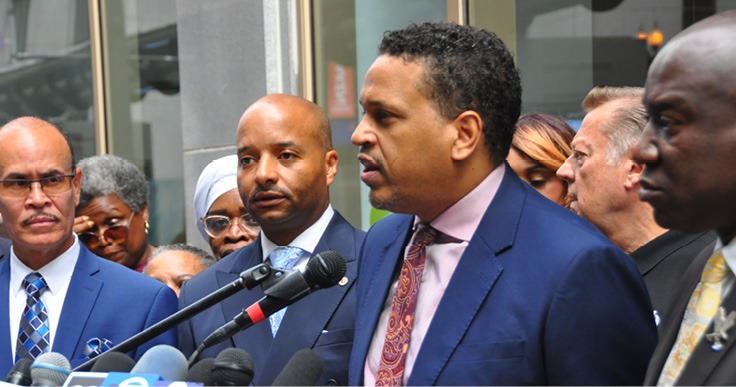
In October 2024, Mr. Muhammad filed a federal civil rights lawsuit in the Northern District of Illinois against the Chicago Board of Education, CPS CEO Pedro Martinez, and several senior officials, according to the complaint filed in federal court.
The lawsuit alleges violations of Title VII of the Civil Rights Act (race and religion discrimination), Sections 1981 and 1983 (equal protection and due process), and Section 1985 (civil rights conspiracy).
It claims that CPS officials “marshalled their resources to block his contract, undermine his authority, and destroy his reputation for no other reason than that he is a Black, male, Muslim member of the Nation of Islam.”
According to the lawsuit, Mr. Muhammad’s troubles began when he attempted to enforce accountability. His attorneys, Sa’ad Alim Muhammad, Abdul Arif Muhammad, and Yolanda Muhammad, contend that he was targeted after reporting missing athletic funds, payroll abuse, and compliance failures that predated his leadership.
CPS has since filed a motion in federal court seeking to dismiss the case, arguing that the district and its officials acted within their authority, according to filings by CPS attorneys. Mr. Muhammad’s legal team has opposed the motion and is seeking discovery of internal communications between CPS’s legal department, the FOIA office, and the CEO’s office.
A flawed investigation—and then came a twist
The investigation that led to Mr. Muhammad’s suspension was riddled with procedural violations, according to documentation reviewed by The Final Call. Among them were untimely notice, denial of access to evidence, failure to interview key witnesses, and improper coordination between investigators and decision-makers before the inquiry even began.
The same investigator, Kelly Tarrant, who once built the case against Mr. Muhammad, later filed her own lawsuit against CPS. Ms. Tarrant’s lawsuit claims her termination violated whistleblower and anti-discrimination laws.
A Latina, she alleges the principals’ association retaliated against her following her 2023 investigation into Abdul Muhammad, a Black principal, which the group labeled racist. According to the suit, CPS didn’t allow her to respond or defend against the charge.
After filing complaints with CPS’s Equal Opportunity Office and the federal EEOC, she received her lowest performance review at CPS, and her investigation of Mr. Muhammad was downgraded.
Her allegations, if proven, lend significant weight to Mr. Muhammad’s claim that his downfall was engineered—not earned.
A pattern, not an exception
Mr. Muhammad’s ordeal reflects a broader, well-documented pattern of racial inequity in CPS leadership. According to reporting by WBEZ, The Chicago Defender, and the Chicago Principals and Administrators Association (CPAA), Black men make up roughly 8% of CPS principals, yet account for nearly 70% of those who have been removed or disciplined.
Between 2019 and 2023, WBEZ reported that of nine principals investigated for “serious misconduct,” six were Black men. The Defender documented seven Black principals removed in a single year—many under vague or later-disproven allegations. The CPAA’s Vindicated report concluded that key evidence was often ignored and due-process standards applied inconsistently.
CPAA President Troy LaRaviere described the climate bluntly: “Due process was nonexistent. Brother Abdul Muhammad didn’t receive notice of charges, discovery of evidence, nor the chance to cross-examine witnesses. We had to threaten a lawsuit just to get access to reports.”
He said Mr. Muhammad’s ordeal exposed a broader truth: “Before Abdul, no principal wanted to go public. They feared the stigma. Abdul was different—his discipline, integrity, and grounding in his faith let us wage a public battle.”
Mr. LaRaviere explained how Mr. Muhammad’s case became a turning point in advocacy: “Watching Abdul changed me. His calm, his truth-centered focus, his dignity—even under attack—made me a better person. That’s why his case was pivotal.”
He further emphasized how Mr. Muhammad’s courage helped expose flaws in CPS’s investigative practices and pushed the district to shift its approach from “removing” to “remediating” school leaders.
“The Kelly Tarrant lawsuit shows our campaign pressured CPS to shift from removing to remediating principals. That’s a major shift in institutional behavior, driven by public exposure.”
These patterns, advocates say, show how administrative tools such as “due process” and “disciplinary investigations” have been weaponized against independent Black leaders under the guise of policy compliance.
A record of excellence
Before his ordeal, Mr. Muhammad built a record of academic and cultural excellence. According to district performance data and testimonials, he raised freshman-on-track rates at Douglass High School from 71% to 100% in three years, reduced suspensions, and expanded dual-credit programs at Julian High School.
At Nancy B. Jefferson High School, located inside the Juvenile Temporary Detention Center, he brought the Broadway musical Hamilton to incarcerated youth—its only performance outside of Washington, D.C., or Broadway.
At Lindblom, he greeted students daily, walked them to bus stops, and partnered with Ald. Stephanie Coleman and State Rep. Sonya Harper to direct new resources to Englewood. Colleagues and parents describe not a negligent leader but one who brought structure, safety, and pride back to the school.
Today, both Muhammad and Tarrant continue to battle the system—he through his federal lawsuit to restore his reputation and pension, and she through her whistleblower complaint to expose what she calls “corruption at the core of CPS.”
Their cases raise pressing questions: Who investigates the investigators? How many educators have been quietly silenced? And what does justice look like in a system where truth itself is seen as insubordination?
This isn’t about Mr. Muhammad alone, say supporters. It’s about a system that punishes Black men for standing on principle and rewards silence over service. His fight is for integrity and the dignity of those who teach our children.
In the aftermath of cases like Mr. Muhammad’s, Chicago principals have gained new protections that strengthen their rights and autonomy. Thanks largely to sustained advocacy from the CPAA—and to the public attention generated by Mr. Muhammad’s ordeal—the Illinois General Assembly passed legislation granting principals clearer due-process rights, protection from retaliatory investigations, and a formal appeals process for disciplinary actions.
The reforms, supported by Mr. LaRaviere and members who rallied around Mr. Muhammad’s case, mark a significant shift: principals are now recognized as educational leaders with contractual and constitutional rights, not merely “at-will” employees vulnerable to political or administrative pressure.
[Editor’s Note: Toure Muhammad taught alongside Abdul Muhammad in the mid-1990s. He is also an alumnus of Lindblom High School.]
