





EAST ST. LOUIS, Ill.—On October 16, 1995, early in the morning, just before dawn, you could hear the footsteps and voices of men briskly walking to the Washington, D.C., mall from all directions on their way to the Million Man March called by the Honorable Minister Louis Farrakhan.
Upon seeing the success of the March, the enemy to the rise of Black people went after the Honorable Minister Louis Farrakhan, the Nation of Islam and Black people.
Three decades later, the question is asked: What happened during that historic period? What progress has been made, and what are Black men doing to better their communities?
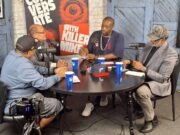
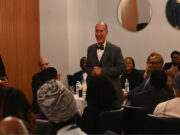
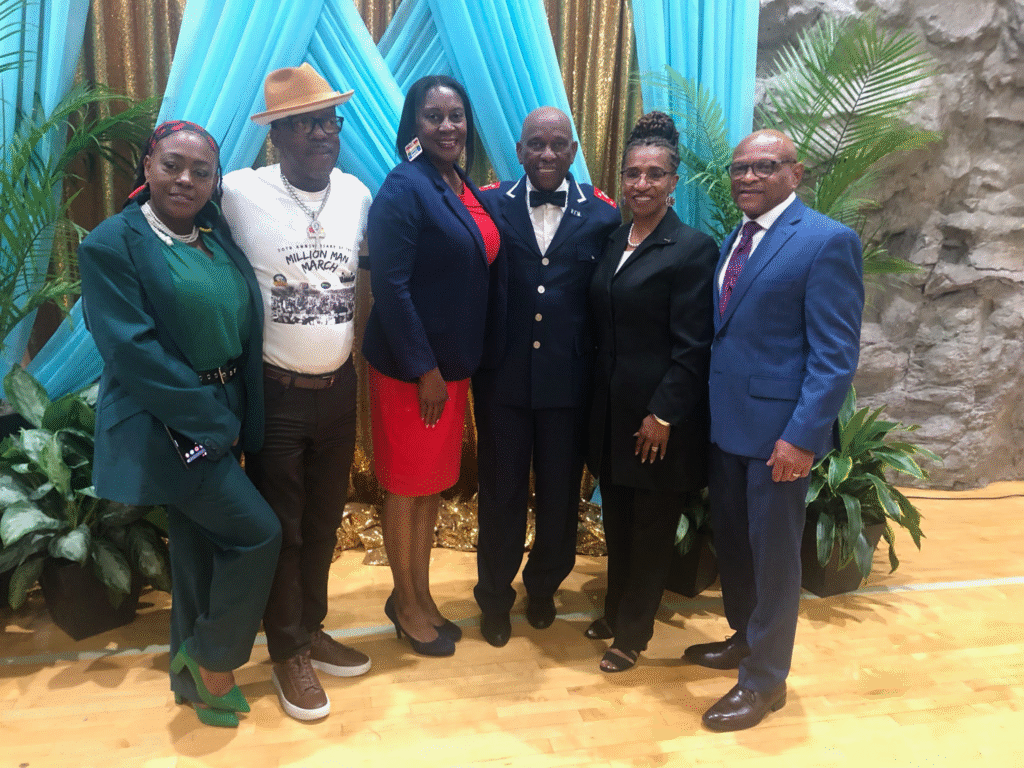
During the weekend of October 18 and 19 in East St. Louis, Illinois, members of Muhammad Mosque No. 28B, in conjunction with the City of Cahokia Heights, hosted a community forum.
Special guests included Student Minister Dr. Wesley Muhammad of the Shura Executive Council of the Nation of Islam, Student Minister Donald Muhammad of Mosque No. 28 in St. Louis, Missouri, and longtime St. Louis activist Brother Anthony Shahid, along with local leaders, politicians, and Million Man March participants.
The discussion centered on the impact of the March and issues facing Black America, as well as what can be done to reignite the spirit of that magnificent and historic day. The panel was moderated by Brother Earl Muhammad of Mosque No. 28B. There were 11 speakers, each offering their perspective on the March’s legacy.
“The Million Man March was not a single day in history; it was a movement that echoes today and throughout tomorrow,” said Robert Betts, East St. Louis City Manager.
“But we, as Black men, we got to stand up and speak out. We have to do better. However, it won’t be done until we take more responsibility and accountability for our own destiny,” he added.
Building on Mr. Betts’s sentiments, Student Minister Ralph Muhammad, of Mosque No. 28B, emphasized unity rooted in love. “We can have unity, but it has to come out of love,” he stated. “People are saying it’s getting worse.
We are bankrupted as Black people, and our Black men have fallen under a conspiracy to keep us non-productive. That’s why we need to reawaken to the spirit of love and unity,” he said.
Dr. Debra Powell, the former first female mayor of East St. Louis in its 134-year history, gave her perspective on the March’s impact. “I feel the [Honorable] Minister [Louis Farrakhan] made the right call and the people showed up, but we need to ask ourselves where do we fit in life’s puzzle. It needs to start internally first. We must figure out who we are and what our mission is so we can cultivate our talents,” she said.
Francella Jackson, chief of staff for the mayor of Cahokia Heights, Illinois, expressed concern about the community’s current state. “Our people are very distracted and are not learning anymore,” she observed. “We used to read books and go to the library.
Now they play games and don’t read or think. I feel we have gone backward. I am a Missionary Baptist woman, but you have ministers who have been bought and sold out. However, the Minister [Farrakhan] and the men of the Nation [of Islam] have stayed true.”
Brother Anthony Shahid spoke passionately about strength and consistency. “We have to speak with strength to our people,” he declared. “No matter what organization you belong to, unity is the key. Once we come together, like the Most Honorable Elijah Muhammad said, our unity is more powerful than an atomic bomb. All we have is each other, and we cannot stop.”
Student Minister Dr. Wesley Muhammad provided insight into understanding unity. “I caution us to not confuse unity with conformity,” he explained. “There are many Black organizations, and you will never find us condemning organizations that have different thoughts than the Nation of Islam.
We need to re-conceptualize what the work is because every organization is doing an aspect of it. No Black organization is doing all of it. The work is so big, and our problems are many, every effort is helpful,” Student Minister Dr. Wesley, who is also a member of the Nation of Islam Research Group, added.
The event had a profound impact on attendees. Damon W., who spent almost three decades in prison, was overjoyed to meet Student Minister Dr. Wesley Muhammad.
He credited the student minister, author and researcher’s books with keeping him enlightened. “This was one of the best days in my life,” he shared. “I had a chance to hear a man with knowledge, wisdom, and understanding.”
Chris McIntosh, a journalist, reflected on the original call to the Million Man March. “The Minister put out a call, and it happened,” she said, speaking about Minister Farrakhan. “It was a message that was clear and concise. The message said what you can do and not what you couldn’t do. He brought it across every faith.
It didn’t matter if you were Baptist, Catholic, or whatever, if you were a Black man, he needed you in D.C. It wasn’t just a message of the moment. The Minister talked about the future because he had the vision to see what was happening then and now.”
As the forum concluded, it was abundantly clear that the spirit of the Million Man March continues to inspire and challenge Black men to take responsibility, unite in love, and work consistently toward the betterment of their communities.
