







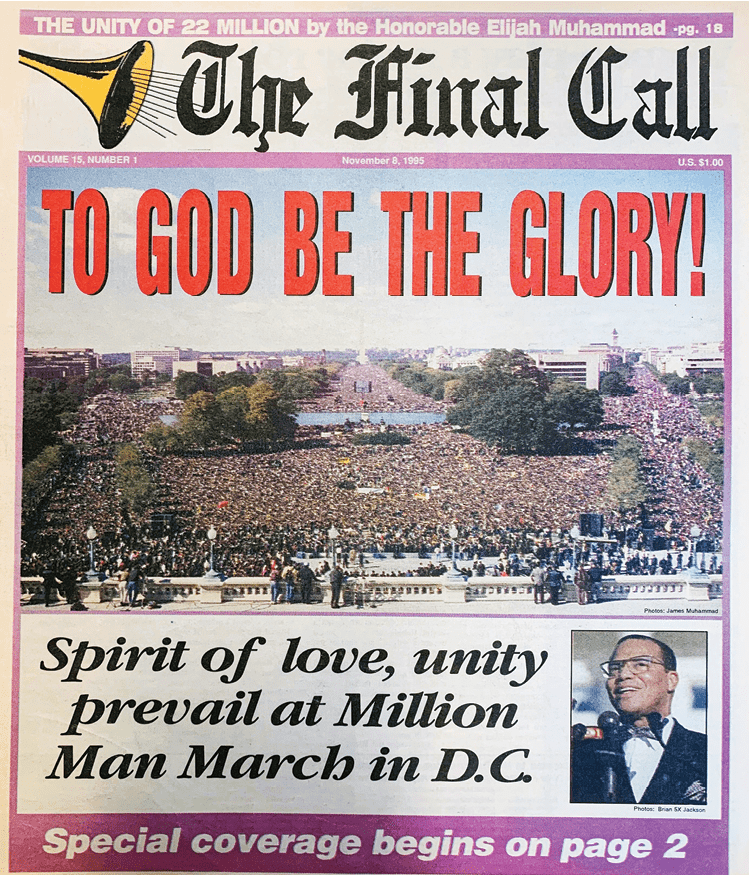

The Million Man March was the greatest assembly of Black men ever in the annals of recorded history. Nearly two million men gathered on the National Mall in Washington, D.C., that sunny day on October 16, 1995, and they came voluntarily. The men came volunarily and paid their own way.
The call was for Black men to “atone” to Allah (God) for their sins, “reconcile” with their families and community and accept the “responsibility” to do better. At the time of the March, Black men were vilified in the media by our enemies as thugs, super predators, deadbeat dads, and felons. The march was called to dispel those images.
Yet, the call itself was vilified.
There were arguments against the March, and false labels were put on the man who called it, the Honorable Minister Louis Farrakhan, by the enemies of the rise of Black people, and consistently repeated in the mainstream media.
While the grassroots embraced the call, many established Black leaders either rejected it outright or approached it with caution and criticism. Those who rejected it knew the tremendous work the Minister had put in over the 40 years he had worked on behalf of his teacher, the Most Honorable Elijah Muhammad, Eternal Leader of the Nation of Islam, to raise the condition of Black people.
They knew that he had come to the defense of many of them when they were attacked by the enemy. They knew of his many cross-country tours speaking to every level of our community to unite, to stop the killing, to do for self, to correct the wrong.
By calling the March, Minister Farrakhan was fulfilling a desire of the Honorable Elijah Muhammad, who, when watching the 1963 March on Washington on television, told Minister Farrakhan there was too much “frivolity” at the march. He told the Minister that He (Elijah) would hold a more serious assembly in the future.
The 1963 March on Washington was called to demand jobs and justice. In his I993 book, “A Torchlight for America,” Minister Farrakhan addressed that mindset: “Black leadership cannot go to the government to beg it to provide a future for us. … That old slave mentality that keeps us at odds with one another and dependent on White people has to be broken,” he wrote on page 40.
The Million Man March called for the Black man to look within himself and to Allah (God) to change the condition of his community. What we saw on that day was an assembly of “many nations” uniting on one accord—to be brothers to one another. What the enemy saw terrified him.
Every effort by every Black man (or woman) who rose to address the condition of Black people has been vilified and called disparaging names—Martin Luther King Jr., Malcolm X, the Honorable Marcus Garvey, Fred Hampton, Stokely Carmichael (Kwame Ture), even W.E.B. DuBois.
In the 1960s there was a department in the FBI whose sole purpose was to prevent the rise of a “messiah” among Black people—the Counter-Intelligence Program (COINTELPRO). What is it about freedom for Black people that upsets White America?
In 1993, Black leaders invited Minister Farrakhan to speak at the 30th anniversary of the March on Washington, only to disinvite him because leaders in the Jewish community threatened to withhold funding if he was allowed to speak.
There was nobody who could threaten the Million Man March by withholding funds because it was funded by members of the Nation of Islam and the Black community.
But that didn’t stop the enemy from trying to disparage self-funding of the March. The Nation of Islam is the only Black organization to release a public audit of the funds raised after a major public assembly.
The enemy tried to label the Million Man March anti-feminist, yet Black women held prominent speaking roles. Among them were Dr. Dorothy Height, Coretta Scott King, Dr. Betty Shabazz, Rosa Parks, Dr. Cora Masters Barry and Queen Mother Moore. Minister Farrakhan invited major Black leaders to speak, even those who initially opposed the March.
There are many lessons we should learn from that day. Among them: We should not allow our open enemies to define for us our brothers’ or sisters’ character or motivation. If we have issues, in the spirit of the March we should reach out to that person;
We should strive to cast out fear and depend on the God we say we believe in to get us through our struggles; We should strive to unite our resources and build a future for our children that doesn’t depend on what our enemies give us.
Today, more than ever, there is an attempt to erase from the history books the struggles and accomplishments of the Black man and woman in America. What happened on October 16, 1995, must be taught to our children, many of whom have no idea of that achievement.
We should take it among ourselves to declare it our National Holy Day and do what two million Black men did—take off work, fast, thank Allah (God) for His presence among us and pray that He protect us from the Fall of America.
The spirit of the Million Man March will live because we will make sure of it!
—James G. Muhammad, Contributing Editor
