






The August 24, 2026, United Nations Security Council latest updates concerning war-torn Sudan, and its escalating conflict, sounded more like a long, drawn-out and troublesome dilemma. Without any UNSC proposed concrete solutions for the worsening conflict and increasing civilian suffering in the world’s largest humanitarian crisis, the conversations appeared to be more of the same.
Hunger has been another fallout from the current crisis. In Sudan, with a population of 51 million, more than 19.5 million are “acutely food insecure,” according to the World Food Program (WFP).
The death toll from direct violence, resulting from the conflict between General Abdel Fattah al-Burhan, leader of the Sudan Armed Force (SAF), and Mohamed Hamdan Dagalo, who leads the paramilitary Rapid Support Force (RSF), has been tracked at nearly 60,000. UN Under-Secretary-General for Political and Peacebuilding Affairs Rosemary DiCarlo warned that “the true death toll is likely in the hundreds of thousands,” and said that “13 million people have been displaced amid widespread atrocities, including mass killings, sexual violence, child recruitment, attacks on hospitals and drone strikes on civilian infrastructure.”
Under-Secretary-General for Humanitarian Affairs and Emergency Relief Coordinator Tom Fletcher said, “over two-thirds of Sudanese civilians desperately need life-saving aid but it is constrained by a lack of action and access. Meanwhile, Sudan’s Ambassador outlined his government’s action to protect civilians,” noted Globalissues.org.
During the briefing, several presenters warned that the war being waged between the SAF and the RSF is crossing regional borders, “fueling refugee flows, land cross-border insecurity and the proliferation of weapons.”
The United States encouraged the UNSC to renew the set to expire on September 12, 2026, arms embargo on Darfur. U.S. plans are to expand the arms embargo on the Sudanese region of Darfur to cover all of Sudan, saying the nation’s brutal conflict risks regional expansion. However, France 24 reported, Russia, with veto power, warned against new measures that would impact the “Sudanese army.”
UN News reported that there was a call to action that urged an immediate humanitarian truce, a permanent ceasefire, and “accountability for atrocities, unhindered aid access, and an inclusive Sudanese-led political process, while pressing external actors to stop fueling the conflict and use their influence to bring the parties to the negotiating table.”
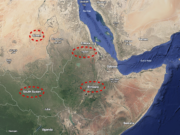
According to reporting by Radiotamazuj.org, on Aug. 22-23 in a meeting in Addis Ababa, Ethiopia, officials from Sudan who oppose the war rejected an initiative by SAF military leader Abdel Fattah al-Burhan for a “Sudanese-Sudanese dialogue,” saying they would neither participate in the process nor recognize its outcomes.
“The groups instead proposed an alternative peace roadmap built around three parallel tracks: humanitarian assistance, a permanent ceasefire and an exclusively civilian political process,” the outlet reported.
Participants in the meeting included representatives of the Sudanese Declaration of Principles, the Popular Congress Party founded by the late politician and former Attorney General Hassan al-Turabi, and headed by Ali al-Haj, the National Umma Party led by Mubarak al-Fadel. Other participants included civil society organizations, women’s and youth networks and independent public figures.
However, according to Middle-East-online.com, in a joint position paper by the non-aligned Sudanese anti-war forces, titled “The Peace Process We Want,” the group explicitly rejected Burhan’s call for dialogue from inside Sudan, reported Middle-East-online.com (MEO).
The coalition explicitly rejected dialogue held from territory controlled by either waring faction
According to MEO, “launching dialogue from areas controlled by one of the warring parties risked producing an unbalanced political process and could entrench Sudan’s existing geographical and political divisions, effectively turning military control on the ground into a permanent political reality.”
In a press statement published on The Middle East Media Research Institute’s website, the coalition warned that the “warring parties would not constitute a genuine peace process and could legitimize military rule.”
The outlet noted that the coalition also called for greater coordination among international mediation efforts and thanked Ethiopia for facilitating the meeting and supporting efforts to end Sudan’s war.
The press statement identified the Quad Roadmap issued on September 12, 2025 “as the best available framework for the peace process.”
That roadmap “affirmed the participants’ full readiness to engage constructively with the Quintet Mechanism and to share the observations and proposals advanced by the anti-war forces, in accordance with the principle of full Sudanese ownership of decision-making. It also called for the efforts of the Quad, the Quintet, and the Troika to be unified within a single coordinated framework capable of strengthening collective pressure to end the war.”
“The Quad” includes, the U.S., Saudi Arabia, the United Arab Emirates and Egypt. “The Quintet” consists of five international and regional organizations, including the United Nations, the African Union, the European Union, the Intergovernmental Authority on Development (IGAD) and the League of Arab States. “The Troika,” consists of Norway, the United Kingdom and the U.S.
The ongoing war in Sudan has various coalitions and groups scrambling as the humanitarian crisis impacting the Sudanese people continues claiming lives.
The coalition that authored “The Peace Process We Want” could be a breath of fresh air when it comes to resolving the war and saving lives. The Horn Review noted that the coalition members span a real ideological distance in their quest to address the conflict but that it could mean progress toward peace.
“What unites them is precisely what united the street six years ago. And it is a genuine precedent that Sudan’s civilian actors are right to reach for,” the outlet reported.
Follow Jehron Muhammad, @Africawatchfcn on X
