






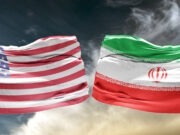

The on-again, off-again so-called peace deal in the U.S.-Israel war against Iran was again in question as controversy surrounded a June 11 pronouncement by President Donald Trump that a Memorandum of Understanding (MOU) was near completion that would stop the fighting.
Hours after his announcement to the press at the White House, Iran’s news agency IRNA published points in the agreement causing Mr. Trump to lash out.
According to firstpost.com, points included: Permanent and immediate cessation of war on all fronts, including Lebanon; complete lifting of the naval blockade within 30 days; and reopening of the Strait of Hormuz within 30 days under arrangements determined by Iran, among others.
The information amounts to “Fake News” that has “NOTHING to do with the terms that were agreed to, in writing,” the president wrote on his Truth Social site.
The leaked information amounts to “Fake News” that has “NOTHING to do with the terms that were agreed to, in writing,” the president wrote on his Truth Social site.
He wrote that Iranian authorities are “Very dishonorable people to deal with. … They better get their act together, and FAST!”
Iran’s Foreign Minister Seyed Abbas Araghchi posted on X that, in fact, an MOU “has never been closer.” He called on media outlets to “refrain from entering speculation about its content.”
The MOU agreement stipulates there would be a cessation of fighting for 60 days while the finer points of contention are hammered out, according to press reports.
Parties in agreement with the MOU in its current form include Israel, Saudi Arabia, United Arab Emirates, Qatar, Turkey, Pakistan, Bahrain, Kuwait, Jordan, Egypt, and others, President Trump acknowledged in a Truth Social post, adding the U.S. Naval blockade of Iran would remain until the agreement is signed.
At Final Call presstime, President Trump announced yet again that a peace deal had been reached. The Iranian outlet PressTV.ir, reported on June 14 that.
“The secretariat of Iran’s Supreme National Security Council (SNSC) has confirmed that Tehran and Washington have finalized the text of a memorandum of understanding (MoU) on ending the war, bringing an immediate and permanent halt to military operations on all fronts, including Lebanon, and terminating the US naval blockade against Iran.”
In an April ceasefire agreement, Iran stipulated lifting of U.S. sanctions and unfreezing of Iranian assets, continued Iranian control of the Strait of Hormuz, reparations for damage done in the war, the withdrawal of U.S. forces from bases in the region, among other demands, many of which still stand.
U.S. Vice President JD Vance recently addressed some of these points: “If the Islamic Republic of Iran meets its obligations, then economic benefits will flow to them and to the entire region,” he posted on X.
On the other hand, the U.S. Treasury Department has announced it will use Iranian assets to help America’s Gulf allies to recover from war damages caused by Iran, according to cbsnews.com.
Days before the MOU announcement, President Trump increased attacks on Iran partly because of the downing of a U.S. Apache helicopter over the Strait of Hormuz but also because Iranians were “taking too long” to reach an agreement.
He announced through Secretary of Defense Pete Hegseth that the U.S. would “negotiate with bombs.” The president also announced a desire to capture Kharg Island, an important Iranian port to store oil.
“At some point in the not too distant future, we will be taking Kharg Island, and other oil infrastructure points, and assume total control of their Oil and Gas Markets, much like we have with Venezuela …” Mr. Trump said on social media.
The U.S. already has enforced a Naval blockade on Iranian shipments. Capturing the island would almost certainly involve U.S. boots-on-the ground, a situation the president said the American public probably would not support.
“Iran is not Venezuela,” commented historian and University of Houston professor Dr. Gerald Horne, adding that President Trump’s persistent promises of ceasefires and peace deals “is an attempt to manipulate the price of oil and stock markets.”
Critics have consistently voiced frustration with the president’s regular contradictory announcements regarding ceasefires and pending peace agreements. Bombs have fallen throughout the April 8 “ceasefire” announcement, partly due to violations from Israel through their attacks against Hezbollah resistance fighters in Lebanon.
At one point, the disagreement grew into a public spat with President Trump scolding Israeli Prime Minister Benjamin Netanyahu for potentially derailing a peace deal.
Who’s in charge?
When Iran launched a June 7 attack on Israel in retaliation for an Israeli assault on Hezbollah in Lebanon, President Trump appealed to Prime Minister Netanyahu to stand down and not retaliate.
“I call all the shots. He doesn’t call the shots,” the U.S. president was quoted saying in response to a question from reporters. The next day, Israel launched attacks into Iran, apparently ignoring Mr. Trumps appeal.
The public disagreements have observers wondering who’s in charge.
Dr. Wilmer Leon, professor of Political Science at Morgan State University, doesn’t consider either leader “in charge” of the direction of the war.
“When you look at how much money AIPAC (American Israel Public Affairs Committee) has poured into this, when you look at the interests of Lockheed Martin and McDonnell Douglas, and General Electric, the military industrial complex is in charge of this,” he declared.
“When you look at Shell Oil, ExxonMobil, they’re in charge of this. Donald Trump is merely a figurehead.”
Dr. Leon said the U.S. and other western nations want to maintain the “settler colonial project known as Israel” in the region and western Christian Zionists have a religious interest in maintaining the status quo.
“I think it was (former president) Joe Biden who said, ‘if Israel didn’t exist, we would create one,’” he noted. “Then you have the Christian Zionists and their interest as it relates to Armageddon and the whole belief of the rapture.”
Appearing at a recent Congressional hearing, Secretary of State Marco Rubio was asked by Rep. Joaquin Castro (D-TX.) whether Israel has nuclear weapons. Rep. Castro prefaced his question stating that he and 29 other representatives wrote Rubio a letter expressing the need to understand the “full risk, including the nuclear risk” involved in the Iran war. With American soldiers in the region, Congress needs to know if Israel would use nuclear force, he implied.
Rep. Castro said the response from Rubio’s Bureau of Legislative Affairs department was Congress should “ask Israel,” a response he described as “very bizarre.”
“Will you tell us … whether Israel, in fact, possesses nuclear weapons?” he asked.
The secretary did not answer the question directly, saying only that “most of the world assesses that they do.” The question was more appropriate for a “classified and sensitive” setting, Sec. Rubio said.
“The reason he can’t answer that question,” said Dr. Leon, “is because as soon as he admits that Israel has a nuclear weapon, that changes the legal dynamics that the United States now finds itself engaged in.”
The Honorable Minister Louis Farrakhan has warned America about her efforts to destabilize foreign nations and warned Muslim leaders to stand united.
“Iranians have the right to resolve their own problems without outside interference, just as the U.S. has claimed its right to conduct elections free of Russian influence,” Minister Farrakhan said in a statement regarding his 2018 trip to Iran and message to Iran and America. Self-determination is a right of every nation, Minister Farrakhan said.
“The Muslim World needs unity and must find the path to reconciliation despite efforts to pit Muslims against one another. Satan seeks to divide Muslims and wants them to kill each other, while Allah God tells us in the Qur’an to be united.”
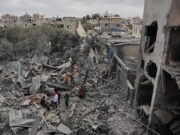
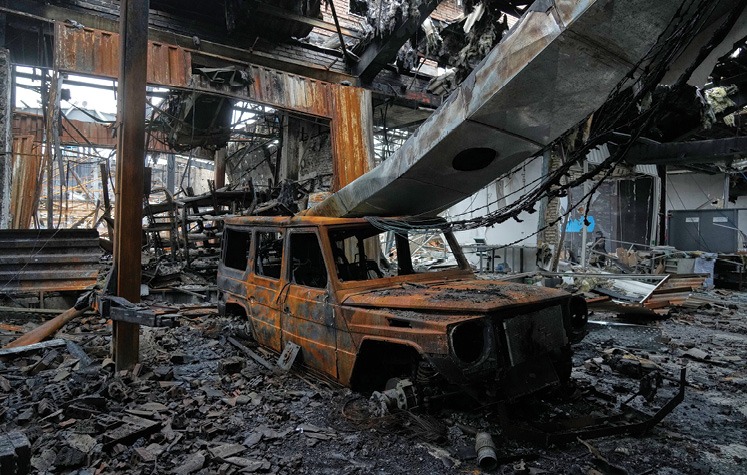
A view of the damages at Hypercar, an auto service center, which according to the company’s officials were caused by strikes on March 1, in Tehran, Iran, March 28. Photo: AP/Vahid Salemi
