





WASHINGTON—In a move that many observers are calling the most aggressive escalation of the decades-long U.S. economic war against Cuba, President Donald J. Trump signed a sweeping new Executive Order aimed at severing the island’s remaining energy lifeline.
The recent order declares a “national emergency” regarding the government of Cuba, erroneously characterizing the Caribbean nation as an “unusual and extraordinary threat” to U.S. national security. Most significantly, the directive establishes a mechanism to impose punitive trade tariffs on any third-party nation that exports oil to Cuba.
The primary target of this “secondary sanction” strategy is Mexico, which has served as a critical energy lifeline for the island since the recent U.S. military operation in Venezuela kidnapped President Nicolás Maduro and his wife. Both are still being detained in New York.
Under the new order:
• Secondary tariffs: The U.S. is authorized to identify countries supplying oil to Cuba and impose tariffs on their goods entering the U.S. market.
• Total blockade strategy: President Trump stated via social media that there will be “zero” oil or money going to Cuba, asserting the government is “ready to fall.”
• Security allegations: The White House justifies the move by alleging Cuba provides a safe haven for groups like Hezbollah and Hamas and maintains “malign” alliances with Russia and Iran.
This latest move by the U.S. government is further evidence of what the Honorable Minister Louis Farrakhan calls “America’s errant foreign policy.” In part 13 of Minister Farrakhan’s 58-week lecture series, “The Time and What Must Be Done,” he stated the following:
“The American people would like to know: ‘Why is it that we are hated in the world?’ because America’s view of herself is that ‘we are a good nation.’ And by and large if the people knew better, most of them would do better; but, at ‘the top of things’ you have a satanic, demonic mind that is the architect of America’s foreign policy.
And this foreign policy has objectives and national interests. But the American people don’t know, necessarily, what those ‘interests’ are, and they don’t necessarily know what the ‘foreign policy objective’ of their government is toward the nations and people of the Earth.”
Havana and Mexico denounce ‘imperial hegemony’
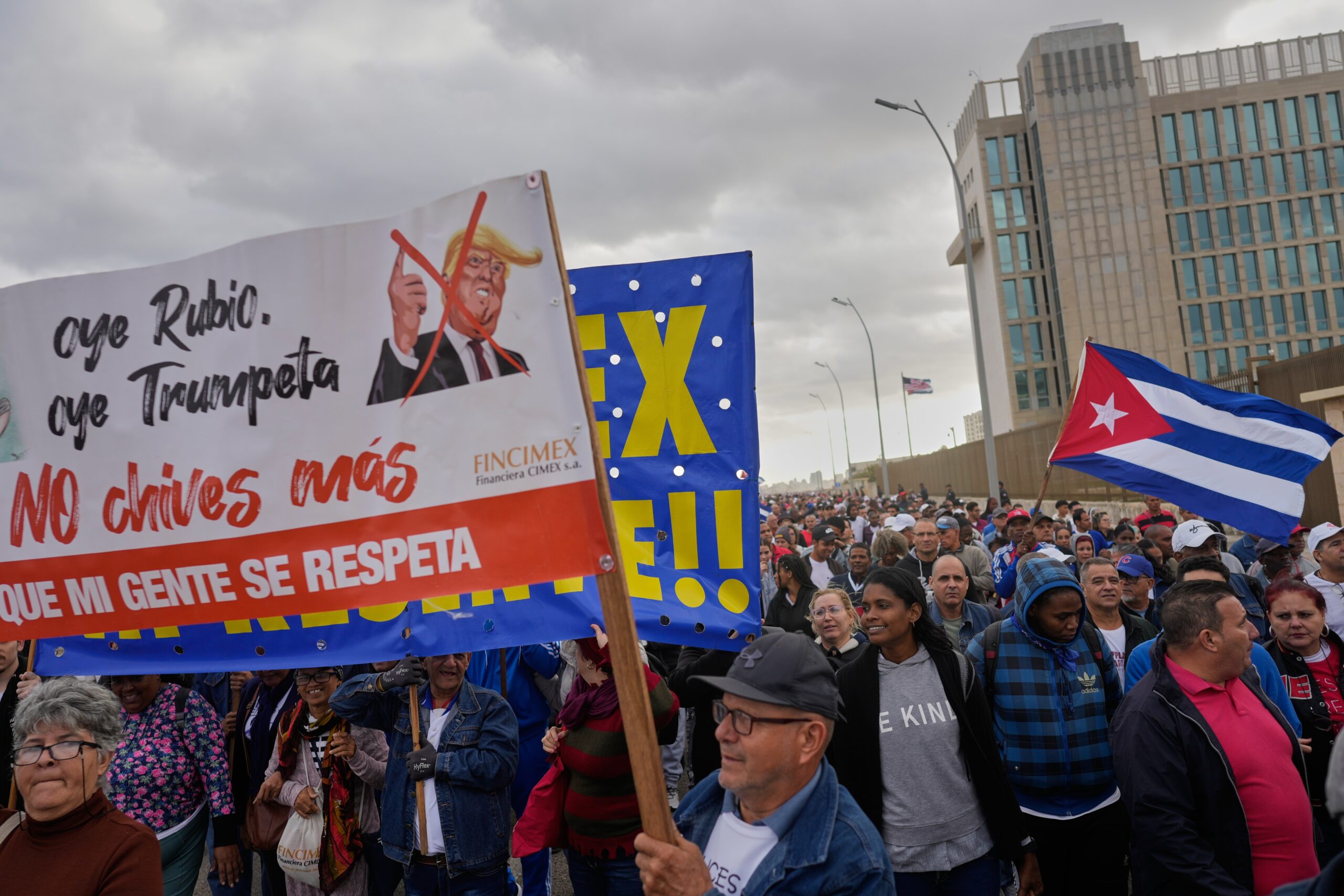
The Cuban government’s response to President Trump’s Executive Order was swift and defiant. In a recent official statement, the revolutionary government condemned the order as a “new escalation” designed to impose a “total blockade” on fuel supplies. Havana dismissed the “national emergency” declaration as a pure fabrication.
“With this decision, the United States government, through blackmail, threats, and direct coercion of third countries, is attempting to impose additional pressure on the economic suffocation measures that have been in place since Trump’s first term to prevent fuel from entering our country.
It consolidates a dangerous way of conducting U.S. foreign policy by force and exercising its ambitions to guarantee its imperialist hegemony. As announced, that country claims the right to dictate to sovereign states which nations they can trade with and to which they can export their domestic products,” the Jan. 30 statement reads.
Cuba’s President Miguel Diaz-Canel posted a series of responses on social media, one of which stated, “This new measure demonstrates the fascist, criminal, and genocidal nature of a cabal that has hijacked the interests of the American people.
Under a mendacious and baseless pretext … President Trump intends to strangle the Cuban economy by imposing tariffs on countries that sovereignly trade oil with Cuba.”
Mexican President Claudia Sheinbaum warned of dire consequences if Mexico halts oil shipments to Cuba. This concern arises after Mexico became Cuba’s leading supplier, replacing Venezuela, following the U.S. military’s Jan.
3 abduction of President Nicolás Maduro and the subsequent control of Venezuela’s energy sector. According to several media reports, over 30 members of Cuba’s armed forces and intelligence agencies were killed in the January 3 attack.
“Applying tariffs on countries that supply oil to Cuba could trigger a far-reaching humanitarian crisis, directly affecting hospitals, food, and other basic services for the Cuban people, a situation that must be avoided,” President Sheinbaum said at a press conference. “We will seek a way, without putting Mexico at risk, of course, but always seeking solidarity with the Cuban people.”
UN raises alarm over humanitarian fallout
At the United Nations, the international community responded with sharp condemnation. The move is viewed as a direct challenge to the body’s long-standing consensus, as the UN General Assembly (UNGA) recently voted for the 33rd year to end the U.S. blockade on Cuba.
The Deputy Spokesperson for the UN Secretary-General, Farhan Aziz Haq, recently reiterated the United Nations’ position in favor of lifting the U.S. blockade against the island nation.
“As you know, the General Assembly has repeatedly called for an end to the blockade against Cuba,” the spokesperson stated in response to a question from Prensa Latina regarding the tightening of this policy, following the new executive order by the Trump administration to unilaterally impose coercive tariffs on countries that sell oil to the Caribbean nation.
“We urge all Member States to comply with the resolutions of the General Assembly,” he said.
According to the UN, the economic, commercial, and financial blockade against Cuba constitutes a unilateral, coercive, and extraterritorial policy that violates International Law and the purposes and principles of the UN Charter.
After 65 years of implementation, the unjust U.S. blockade’s main goal remains unchanged: to degrade the population’s quality of life and cause dissatisfaction, despair, and irritation. This is intended to provoke a shift in the constitutional order freely elected by the Cuban people.
The U.S. administration continues to ignore the nearly unanimous call from the international community to end this illegal and inhumane policy against Cuba, as expressed in 33 UN General Assembly resolutions.
“This is a cowardly and coercive measure that stems from a cowardly and coercive political culture. The bottom line is U.S. Imperialism will continue to attempt to diplomatically isolate and stifle Cuba until there is an eruption inside U.S. borders, that matches the disgust of the whole planet, who has said enough is enough,” Obi Egbuna Jr., External Relations Officer to the Zimbabwe Cuba Friendship Association, told The Final Call.
A people facing uncertainty
On the ground in Havana, the atmosphere is one of mounting anxiety. The island is enduring its worst energy crisis in years, with frequent blackouts and less than 20 days of fuel reserves remaining.
While Washington maintains the goal is to negotiate a “transition away from an authoritarian system,” critics argue the strategy is a deliberate attempt to trigger a humanitarian collapse.
“However, oil will go to Cuba, and their suppliers will bypass the U.S. and find other trading partners,” international community activist Luci Murphy told The Final Call. “Causing the U.S. market to contract. His trade policies are already crippling the buying power of ordinary people in the U.S.”
Helen Cairo has lived in Old Havana her entire life. “What about the Cubans? Do they want what Trump wants?” she told The Final Call. “It’s really a crime for us. We have too many difficulties now. This will kill us,” she said.
As the international community grapples with the challenge posed by this “might makes right” U.S. doctrine, the Cuban government remains resolute. “We will face this new attack with firmness, equanimity, and the certainty that reason is absolutely on our side. The decision is one: “Homeland or Death, We Shall Overcome!” the Cuban government’s Jan. 30 statement concluded.
