











WASHINGTON—One year into President Donald Trump’s second term, a new economic analysis reveals that American families—particularly Black and low-income households—face rising costs for basic necessities, declining job opportunities, and increasing economic uncertainty, according to a recent report released by the Center for American Progress, a Washington-based policy institute.
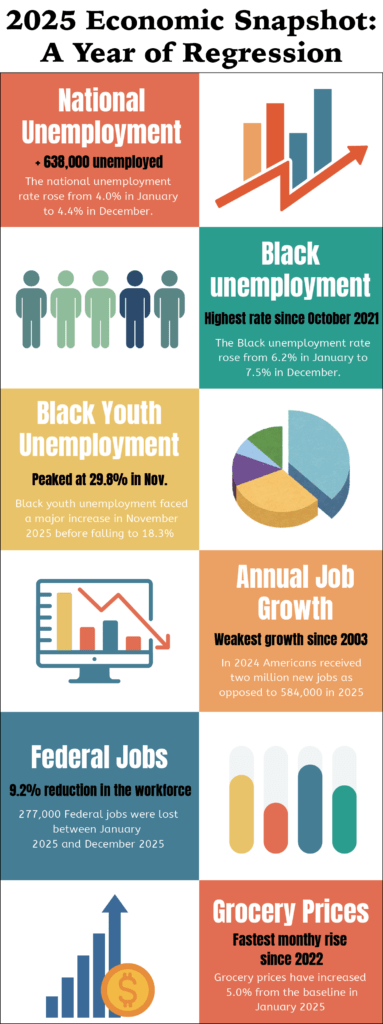
The Center for American Progress analysis found that the administration’s tariff policies alone cost American households an average of $1,700 annually, with clothing prices jumping 14% from pre-tariff levels. The tariffs also added approximately $17,500 to the cost of building a new home.
Grocery prices—a critical concern for families already struggling—rose at their fastest monthly pace since fall 2022 last December, with a typical grocery basket costing about 5% more than a year earlier. Nearly half of Americans reported difficulty affording food.
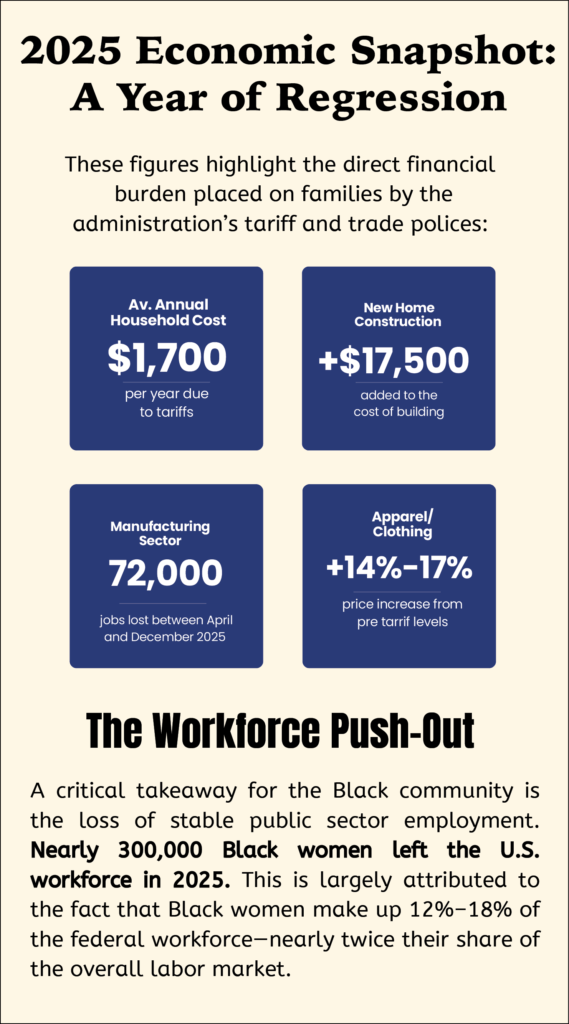
The unemployment rate climbed from 4.0% in January 2025 to 4.4% by December, leaving 638,000 more workers unemployed. Total job growth fell to just 584,000 positions—the weakest annual performance outside a recession since 2003.
Black communities feel disproportionate impact
The employment picture for Black Americans deteriorated dramatically over the past year, according to the “State of the Dream” report produced by the Joint Center for Political and Economic Studies. Black unemployment increased to 7.5% by December 2025 from 6.2% in January—a rise of 1.3 percentage points in a single year.
“The data in State of the Dream 2026 shows that 2025 represented both a regression and a recession for African Americans,” said Dedrick Asante-Muhammad, president of the Joint Center for Political and Economic Studies, in a press release.
“Rising Black unemployment, the elimination of federal jobs, and the withdrawal of protections and investments that have historically helped Black communities weather economic shocks point to the urgent need for deliberate action to reverse course.
I am grateful to continue ensuring that the dream Dr. King articulated remains both measurable and achievable for Black Americans.”
Most alarming in the report were the fluctuations in Black youth unemployment, which swung from 18.6% in September to a devastating 29.8% in November before dropping back to 18.3% in December. These wild swings reflect deep instability in job opportunities for young Black workers.
The data shows that if Black people had maintained the same prime-age employment rate in 2025 as in 2024, approximately 260,000 more prime-age Black people would have been working. Of this number, about 200,000 were prime-age Black women.
“These are more than just numbers. They are our mothers, our sisters, our daughters who can’t find work or who’ve been pushed out of jobs they had,” said Patricia Langston, a laid-off D.C.-based federal worker still looking for a job. “Every one of those 200,000 women represents a family struggling to keep food on the table.”
Research shows that nearly 300,000 Black women left the U.S. workforce in 2025, attributed in part to federal layoffs. Federal employment has long provided stable, well-paying jobs for Black women, who make up more than 12% of the federal workforce—nearly twice their share of the overall workforce.
The timing of these economic challenges recalls the warnings and guidance of the Most Honorable Elijah Muhammad, the Eternal Leader of the Nation of Islam, who consistently taught that Black people in America would face economic hardship regardless of which political party held power, and that our salvation lies in pooling resources and doing for self.
“If we recognize the need for unity and begin to pull our resources, we could become very strong, economically,” the Honorable Minister Louis Farrakhan said in a tribute to Black entrepreneur Joe L. Dudley Sr. That message, titled “Our Unity And Pooling Resources For Economic Strength,” was delivered May 21, 2016, and is just as applicable and relevant today.
Administration defends economic record
The Trump administration has pushed back against criticisms of its economic policies. However, while rising prices grip many Americans, the president has conducted what the White House calls a series of speeches addressing the “affordability” problem, which he recently dismissed as “the greatest con job” ever conceived by Democrats.
Treasury Secretary Scott Bessent recently spoke in Minnesota and credited President Donald Trump’s tariffs, saying they have encouraged corporations to invest in the U.S. The long-term consequences of President Trump’s tariffs are yet to be determined. Although the U.S. trade deficit has decreased considerably, manufacturing jobs have continued to dwindle.
Muhammad’s Teaching: Do for self
The Most Honorable Elijah Muhammad taught that Black people should not place their hope in political parties or politicians, as both Democrats and Republicans have historically failed to address the fundamental needs of Black communities.
He addressed this in His 1965 book, “Message to the Blackman in America,” in the chapter, “The National Election.”
“How much good have the two parties (Republican and Democrat) done for us for the last century in the way of freedom, justice, and equality? Regardless of what party wins, the die is always set against us (the Black people in America),” He wrote.
The current economic data bear out what the Most Honorable Elijah Muhammad pointed out. Economists note that low-income households—disproportionately Black and Brown—bear the heaviest burden from tariffs because they spend a larger proportion of their income on essentials like food, clothing, and household goods.
“With the constantly changing tariffs, one constant remains certain: low-income households will disproportionately feel the effects more than the average American,” Algernon Austin, economist and director of race and economic justice at the D.C.-based Center for Economic and Policy Research, told the media.
The Teachings of the Most Honorable Elijah Muhammad offer a blueprint for navigating economic hardship through unity and doing for self. He taught and demonstrated the importance of pooling resources, supporting Black businesses and acquiring land.
“Why should we depend on ourselves?” asked Minister Farrakhan, in a message published in The Final Call, April 15, 1988, titled “We Must Depend On Allah and Ourselves.”
“There is an old saying that God helps those who help themselves, and we are taught in the Holy Qur’an, ‘Surely Allah changes not the condition of a people, until they change their own condition,’” Minister Farrakhan stated.
Looking ahead
Nearly 70% of Americans expect economic difficulty in 2026, according to polls. Healthcare costs have increased after the Affordable Care Act’s premium tax credits expired, with marketplace premiums projected to rise 114%. Utility bills are rising nationwide, with states expected to pay $86 billion in rate increases by 2028.
While the administration claims its policies will help workers and GDP growth remains strong, many families—especially in Black communities—experience different realities.
“WE MUST DEPEND ON ALLAH AND OURSELVES,” Minister Farrakhan said in his 1988 message.
“Let every Muslim get up with a mind to work. Let every believer determine there is no help for us but the help of Allah (God) and ourselves. And let us show the world that Allah (God) is sufficient for the Believers. On Him let the Believers rely!”
