









The African American Mayors Association (AAMA), National Forum for Black Public Administrators (NFBPA) and National Organization of Black Law Enforcement Executives (NOBLE) are partnering to help build safer communities, more equitable systems, and stronger public trust.
Their aim is to build stronger relationships between professionals serving in administrative roles and those in law enforcement, and increase public awareness in Black communities on important issues such as public safety, community policing and city administration.
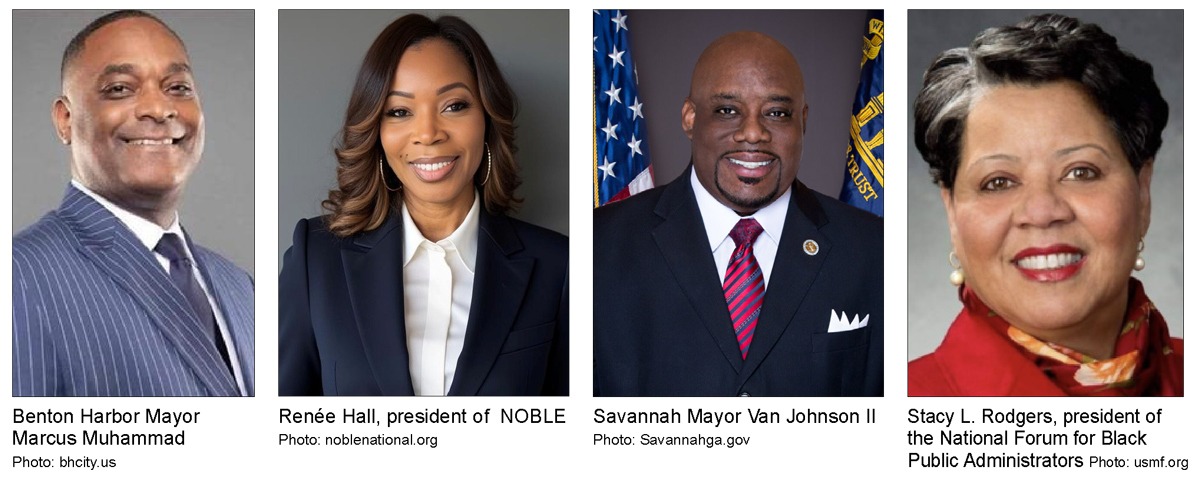
“As President of AAMA, I want to be clear that this partnership is intentionally national in scope and local in execution. Our forums, workshops, and leadership development programs will be hosted in cities across the country, with a strong emphasis on communities led by African American mayors and administrators,” stated Van Johnson II, who is also mayor of Savannah, Georgia.
The three organizations will also leverage major convenings already hosted by AAMA, NFBPA, and NOBLE, including their national conferences and regional meetings, to launch joint programming. The first pilot forums and leadership workshops were slated to begin in late 2025 with additional programming rolling out in early 2026, according to Mr. Johnson.
“We are being deliberate about sequencing, starting where there is readiness, strong local leadership, and the ability to scale best practices, so that what we build is sustainable, measurable, and impactful,” he told The Final Call.
“This partnership grew out of both urgency and opportunity,” he continued. For decades, Black mayors, Black city managers, and Black law enforcement executives “have often been working toward the same goals, safer communities, more equitable systems, and stronger public trust, but too often in parallel rather than in partnership,” Mr. Johnson explained.
“I say this not just as AAMA president, but as someone who has been a proud member of both NOBLE and NFBPA for decades. I’ve seen firsthand the power of each organization individually, and I’ve also seen the missed opportunities when organizations serving different segments of the Black community don’t fully align around shared interests,” stated Mr. Johnson.
The collaboration was sparked by a shared recognition that the current moment demands coordination, he said. It also comes on the heels of record double-digit declines in crime reduction throughout the country in violent crimes like homicide, robbery, and assault, continuing a trend from 2024, and a greater focus on mental health outcomes.
According to Mr. Johnson, cities are seeing meaningful progress in public safety, communities are demanding more transparency and equity, and there is a growing need to build pipelines for Black leadership in administration, public safety, and governance.
Rather than reinventing the wheel, the three groups chose to work together because organizations that serve specific segments of the community are strongest when they collaborate for the collective good.
“Equally important, we are grounding this partnership in what mayors, administrators, and police chiefs are seeing on the ground: that enforcement alone is not enough.
There is an increasing reliance on co-responder models, crisis intervention teams, diversion programs, and trauma-informed approaches that address mental health and substance use as public safety issues,” said Mr. Johnson.
“Public safety, effective governance, and community wellbeing are deeply connected,” said Stacy L. Rodgers, president of the National Forum for Black Public Administrators. “By aligning administrators, mayors, and law enforcement leaders, we are building stronger pipelines for leadership, improving public trust, and advancing solutions that strengthen communities nationwide,” she said.
“The National Organization of Black Law Enforcement Executives is honored and excited to join in partnership and in service with the African American Mayors Association and the National Forum for Public Black Administrators.
We are confident that this partnership will strengthen public safety in all our communities while helping to ensure equity in the administration of justice,” said Reneé Hall, national president of NOBLE.
As their partnership matures, AAMA, NFBPA, and NOBLE plan to jointly compile and publish summaries of best practices, data snapshots, and policy briefs drawing from existing public reports and member-city outcomes. Central to their effort will be transparency and evidence-based decision-making.
“At the end of the day, this partnership reflects a simple truth: public safety, effective governance, and community well-being are inseparable. When Black-led institutions work together, and invite others to do the same, we create pathways not just for leadership, but for lasting progress that benefits all our constituents,” Mr. Johnson added.
The partnership plans to engage community activists, faith leaders, health professionals, civic organizations, and community-based groups to build safer, healthier, and more equitable communities.
Benton Harbor, Michigan, Mayor Marcus Muhammad explained that it is critically important to develop partnerships, alliances and build and foster relationships to maximize the opportunity to provide the best service to their constituents.
A long-standing model for him, from a biblical perspective, is from John 5:30, “I can of myself do nothing,” he shared. “Reaching out and using the Office of the Mayor to call agencies, organizations, nonprofit groups, etc., for the betterment of our communities, mine in particular, is a great way to improve the quality of life for residents,” he said.
Mayor Muhammad believes there is a nationwide shift in Black communities where people are beginning to see that they are stronger together and work more closely together, through churches, organizations, civic and religious groups.
“From my perspective, it is a result of the Million Man March, the Million Family March, the Millions More Movement, 10/10/15 (‘Justice or Else’), down to the 30th Anniversary of the Million Man March,” stated Mayor Muhammad.
He was referring to the Honorable Minister Louis Farrakhan’s historic call for one million Black men (and two million responded) to meet him in Washington, D.C., on October 16, 1995. Minister Farrakhan introduced the process of atonement, reconciliation and responsibility to the men and to a global audience.
The subsequent gatherings called by Minister Farrakhan attracted tens of thousands of more people of various backgrounds. Minister Farrakhan, like his teacher, the Most Honorable Elijah Muhammad, have taught Black people and organizations the importance of unity and working together.
There has been an ongoing march amongst Black leadership, in spite of the onslaught that has been attacking Black communities in many different ways, Mayor Muhammad explained.
But the results of the resilience of Black people in America are beginning to manifest, he observed, adding: “There is no group that the Honorable Minister Louis Farrakhan has not spoken to in his 70 years of ministry.
He’s spoken to the police league, the psychologists, the lawyers, the journalists. In every professional sector of Black life, the Honorable Minister Louis Farrakhan has delivered a message of upliftment and positivity. And I believe that the seeds that were planted yesterday are sprouting today,” he added.
The new collaboration’s plans include in part:
Working together to develop and deliver community policing education programs.
Providing training and leadership development for Black professionals in law enforcement and public safety, with emphasis on ethical policing and community responsiveness.
Collaborating on data-driven initiatives that address disparities in policing outcomes and promote restorative justice practices.
Championing recruitment and retention strategies that diversify law enforcement agencies and reflect the communities they serve.
“This is what’s needed, that the experience of Black law enforcement officers that are conscious, I’ve got to make that clear, because not all ‘skinfolk’ is our kinfolk, but that are conscious, unite with Black civic leaders,” said Damon K. Jones, the New York representative of Blacks in Law Enforcement of America and former Northeast regional president of the National Black Police Association.
He is excited about the new opportunities for recommendations by Black law enforcement organizations to be received by Black politicians and applauds the partnership.
It is long overdue that Black elected officials and law enforcement will officially sit down and collaborate on issues of criminal justice, police reform, and community relations and policing, Mr. Jones told The Final Call.
—Charlene Muhammad, National Correspondent
