










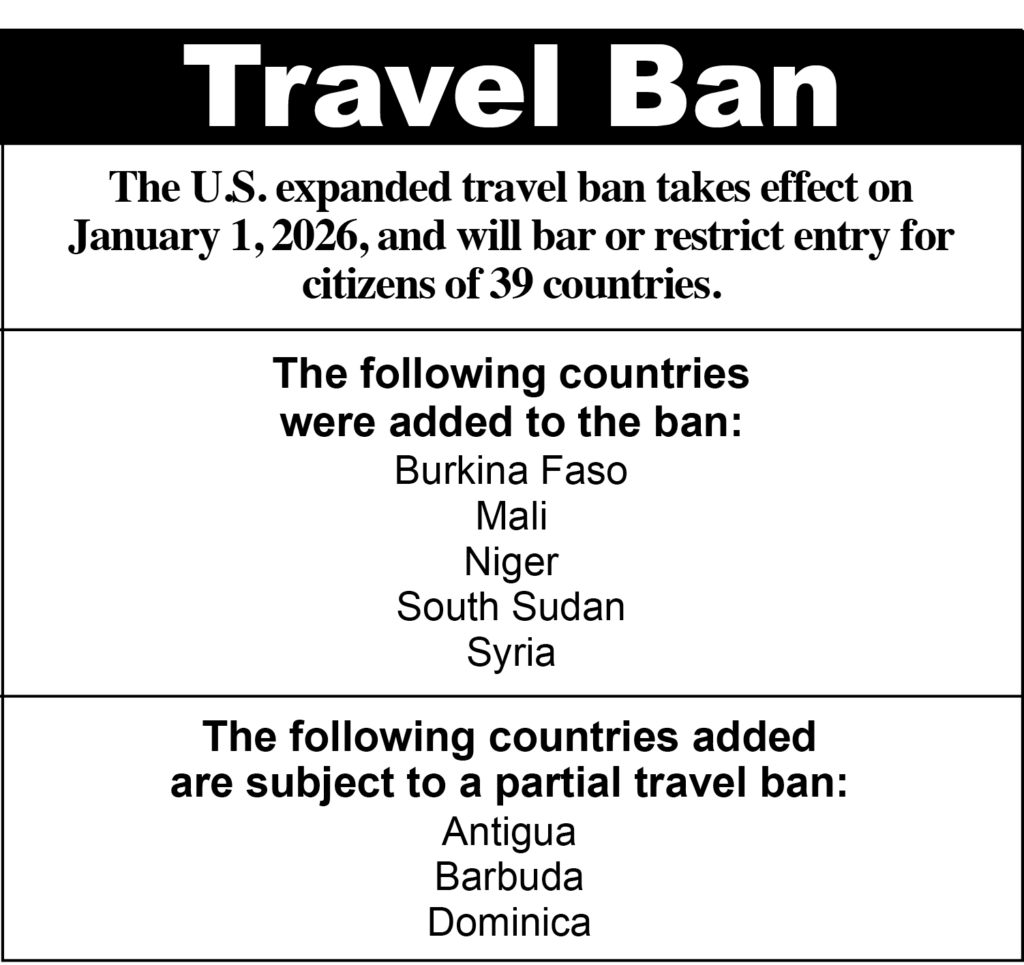
WASHINGTON, D.C.—The Trump administration expanded its travel ban, unveiled December 16 and set to take effect January 1, 2026, which now bars or restricts entry for citizens from 39 countries—including Burkina Faso, Mali, Niger, South Sudan, and Syria—and prohibits travel on Palestinian Authority–issued documents.
The policy also imposes partial restrictions on citizens of numerous African, Caribbean, and other nations, a dramatic broadening of immigration limits first announced in June.
The White House defends the action as necessary to protect national security, citing concerns about vetting, documentation, high visa overstays, and poor information-sharing with U.S. authorities. It frames the expanded list as targeting countries whose systems make it difficult to screen and assess the risk posed by foreign nationals seeking entry.
However, key lawmakers and civil society groups have condemned the policy as discriminatory, harmful to families, and contrary to the so-called U.S. values of fairness and inclusion. Nearly half of the 39 countries banned or restricted are Muslim-majority nations.
Congressional Black Caucus responds
The Congressional Black Caucus (CBC) reaffirmed its longstanding opposition to travel bans that disproportionately affect Black and majority-Black nations.
In June 2025, CBC Chair Rep. Yvette D. Clarke (D-N.Y.) and members condemned the previous iteration of the travel ban—which then targeted 19 countries—as “a blatantly cruel and racist attempt to prevent select foreign nationals from accessing opportunities.” They criticized the policy for perpetuating family separation and demonizing vulnerable communities.
While the CBC has not yet issued a separate statement on the latest expansion, its June declaration signals that the caucus views such sweeping restrictions as rooted in ethnic and regional bias rather than in legitimate security needs.
Members have emphasized that immigrants built the United States and that policies singling out entire regions under the guise of security undermine core American principles.
Black immigrant organizations sound alarm
African Communities Together, which advocates for African immigrant communities, strongly condemned the expanded restrictions. Diana Konaté, the organization’s Deputy Executive Director of Policy and Advocacy, stated the policy “advances his quest to shut down any pathway to citizenship for Black and Brown immigrants,”
She said, referring to President Trump. She also said the move “further isolates the United States and deprives our nation of the expertise, culture, and humanity that immigrants bring.”
In an earlier statement on the June ban, African Communities Together described the policy as “unjustified, racist, and dangerous,” emphasizing that it “blocks people from 12 countries from entering the United States and imposes restrictions on seven more—cementing a legacy of xenophobia and racism against Black and Brown communities.”
The Coalition of Haitian-American Organizations in the Chicagoland Area and the United African Organization issued a joint statement characterizing the policy as one that “endangers lives, fuels anti-Black and anti-immigrant sentiment, and dishonors the contributions of Haitian and African immigrants.”
Refugee advocates warn of possible humanitarian crisis
Human Rights First called the December expansion “a sweeping act of collective punishment” that “stigmatizes entire nationalities, relies on fear and generalizations, and doubles down on policies that have already caused enormous human suffering.”
Uzra Zeya, president and CEO of Human Rights First, noted that “Twenty-six of the 54 nations on the African continent are now banned from travel to the United States, which is a truly unconscionable moment in our history.”
The International Refugee Assistance Project called the expanded ban “another shameful attempt to demonize people simply for where they are from.” Laurie Ball Cooper, IRAP’s vice president of U.S. Legal Programs, emphasized the policy is “not about national security.”
Global Refuge President and CEO Krish O’Mara Vignarajah criticized the administration for “using the language of security to justify blanket exclusions that punish entire populations, rather than utilizing individualized, evidence-based screening.”
She expressed particular alarm that the ban targets “countries experiencing active conflict, humanitarian crises, or widespread persecution, such as Afghanistan, Sudan, South Sudan, Syria, and Haiti.”
The National Immigration Law Center (NILC) also issued a public response objecting to the ban, with Vice President of Strategy and Partnerships Raha Wala denouncing the move as arbitrary and discriminatory for barring larger numbers of people of color without individualized risk assessments.
NILC’s statement framed the policy as inconsistent with both historical U.S. immigration diversity and sound security practice.
Impact on families and students
The restrictions block both immigrant and certain non-immigrant visas, including student, tourist, and business travel visas. The December proclamation also narrows previous family-based exceptions, making it significantly harder for U.S. citizens to reunite with immediate family members from targeted countries.
Nigeria, one of the top sources of international students to the United States, now faces partial restrictions that will prevent Nigerian nationals from receiving student visas beginning January 1. The proclamation includes limited exceptions for lawful permanent residents, existing visa holders, specific visa categories such as athletes and diplomats, and individuals whose entry is deemed to serve U.S. national interests.
The African Union urged the United States to protect its borders “in a manner that is balanced, evidence-based, and reflective of the long-standing ties and partnership” between the U.S. and African nations, warning of “the potential negative impact of such measures on people-to-people ties, educational exchanges, commercial engagement, and the broader diplomatic relations.”
Human rights organizations and immigrant advocacy groups indicated they are evaluating potential legal challenges to the expanded restrictions.
What’s next?
With the expanded ban scheduled to begin on January 1, 2026, legal challenges and legislative pushback are expected to intensify. Civil rights and immigration advocacy groups have suggested litigation based on discrimination and procedural grounds, and congressional leaders are gearing up for renewed debate over broader immigration reform as the policy’s human and diplomatic impacts come into sharper focus.
