


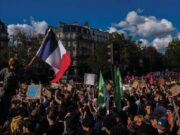
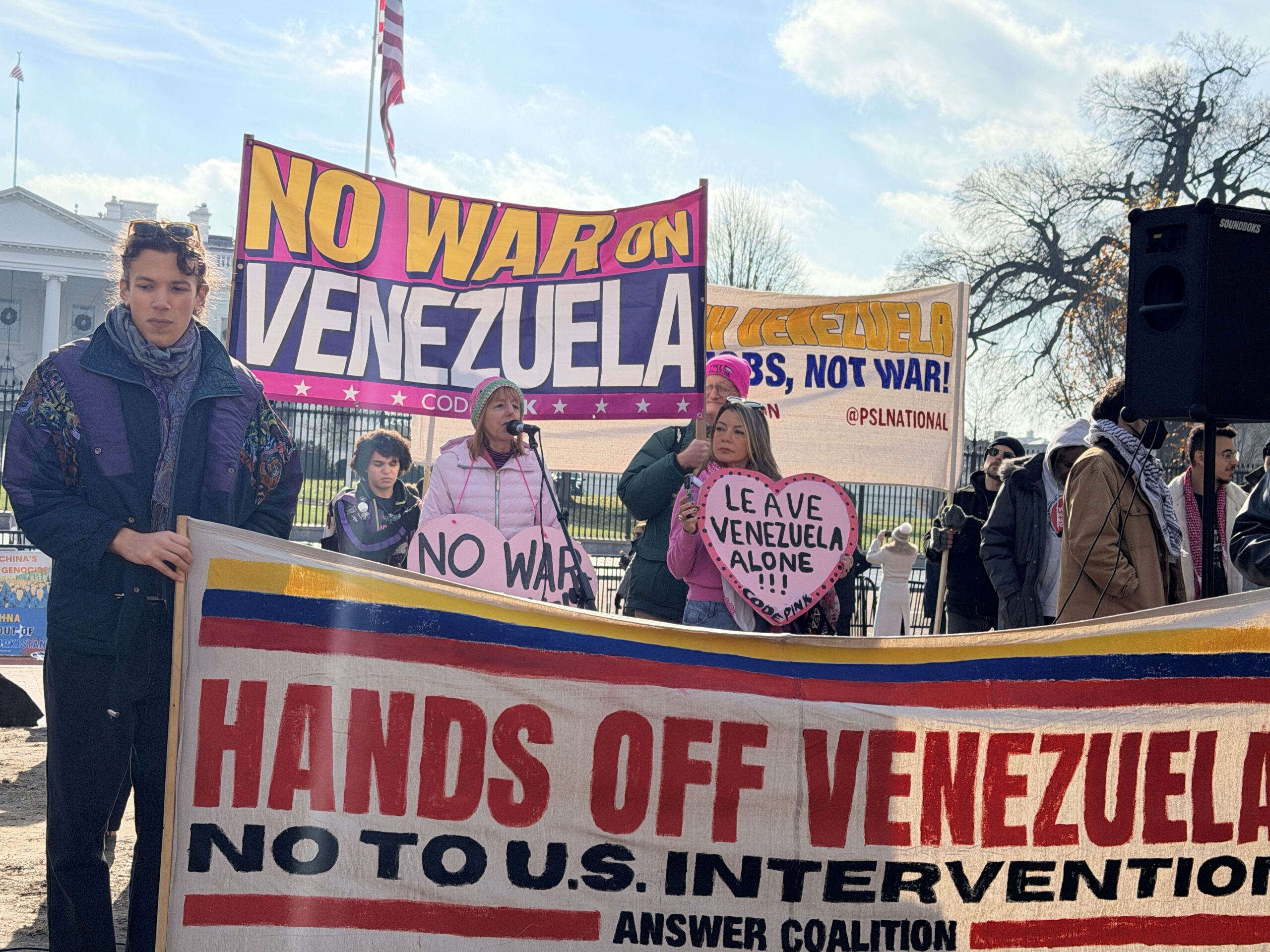

WASHINGTON, D.C.—Demonstrators gathered outside the White House as part of the coordinated “No War in Venezuela” protests spanning 63 cities nationwide. Organizers described the moment as urgent, pointing to growing fears that the administration may escalate military action in Latin America.
The D.C. event held Dec. 6 drew hundreds to Lafayette Square, where speakers from anti-war organizations and other allied groups urged immediate public pressure to stop any march toward war. The rally unfolded in front of the White House, which protesters framed as the center of a brewing foreign-policy crisis.
Brian Becker of the ANSWER (Act Now to Stop War and End Racism) Coalition argued that public action could shape the administration’s next steps. “There is a battle going on over whether or not the Trump administration should actually go forward and launch an all-out war against Venezuela,” he told the crowd.
He accused Wall Street, the military-industrial complex, and federal immigration forces as the true sources of harm, not the people of Venezuela.
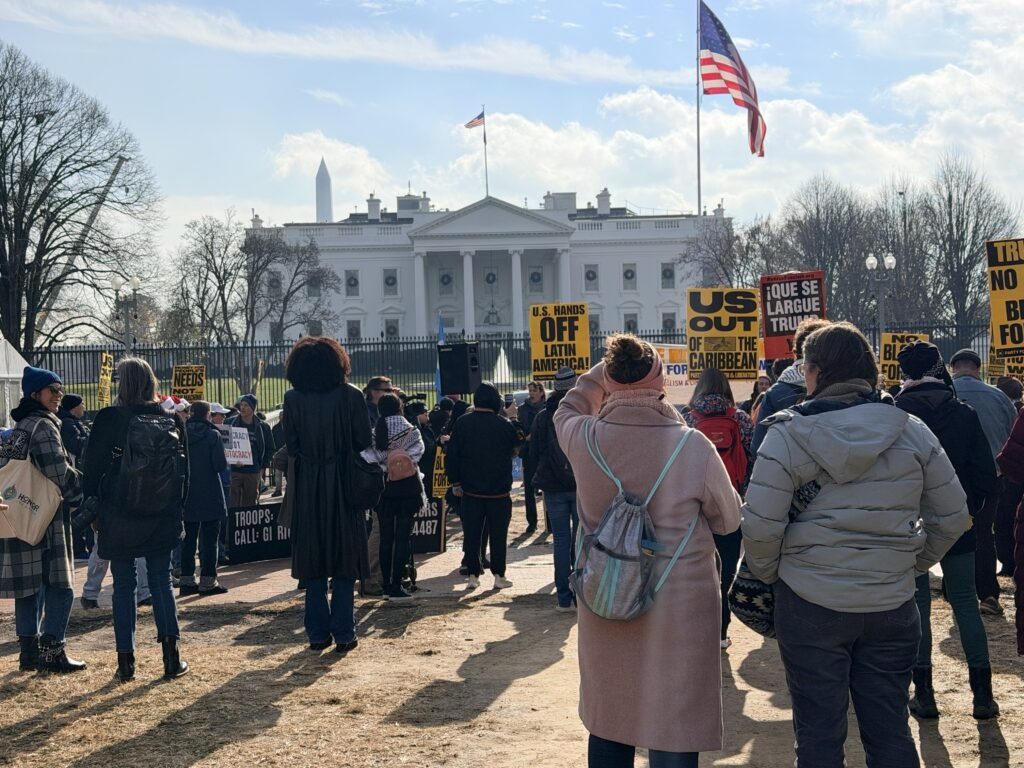
Photo: Anisah Muhammad
Another dimension of U.S. intervention was expressed by Arther Isaac, a driver who dropped marchers off at the event, who called his homeland, Puerto Rico, “a prime example of U.S. foreign policy.”
He did not mince words. He told The Final Call, “There is little difference between slavery and what’s happening in Puerto Rico. We have always been enslaved. People just don’t understand.”
Mr. Isaac pointed to unequal federal benefits and long-standing attempts to erase Puerto Rican culture as evidence of a deeper pattern. “Here’s an example. If you’re 100% American over here, when you move down to PR, you’re just 50%.
Let’s say if you’re military, when you get your benefits over here, you get 100%. If you move down to PR, they will cut it off to 50%. Just because we are not a state. We’re just a territory.”
He added that the United States had for decades tried to suppress Puerto Rican identity. “We are foreigners. Our first language is Spanish, not English. The U.S., back in the day, tried to force us to stop speaking Spanish, just like they did with Hawaii and Samoa. They tried to erase our identity, our culture, but we refused.”
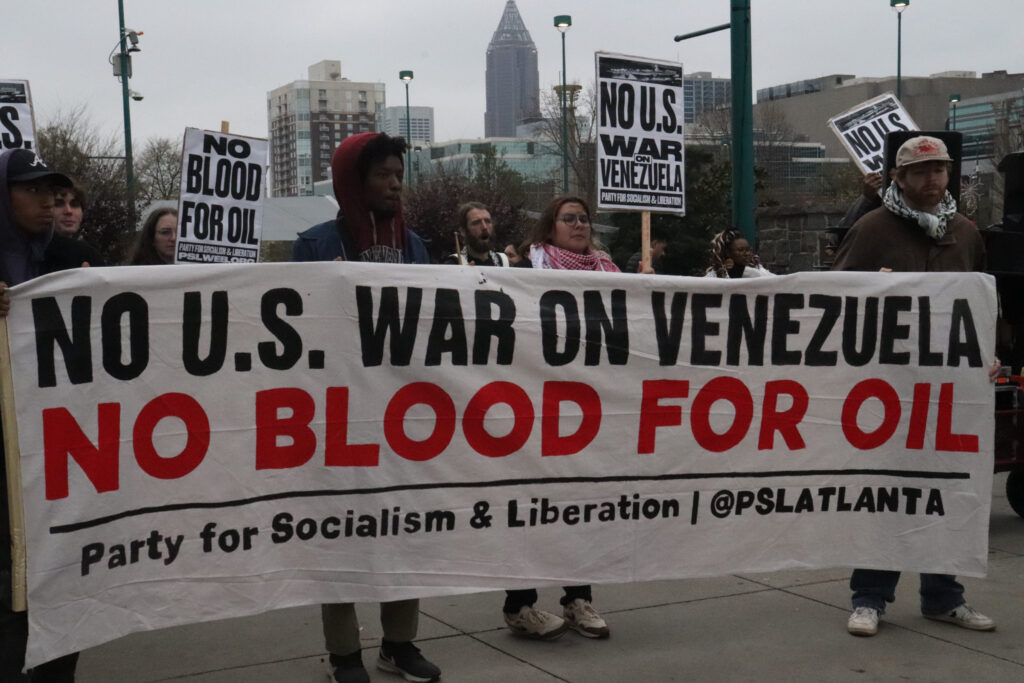
Photo: Charlene Muhammad
Medea Benjamin, co-founder of Code Pink, underscored how widespread opposition to any invasion of Venezuela has become. “It’s not just progressive people, it’s not just Democrats, it’s Republicans,” she said. Many of those voters, she noted, initially supported the president because he campaigned as an anti-war candidate.
Ms. Benjamin framed U.S. threats against Venezuela as part of a larger pattern of intervention stretching across Latin America—including recent sanctions and diplomatic pressure on Cuba, Honduras, and Argentina.
“Everything the U.S. is doing in Latin America is making the lives of people miserable,” she said.
Saturday’s Dec. 6 protests—from Miami to Minneapolis, Los Angeles to Louisville—shared the same message: a demand for diplomacy, restraint, and an end to the steady expansion of U.S. militarism. In Washington, that message was amplified by voices from across the Americas, each pointing to the human costs of intervention.
“Every day this war doesn’t start is another day to stop it,” Ms. Benjamin told the crowd.
As people gathered in downtown Atlanta for a championship college football game, community organizers protested in the frigid cold amidst heavy pedestrian traffic, chanting against the U.S. government’s actions against Venezuela.
The Atlanta protest took place on a downtown street corner near Centennial Olympic Park, directly across the street from football tailgaters. Many of the protesters were college students and young adults. They hailed from different races and ethnicities, including Black, White, Mexican, Venezuelan and others.
Program speakers condemned the U.S. escalating tensions in Venezuela and the surrounding region and the buildup of war, as the U.S. increases its forces in the area. They charged the U.S. with being driven by oil interests rather than the interests of the American people, which include basic human needs such as food, housing, healthcare and education.
“We’re seeing an escalation to actual boots-on-the-ground invasion of Venezuela, extrajudicial killings on the coast of Venezuela. We’re out here to say that this war needs to stop before it even begins,” Stephan Sellers with the Party for Socialism and Liberation and a fourth-year student at Kennesaw State University said to The Final Call.
Claudia Andrade, with the ANSWER Coalition, is of Mexican descent and decided to protest after recent news of the U.S. government’s striking of a boat in the Caribbean in early September. News outlets are now reporting that the boat was not headed to the U.S., as the government claimed, but to Suriname. U.S. forces issued a “double-tap” strike on the boat, meaning they carried out two consecutive strikes with deliberate timing.
“We’ve been seeing these strikes happen for over two months, and they say they’re fighting narco-terrorists, but they don’t even have evidence,” Ms. Andrade said to The Final Call. She feels that it’s important for people to stand up and tell the government, “No.”
“They’re going to have the green light to just go and send troops,” she said. “Trump did not rule out a ground invasion with U.S. troops. It would be like another Vietnam, which means thousands of U.S. troops die, and even more Venezuelan people die. What crime did they commit? The Venezuelan people did not commit any crime.”
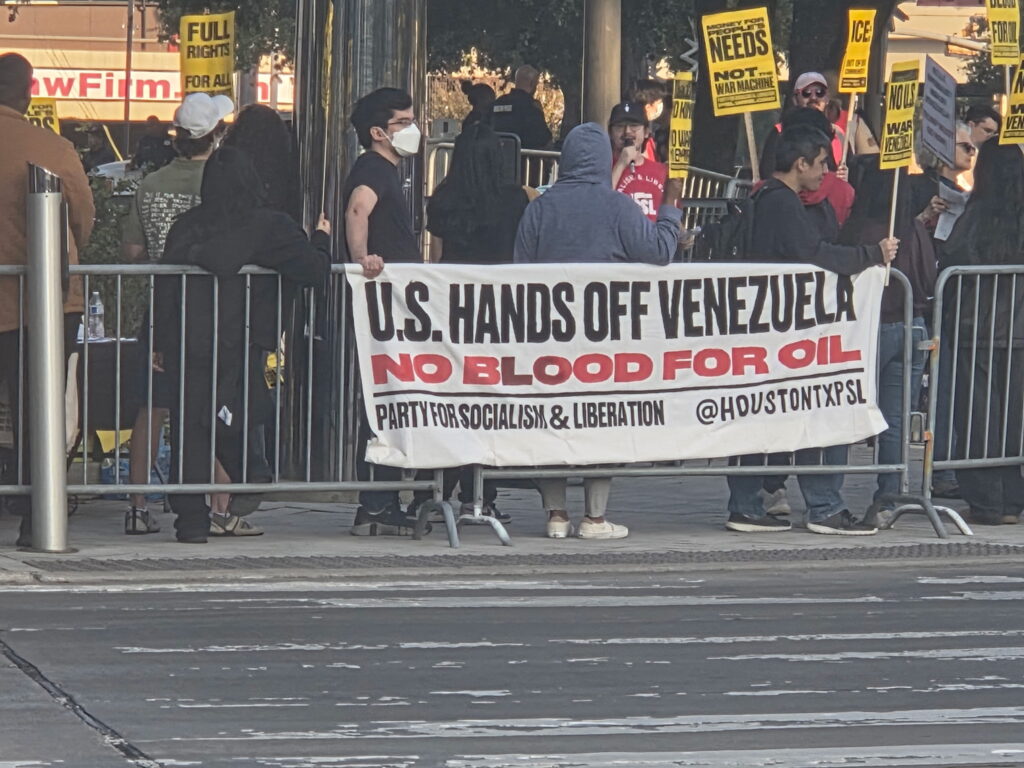
Photo: Charlene Muhammad
Protesters also discussed the impact of U.S. sanctions on Venezuela and criticized the U.S. government’s foreign policy. Mr. Sellers argued that the sanctions imposed on Venezuela have crippled the country’s economy and compared the U.S. government’s actions to the war in Iraq, where America’s young people signed up “to kill and die for a war that did not serve them at all.”
“We want all the sanctions to be lifted,” he said. “We want Venezuela to be able to develop in the way that they can, have self-determination as a country, have sovereignty as a country and be able to allocate the resources the way that they see fit.”
Young advocates predominantly in their 20s spearheaded Houston’s participation in the anti-war protests.
“Since September, he’s (President Trump) deployed 15,000 troops to the Caribbean. He’s launched 20 strikes on boats that have resulted in dozens of people dying. And we’re here to say that the majority of the people in the United States do not support another war.
We do not want an endless war and we know that this war that they’re trying to drum up on Venezuela is built on lies,” stated Rachel Domond, a Haitian organizer, artist and writer, and organizer with the Party for Socialism and Liberation (PSL).
The lies are a precursor to injustice, in the same way that the wars across the Middle East were built on complete lies, such as the “weapons of mass destruction” lies, which resulted in 20 years of war in Afghanistan, said Ms. Domond.
“We know that our people here are struggling. We need our tax dollars to fund our needs here, housing, healthcare, everything else, and instead of funding another endless war in the Caribbean,” she emphasized.
In her view, Pres. Donald Trump’s open, threatening escalation of his aggression on Venezuela is a “rich man’s war” for oil and U.S. corporate interest, not in any benefit to any of the U.S. working class people, Ms. Domond told The Final Call.
A Palestinian youth movement activist named Shada drew parallels between Palestine and Venezuela. At first glance, the two parts of the world seem completely separate in terms of language, history, and struggles, but a closer look reveals the same patterns repeating themselves, she observed.
In Palestine, people live under military occupation, checkpoints, destroyed homes and restrictions that dictate their everyday life. “Their land, their movement and their future are controlled because their region is strategically important to powerful governments. This is not an accident. It’s not a coincidence. It’s a result of a system built on controlling people and territory for strategic advancements,” she said to those gathered.
In Venezuela, the methods are different, but the purpose is the same, said Shada. What began as economic pressure through sanctions has now escalated, she noted. “U.S. warships control Venezuelan waters. Air strikes have been carried out.
And officials openly refuse to rule out military action. Venezuela is not being pressured because it poses a threat to the world. It’s being pressured because it controls massive oil reserves and refuses to let foreign powers like the U.S. dictate how those resources should be used,” she stated.
She urged awareness that when powerful countries use their military, economic, and political strength to dominate weaker nations, it’s not about spreading democracy and helping people. It’s about controlling resources, controlling markets, and shaping the world in ways that benefit corporations and the wealthiest few.
Ayah Haneefa, a member of PSL, told The Final Call she attended the protest to advocate against war in Venezuela because she feels the U.S. has been far too corrupt and is involving itself in already long-suffering countries, like Venezuela.
“America being involved in that country is only going to strip the natural resources from the people whom it belongs to,” she stated.
Final Call Staff Writer Nisa Islam Muhammad reported from Washington, D.C., National Correspondent Charlene Muhammad reported from Houston and Staff Writer Anisah Muhammad reported from Atlanta.
