












The Montgomery Bus Boycott was and is an important and critical moment in the history of Black America. December 2025 marks the 70th anniversary of the time when Black folks in Montgomery declared they had “had enough.”

The story is well-known: On December 1, 1955, Rosa Parks, a secretary for the local chapter of the NAACP, refused to give up her seat to a White man on a public bus in defiance of unjust and anti-Black Jim Crow laws, and was subsequently arrested.
According to the Virginia Commonwealth University library’s social welfare history project, “Jim Crow Laws were statutes and ordinances established between 1874 and 1975 to separate the white and black races in the American South.
In theory, it was to create ‘separate but equal’ treatment, but in practice Jim Crow Laws condemned black citizens to inferior treatment and facilities.”
Being required to sit in the back of the bus or relinquishing seats to White folks was just a small example of life and circumstances facing the Black man and woman of America.
In 1955, Black people were still reeling from the shocking and brutal lynching of Emmitt Till, which took place just a few months earlier, in August. And before Rosa Parks, there were other Blacks who had defied the bus “laws” in Montgomery.
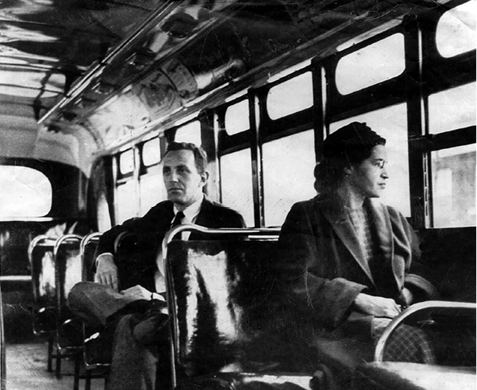
The arrest of Ms. Parks propelled Black folks in Montgomery into action. On Dec. 5, just four days after her arrest, Black folks unified, organized and for 381 days, did not ride the buses in Montgomery.
Black people—who represented 75% of Montgomery’s bus customers—walked, carpooled and did what they had to do in a demonstration of unity. “Approximately 40,000 Black bus riders—the majority of the city’s bus riders—boycotted the system …,” noted History.com.
What occurred in Montgomery also propelled a young minister, Rev. Dr. Martin Luther King Jr., into the forefront of what would be known as the civil rights movement.
“To ensure the boycott could be sustained, Black leaders organized carpools, and the city’s African American taxi drivers charged only 10 cents—the same price as bus fare—for African American riders.
Many Black residents chose simply to walk to work or other destinations. Black leaders organized regular mass meetings to keep African American residents mobilized around the boycott,” noted History.com.
There are plenty of lessons we can learn from the Montgomery Bus Boycott that were applicable then and now. One lesson is that our people can come together for a cause greater than ourselves.
The Most Honorable Elijah Muhammad, Eternal Leader of the Nation of Islam, taught us that “our unity is more powerful than an atomic or hydrogen bomb.” He began teaching Black people the importance of unity in the 1930s. The Most Honorable Elijah Muhammad understood that we must depend on Allah (God) and ourselves.
“In unity, we can accomplish much,” He writes on page 61 of “Message To The Blackman In America,” in the chapter titled, “The So-Called Negro Must Do Something For Himself.”
Later in his ministry and work, Dr. King began to understand that unity, especially economic unity among Black people, was a key to our progress.
The Honorable Minister Louis Farrakhan, National Representative of the Most Honorable Elijah Muhammad, spoke to this evolution of Dr. King’s thinking.
Dr. King wanted Black people to unify and to “redistribute the pain.” Years after the Montgomery Bus Boycott, Dr. King understood this importance. Minister Farrakhan explained that just days before his assassination, Dr. King spoke about justice and the importance of targeted economic boycotts for Black people.
As we reflect on and commemorate the importance of the Montgomery Bus Boycott, let us also reflect on the words Minister Farrakhan shared about the civil rights martyr, as we are in the middle of the “holiday” season, where excess spending and frivolity often take center stage among our people.
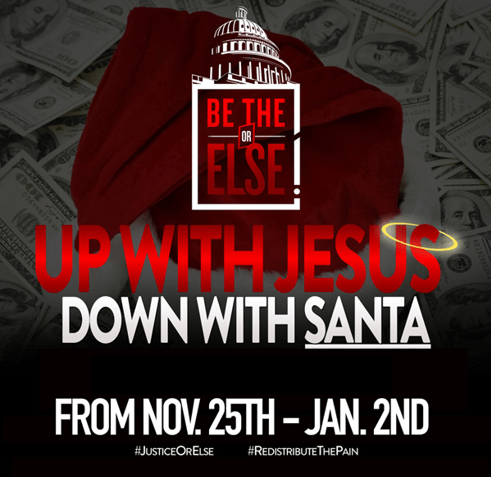
Ten years ago, Minister Farrakhan introduced “Up With Jesus, Down With Santa,” and encouraged Black people not to spend money with retailers and businesses that fund our oppression. Instead, he said that if we must spend, we should spend with Black-owned businesses.
“Dr. King said, ‘Well, if you don’t want to be fair with us, we’re just going to practice economic withdrawal. We’re going to redistribute the pain.’ The 20th Anniversary is on ‘10.10.15’—but Christmas is right around the corner.
We have to distribute some pain! ‘Black Friday,’ the day after Thanksgiving: You should not show up at any market spending money that you don’t have, buying Christmas gifts for those you love—you’re feeding the economy of those that hate you!
And with Christmas and Black spending, they make enough money for the whole year of business to be profitable. Let’s distribute the pain,” Minister Farrakhan said.
The journey toward unity is not easy, but it is necessary. The Most Honorable Elijah Muhammad taught us that “You don’t even have to fire one shot—all you have to do is fire the cannon of our unity,” Minister Farrakhan has stated.
In his 2015 message, “Why We Are Calling You To Boycott Christmas,” Minister Farrakhan laid out a strategy that, if we strive to follow it, would be another powerful example of unity for a cause bigger than ourselves.
“Now suppose we withheld our money during November and December? That’s easy to do: Just keep your money in your pocket. And if you keep your money in your pocket, that’s money that you will have saved.
Imagine if we save hundreds of millions of dollars during that time, we will have money to spend and money to invest in creating a future for ourselves. Did you know that if we just spent one-tenth of 1% of what we spend for these holidays with Black businesses, they would be able to hire thousands of Black people, giving them jobs?
Imagine if we knew how to invest the money that we would save; we could be free, justified and equal, building our own economic base,” Minister Farrakhan said.
The lessons from Montgomery can prove invaluable to us today. Today, we have a blessed opportunity to demonstrate the same focus, discipline, and unity that our brothers and sisters did in 1955-1956. Let us continue to “redistribute the pain.”
