










The genocide in Gaza could not have happened without the United States providing more than $20 billion in funding and resources to Israel, and the direct and indirect cost in lives makes the war in Palestine one of the worst in recent memory, according to two separate recent reports analyzing the crisis since it began two years ago.
One report, “U.S. Military Aid and Arms Transfers to Israel, October 2023 – September 2025,” indicates that the United States has provided at least $21.7 billion in military aid to Israel since the start of the war in Gaza on October 7, 2023.
However, under both the Biden and Trump administrations, an additional tens of billions of dollars in arms sales agreements have been committed for weapons and services that will be paid for in the years to come, according to the report by William Hartung, a senior research fellow at the Quincy Institute for Responsible Statecraft and the Costs of War Project at Brown University.
This report, released on Oct. 7, covers the spending streams funneled into the $21.7 billion. It also details the billions in commitments that the U.S. government has promised for arms to be supplied in the future, saying much or all of which will be paid for by additional appropriations for military aid to Israel.
“Given the scale of current and future spending, it is clear the Israeli Defense Forces (IDF) could not have done the damage they have done in Gaza or escalated their military activities throughout the region without U.S. financing, weapons, and political support,” states the report.
It cites from a companion report (“Costs of United States Military Activities in the Wider Middle East Since October 7, 2023”) by Linda J. Bilmes and Daniel Patrick Moynihan, senior lecturer in public policy at Harvard Kennedy School.
That the U.S. has spent an additional $9-12 billion on military operations in Yemen and the wider region sparked by or in support of Israeli military operations since October 7, 2023. The total is $31-33 billion and counting in U.S. spending on two years of war, according to Professor Bilmes’ report.
Mr. Hartung’s report breaks down the $21.7 billion already provided in military aid, stating that $17.9 billion was provided in the war’s first year and $3.8 billion in year two.
“Some of the $21.7 billion in aid has already been delivered to Israel in the form of weapons, bombs, and funding, while the (other) portions will be delivered in future years,” he stated, in the report. That figure, continued Mr. Hartung, is about how and when U.S. arms and military funding are paid for.
“It is a separate question to ask how long it will take to produce or deliver those weapons, or what it takes to keep them up and running in the midst of a war. In terms of combat capability, these are the most important questions. Yet they are also the areas where there is the least amount of public information,” he explained.
An effective U.S. government effort to impede Israel’s military operations in Gaza and beyond must include a ban on new sales and a suspension of arms in the already-committed but yet to be delivered pipeline, according to the Hartung report. In addition, it mandates a cut off of spare parts and support for the maintenance of Israeli weapons systems already in use, he said.
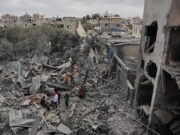
“The current Trump administration has accelerated the delivery of military aid to Israel, including lifting a suspension on the delivery of Mark 84 and BLU-109 2000-pound bombs, which the Israeli government has used extensively to destroy apartment buildings, hospitals, water infrastructure, and other civilian targets,” he notes.
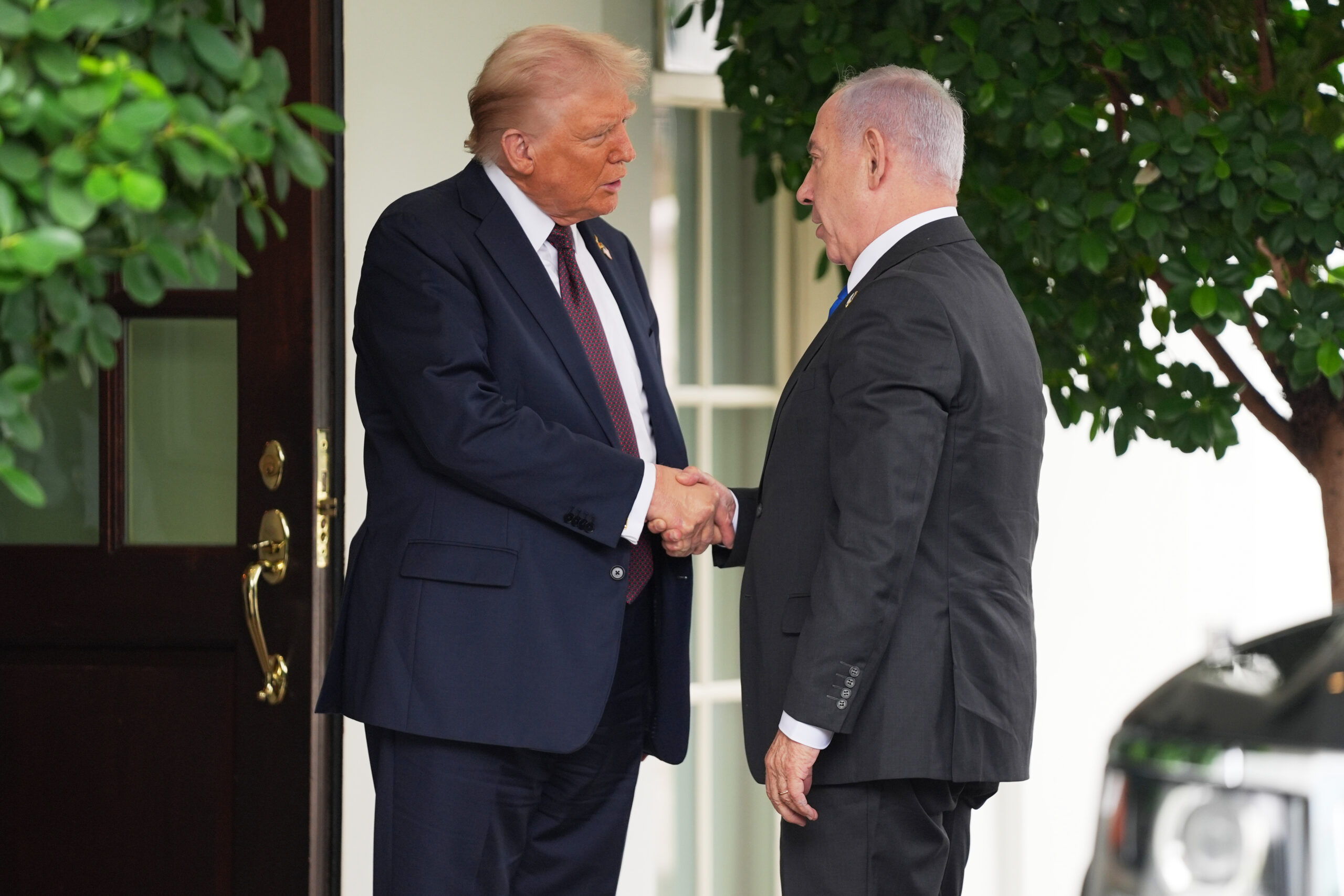
In addition, the Trump administration also reinstated the delivery of 20,000 assault rifles approved by the State Department, which had been delayed by the Biden Administration.
A significant example of future arms commitments excluded from the $21.7 billion detailed in Mr. Hartung’s report includes an $8 billion arms sale to Israel that was announced by the Biden administration in January 2025, their final month in office.
The sale includes but is not limited to: Medium-range air-to-air missiles; 155 mm projectile artillery shells for long-range targeting; Hellfire AGM-114 missiles; and 500-pound bombs, among other items.
According to Mr. Hartung’s research, arms sales to Israel notified to Congress since the Trump administration took office on January 20, 2025, have totaled at least $10.1 billion.
“Trump administration support has coincided with an increase in U.S. military presence and operations in the region at sea, near Yemen, and elsewhere, including air strikes against Iran,” he documented.
“Without U.S. money, weapons and political support, the Israeli military could not have committed such rapid, widespread destruction of human lives and infrastructure in Gaza, or escalated its warfare so easily to the regional level by bombing Syria, Lebanon, Qatar and Iran.
Without U.S. support, the Israeli government would have no combat aircraft to drop bombs and many fewer bombs. An increasing share of Israel’s arsenal would be down for maintenance without U.S. government or U.S. contractor mechanics and spare parts.
In addition, Israel’s government could not have built a military of its current size and sophistication without U.S. financial backing,” concluded Mr. Hartung’s report.
Another report, “The Human Toll of the Gaza War: Direct and Indirect Death from 7 October 2023 to 3 October 2025,” was authored by Neta Crawford, co-founder and strategic adviser at the Costs of War Project.
Ms. Crawford’s report emphasizes that “the consequences of the war for the population of Gaza were foreseeable, foreseen, and documented by observers and the Israeli government throughout the war.”
According to another analysis of data highlighted in the report (by public health scholars Jamaluddine, Abukmail, Aly, Campbell, and Chechi) from October 7, 2023 to June 30, 2024, “the majority of deaths (59.1%) occurred among women, children, and older people, groups considered particularly vulnerable in conflict-affected settings and less likely to be combatants.”
In May 2024, Ms. Crawford reported, the International Court of Justice ordered Israel to “halt its military offensive, and any other action in the Rafah Governorate [at the southern tip of Gaza], which may inflict on the Palestinian group in Gaza conditions of life that could bring about its physical destruction in whole or in part.
While her report summarized the human toll of the ongoing war in a few statistics, it emphasized, “raw numbers cannot do justice to the raw suffering.”
“The Israel Defense Forces have killed and seriously injured more than 10% of the population and, through the destruction of infrastructure—including energy, water, sanitation, agriculture, housing, and healthcare—rendered the conditions of life so difficult as to cause long-term harm for the rest of the population,” detailed the report.
As of October 3, 2025, according to the Gaza Ministry of Health:
• 67,075 people have been killed and 169,430 people have been injured out of the approximately 2.2 million people living in the Gaza Strip in July 2023 (not including Israeli military forces).
• The total number of Gazans has declined to an estimated 2.1 million people since the start of the war due to death and the exodus of about 100,000 people from the territory.
• The total number of casualties, 236,505 people who have been killed and injured, constitutes more than 10% of the pre-war population of Gaza. That is, if the statistics from the Gaza Ministry of Health are complete.
According to Ms. Crawford, recent analysis by public health experts suggests that the number of fatalities reported by the Gaza Ministry of Health, which faces many obstacles to making a full account of the deaths, may be a significant undercount of the violent deaths.
Further, according to this report, 1,048 people have been killed and 10,320 people injured in the West Bank, from October 7, 2023, to October 3, 2025, by direct violence.
“The destruction of food, infrastructure, and medical care, and the denial of adequate amounts of aid has placed the entire remaining population of Gaza at risk for high rates of morbidity and mortality.
An additional half a million people, according to the Famine Review Committee, currently face the worst level of food insecurity—“catastrophic” – and an additional 1.07 million people are confronting a food “emergency,” wrote Ms. Crawford.
She concluded: 1) international humanitarian law enjoins combatants to minimize harm to civilians and to care for those in occupied zones; 2) as a direct result of the Israeli military conduct in the war, more than 10% of the pre-war population of Gaza has been killed and injured;
And 3) the deaths that have and will result from the destruction of infrastructure, the denial of humanitarian medicines and food, and the starvation caused by the Israeli bombardment and blockade, are also likely underestimated.
