











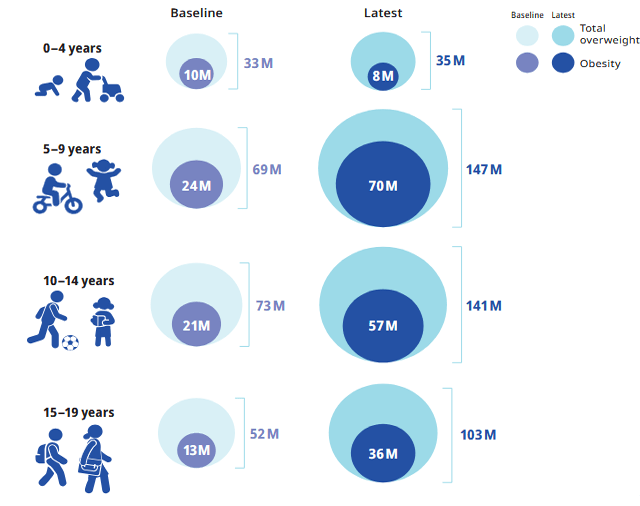

A major shift in global child nutrition has occurred. According to a new UNICEF Child Nutrition Report, obesity among school‐age children and adolescents (ages 5-19) has surpassed underweight for the first time in recorded data. The agency estimates that 188 million young people are obese, marking a dramatic shift in child nutrition patterns over the past 25 years.
Obesity now surpasses underweight in most regions worldwide, except for sub-Saharan Africa and South Asia. The highest rates are observed in several Pacific Island nations, including Niue (38%), the Cook Islands (37%), and Nauru (33%).
High-income countries also report concerning figures: 27% of 5- to 19-year-olds in Chile, and 21% in both the United States and the United Arab Emirates. The 2025 report is titled, “Feeding Profit: How food environments are failing children.”
For decades, the Most Honorable Elijah Muhammad, Eternal Leader of the Nation of Islam, taught Black people the importance of what to eat, what not to eat and what times to eat in His books, “How to Eat to Live,” based on the Wisdom He was taught by Allah (God) in the Person of Master Fard Muhammad, The Great Mahdi.
“Eat one meal a day and eat the food that will not harm you so quickly,” He wrote in book 1 in the chapter, “How to Keep Food From Hurting Us.” In the same chapter, He wrote, “Sugar diabetes can be controlled and cured if you only eat correctly.
Stay off sugar and starchy foods and leave those old, white potatoes alone. Do not eat spaghetti and macaroni at every meal. If you are overweight, do not eat it at any meal, and if you want to live a long time, do not eat it at any meal.
Foods such as spaghetti and macaroni are processed and are hard to digest.” He also warned that people who are overweight should avoid consuming white potatoes and pasta, and instead opt for fruits and vegetables, which are healthier.
Global research is slowly catching up to the Wisdom in the Teachings of the Most Honorable Elijah Muhammad.
“When we talk about malnutrition, we are no longer just talking about underweight children,” said UNICEF Executive Director Catherine Russell in a statement. “Obesity is a growing concern that can impact the health and development of children.
Ultra-processed food is increasingly replacing fruits, vegetables, and protein at a time when nutrition plays a critical role in children’s growth, cognitive development, and mental health.”
Children are considered overweight if they weigh significantly more than is healthy for their age, sex, and height. Obesity is a more severe form of being overweight.
It raises the risk of developing insulin resistance, high blood pressure, and serious diseases later in life, including type-2 diabetes, heart disease, and certain cancers. Obesity also negatively impacts physical and mental well-being, leading to stigma, decreased school performance, and a lower quality of life.
The report warns that ultra-processed and fast foods—high in sugar, refined starch, salt, unhealthy fats, and additives—are influencing children’s diets through unhealthy food environments, rather than personal choice.
These products, especially in poor communities where fresh food is scarce, dominate stores and schools, while digital marketing provides the food and beverage industry with strong access to young audiences.
In the U.S., obesity among children and adolescents remains a serious public health issue, affecting nearly one in five youth. While underweight prevalence is lower, the dual burden of malnutrition—from both obesity and undernutrition—continues to shape child health outcomes across racial, economic, and age groups.
U.S. Secretary of Health and Human Services Robert F. Kennedy Jr. issued a “Make America Healthy Again” report on childhood health in America, highlighting the risks of childhood obesity and ultra-processed foods.
The report stated that the administration would look into creating industry guidelines, but stopped short of requiring the food industry to stop targeting children with junk food ads, which has left many food policy experts feeling let down.
“I’m overweight, my mother was overweight, my grandmother was overweight, and my children are overweight except my son, who plays football,” D.C. resident Lashauna Toliver told The Final Call. She said access to better-quality food for her and her family is challenging.
“Why is bad food so cheap, and the food that’s better for you costs more? I want to eat better, I want my family to eat better, but it’s not easy. Fresh fruits and vegetables are two bus rides away.”
The UNICEF report found that if steps are not taken to stop children from becoming overweight or obese, countries like Peru could face health and money problems costing over $210 billion because of obesity-related health issues. By 2035, the world could spend more than $4 trillion each year due to overweight and obesity.
The report underscores the positive measures implemented by some governments. For instance, in Mexico, where childhood and adolescent obesity is prevalent and sugary drinks along with ultra-processed foods make up 40 percent of children’s daily caloric intake.
The government has recently prohibited the sale and distribution of ultra-processed foods and products high in salt, sugar, and fat in public schools. This initiative has positively influenced the food environments of over 34 million children.
Trends, disparities, and risk factors
Obesity is more frequent among older children and adolescents compared to preschoolers, the report noted. Hispanics and non-Hispanic Black children have higher obesity rates. Children from families with lower incomes are also disproportionately affected.
Studies show that children who are overweight or at high BMI (body mass index) percentiles early (e.g. kindergarten) are much more likely to become obese by adolescence.
To transform food environments and ensure children have access to nutritious diets, UNICEF is calling on governments, civil society, and partners to urgently implement comprehensive mandatory policies to improve children’s food environments, including food labeling, food marketing restrictions, and food taxes and subsidies.
“In many countries, we are seeing the double burden of malnutrition—the existence of stunting and obesity. This requires targeted interventions,” said Ms. Russell.
“Nutritious and affordable food must be available to every child to support their growth and development. We urgently need policies that support parents and caretakers to access nutritious and healthy foods for their children.”
The Most Honorable Elijah Muhammad and His National Representative, the Honorable Minister Louis Farrakhan, teach on the importance of Black people acquiring land to grow healthy food to provide to Black people.
“It would be great if we had more stores in our community servicing our needs. But we need earth to produce the food so the stores can bring the food that we produce to market so our people can have access to healthy food and good food.
Yes, we need more convenience stores, more stores, more supermarkets, but what is the root of that? It is the earth and what the earth produces,” Minister Farrakhan said in a 2010 interview with The Final Call.
“We need both. We need the earth to produce food and we need the urban marketplace to bring our produce to the market so our people absolutely can have good food.”
—Nisa Islam Muhammad, Staff Writer
