





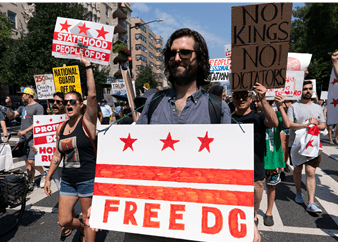

WASHINGTON, D.C.—After weeks of federal troops patrolling city streets, checkpoints disrupting commutes, and customers steering clear of once-bustling corridors, small businesses in the nation’s capital thought there was a light at the end of what some thought was a tunnel for 30 days, only to have the president threaten to do it again.
President Donald Trump has warned that unless the D.C. Metropolitan Police Department resumes cooperation with Immigration and Customs Enforcement (ICE), he will declare another national emergency and re-federalize the city’s police force.
The warning has rattled entrepreneurs still reeling from August’s federal takeover, when the emergency order placed D.C.’s police under White House control.
According to Publishers Weekly (PW), the effects of the takeover were more than a decrease in crime. For restaurant bookstores like Busboys and Poets (B & P), one of their three D.C. locations, the one closest to downtown has been most impacted by the police and military presence, with a checkpoint a block away.
Owner Andy Shallal told PW that he hasn’t seen patrols in the Penn Quarter and Anacostia neighborhoods, where the other two B&Ps are located. “If they’re really concerned about crime, Anacostia, in Southeast D.C., has the most crime,” he said. “Why aren’t they there?”
“We’ve seen from our windows [agents] apprehending, kidnapping people,” Mr. Shallal said, noting that sales at all three District locations have dipped about 5% since August 11.
However, he reported that he hasn’t observed less foot traffic, and in-store events continue to draw audiences. “Ironically,” he added, sales are slightly up in the mini-chain’s five suburban locations, with suburbanites “trying to avoid the city now.”
President Trump has supported federalization by saying that D.C. crime has closed restaurants. He told reporters, “Half the restaurants closed, because nobody could go, because they were afraid to go outside,” he said.
World Central Kitchen’s Chef Jose Andrés disputes that. “I’ve lived here for 33 years, and it’s a flat-out lie that half the restaurants have closed because of safety … but restaurants will close because you have troops with guns and federal agents harassing people … making people afraid to go out,” he posted on social media.
“Cities and towns and rural areas of America need policies that allow small businesses to thrive and all people, including immigrants, to live and work with dignity. People shouldn’t be afraid of their government … government should have respect for its people, not terrorize them.”
A recovery cut short?
During the takeover, restaurants saw online reservations fall as much as 31% year-over-year, according to industry data. Bookstores across the city reported double-digit declines, with some describing their shops as “empty” on weekends. Immigrant workers, especially in the hospitality sector, often stayed home, fearful of commuting past ICE checkpoints.
The return to local control in early September offered hope. Mayor Muriel Bowser pledged to sustain public safety without extending the emergency order, balancing prevention programs with local policing. President Trump’s ultimatum has reopened the sense of instability.
“Uncertainty is toxic for a small business,” Hillary Kingson, a D.C. small business consultant, told The Final Call. “You can’t hire, you can’t expand, and customers hesitate to come downtown when they don’t know what tomorrow will look like.”
Broader economic risks
City economists warn the disruption is layered atop already grim forecasts. D.C.’s chief financial officer projects more than $1 billion in lost revenue over the next three years, driven in part by federal job cuts, reduced consumer spending, and commercial property vacancies.
For restaurants and retailers with narrow margins, the possibility of renewed federal intervention could stall recovery altogether. A survey conducted by a local restaurant association found that 44% of owners fear permanent closure by year’s end if business declines return to August levels.
Under the Home Rule Act, the president can federalize D.C.’s police force for 30 days without congressional approval. President Trump’s latest threat hinges on his demand that local police assist ICE in identifying and detaining undocumented residents—a move Mayor Bowser has repeatedly resisted.
“The city doesn’t need another emergency declaration,” she said recently. “We need steady, collaborative solutions that make residents safe and keep our economy strong.”
For business owners, the debate is less about politics and more about survival.
“We survived the pandemic. We survived inflation. This, though, feels different,” said the owner of a small D.C. carry-out who asked not to be named out of fear of retaliation. “How many more times can we rebuild before there’s nothing left?”
