









While governments may be silent, Muslims around the world are raising their voices, raising funds, and trying to help the starving people in Gaza.
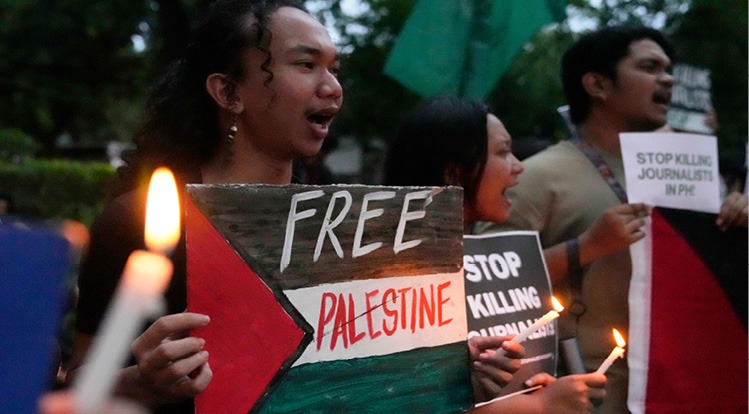
Ordinary citizens are making their discontent with governmental inaction loud and clear, from Kuala Lumpur, Malaysia, where protesters recently gathered shouting, “Free, free Palestine,” to the plans announced in Tunisia for a global flotilla of aid setting sail in late August.
A large civilian flotilla (group of small ships moving together) plans to leave for the Gaza Strip to break Israel’s blockade of humanitarian aid.
The Joint Action Coordination for Palestine, a civil society coordination platform, hosted a recent news conference in Tunis, Tunisia, where members of the Global Sumud Flotilla said activists from 44 countries have signed up for the coordinated effort.
“This summer, dozens of boats, both large and small, will set sail from ports across the world, converging on Gaza in the largest civilian flotilla of its kind in history,” said organizer Haifa Mansouri.
The flotilla combines four initiatives: the Maghreb Sumud Flotilla, the Global Movement to Gaza, the Freedom Flotilla Coalition, and Sumud Nusantara. Their goal, Ms. Mansouri explained, is to “break the illegal blockade on Gaza by sea, establish a humanitarian corridor, and confront the ongoing genocide against the Palestinian people.”
The first convoy will leave Spanish ports on Aug. 31, followed by a second from Tunisian ports on Sept. 4.
Seif Abu Keshk, another organizer, said more than 6,000 activists have already registered online to join. “Participants will undergo training at departure points, with solidarity events and encampments planned along the way,” he added. “This is a renewed attempt to pressure governments by sending dozens of ships and thousands of activists to break Gaza’s blockade.”
Flotillas to Gaza are a risky business. Israeli naval forces recently intercepted the Handala aid ship, a part of the Freedom Flotilla Coalition, as it neared Gaza’s shores and escorted it to Ashdod Port.
The vessel had reached about 70 nautical miles from Gaza, surpassing the distance covered by the Madleen, which made it 110 miles before being stopped, according to the International Committee to Break the Siege on Gaza.
Israel’s foreign ministry confirmed in a statement on X that the “Israeli navy has stopped the vessel Navarn (Handal’s original name) from illegally entering the maritime zone of the coast of Gaza.”
Other worldwide efforts include the following:
Humanitarian aid: Since October 2023, international non-governmental organizations (NGOs) like Islamic Relief, which operates globally, have raised millions to provide food, medical supplies, hygiene kits, and clean water to Gaza. These groups distribute meals, fresh vegetables, and mental and emotional support to children and women.
The people in countries like Türkiye, Saudi Arabia, Qatar, and Egypt have organized fundraising drives, charity events, and social media campaigns to gather donations for Gaza. For example, Islamic Relief’s “Palestine Appeal” mobilizes public contributions for emergency relief.
Political advocacy and diplomatic pressure: Unified Calls for Ceasefire: Muslim-majority countries, through the Organization of Islamic Cooperation (OIC) and the Arab League, have jointly condemned Israeli actions and advocate for a two-state solution. They call for unrestricted aid access and oppose forced displacement.
Support for reconstruction plans: Countries like Egypt, Saudi Arabia, and Qatar back a $53 billion Arab-led reconstruction plan for Gaza, endorsed by the OIC, to rebuild infrastructure and restore governance under the Palestinian Authority.
Medical and logistical support: Medical evacuation efforts by Jordan, Türkiye, and Egypt have accepted critically injured Gazans for treatment. For instance, the WHO facilitated the evacuation of 23 patients to Jordan and Türkiye in July 2025.
Field hospitals and supplies: Islamic Relief and partners like the Union of Medical Care & Relief Organizations delivered medical kits, blood units, and surgical support to overwhelmed hospitals in Gaza.
Muslim majority Indonesia has pledged to treat 2,000 wounded Palestinians on Galang Island, a humanitarian effort reminiscent of the island’s past as a refuge for displaced people.
This is in addition to the ongoing humanitarian aid the small South Asian country has sent since October 2023, which Gaza health officials say has killed more than 60,000 Palestinians.
“Indonesia will give medical help for about 2,000 Gaza residents who became victims of war, those who are wounded, buried under debris,” presidential spokesperson Hasan Nasbi told reporters, adding that the exercise was not an evacuation. The patients would be taken back to Gaza after they had healed, he said.
According to Gaza’s Health Ministry, the number of wounded has reached more than 150,000.
At least 18,500 of those wounded will require long-term rehabilitation. At least 4,700 have had one or more limbs amputated as a result of their injuries, of which at least 1,000 are children.
Global news accounts have reported the worsening conditions in Gaza. “It’s clearly a disaster unfolding in front of our eyes, in front of our television screens,” said Ross Smith, UN World Food Program (WFP) director of emergencies. “This is not a warning; this is a call to action. This is unlike anything we have seen in this century,” he recently told journalists in Geneva.
According to the WFP, half a million people in Gaza are on the brink of famine, while the rest are enduring emergency levels of hunger. The latest Integrated Food Security Phase Classification Alert indicates that more than 500,000 people—almost a quarter of Gaza’s population—are experiencing famine-like conditions, while the rest face emergency levels of hunger.
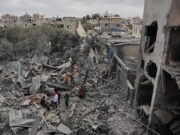
Ongoing conflict, the collapse of essential services, and severe restrictions on the delivery and distribution of humanitarian aid have created catastrophic conditions across the Gaza Strip.
Across the Muslim world, government halls remain largely hushed on the crisis in Gaza, offering carefully worded statements or none at all. The silence is strategic, born of fragile diplomatic ties and geopolitical calculations. But outside those halls, in mosques, marketplaces, and city squares, ordinary people are mobilizing—turning their frustration into action.
In Kuala Lumpur, Malaysia, thousands came from around the city and converged on Independence Square to protest Israel’s recent announcement that it planned to take full military control of Gaza.
Protester Nursabrina Hassan told Al Jazeera, “It is not self-defense because they are bombing children. Israel is very cruel.” Protester Muhd Syed Fardi told Al-Jazeera, “It’s a new occupation that should be opposed by the global community. There should be more humanitarian action.”
Some nations have taken measured steps.
Despite protests around the world at Egypt’s embassies for what many believe is a lack of action in support of the Palestinians, their Foreign Minister Badr Abdelatty recently told reporters in Athens, “The international community should be ashamed of the tragic situation unfolding in Gaza and the devastating actions being carried out by Israel.”
“What is unfolding is a human tragedy, and the suffering witnessed is a stain on the conscience of the international community,” he said.
Calls from faith leaders around the world have grown louder. Recently, nearly 100 Muslim scholars and institutions released a joint statement expressing their view that the governments of Muslim-majority countries, including Arab Muslim nations located near Palestine, can take “immediate and concrete action” to secure an end to the Israeli occupation’s escalating genocide in Gaza.
“We, the undersigned Islamic scholars, religious leaders, and institutions, write today to share our view that the political leaders of the world’s Muslim-majority nations should take greater, concrete action to stop the ongoing genocide of our brothers and sisters in Gaza.”
“We wake up every morning to see new images of men, women, and children in Gaza whose rib cages protrude through their skin because of starvation, whose heads have been hollowed out because of Israeli snipers, or whose bodies have been charred like charcoal because of a bombing.”
They believe that these governments could help end the genocide by cutting all ties with Israel, considering an embargo on global oil and gas sales that directly or indirectly contribute to the Israeli government’s genocide, shutting down military access, opening access points to Gaza and offering diplomatic aid missions.
“We believe that if they take the aforementioned steps and use other appropriate tools at their disposal in an attempt to stop the genocide, the entire Muslim world and people of good faith around the world will rally around them.”
—Nisa Islam Muhammad, Staff Writer
