









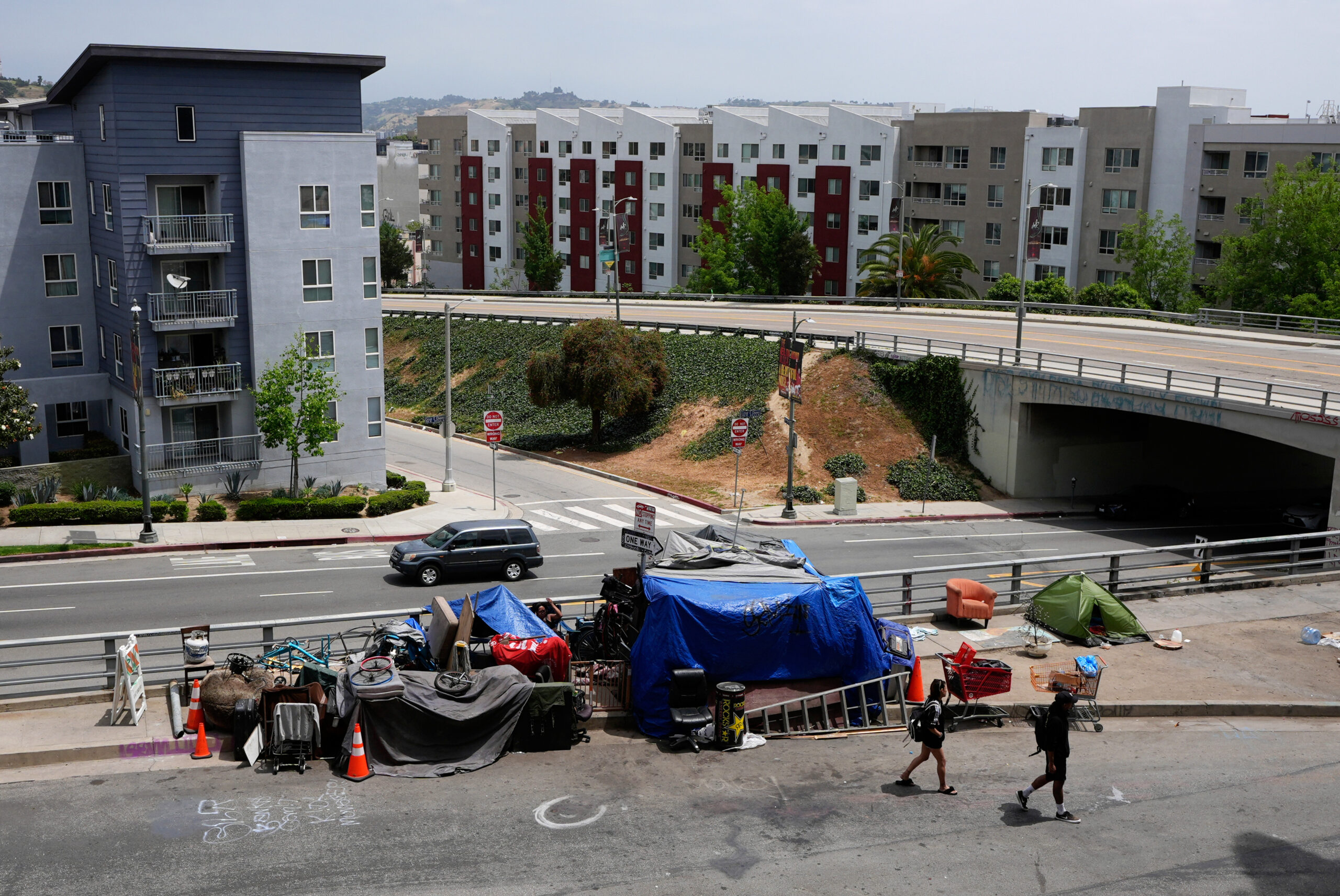

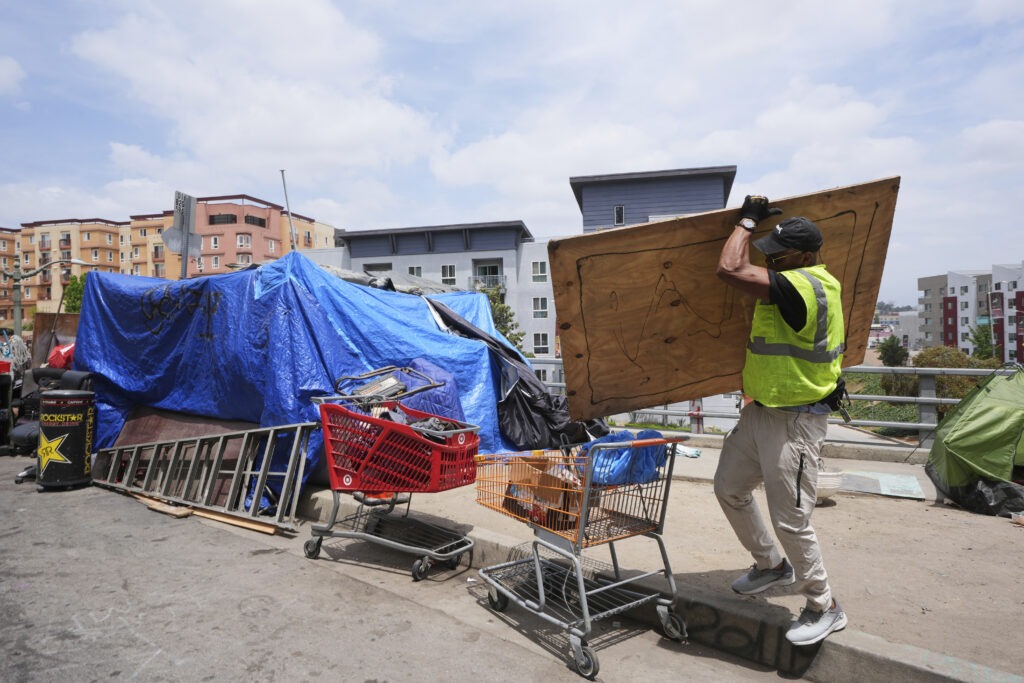
Advocates argue that the federal government’s crackdown on homelessness will have a domino effect, but they say the concerning recent polices amount to criminalization of the homeless and are nothing new.
President Donald J. Trump issued Executive Order, “Ending Crime and Disorder on America’s Streets” which “reverses judicial precedents and end consent decrees that limit State and local governments’ ability to commit individuals on the streets who are a risk to themselves or others;
Prioritize grants for states and municipalities that enforce prohibitions on open illicit drug use, urban camping and loitering, and urban squatting, and track the location of sex offenders.
And redirects funding to ensure that individuals camping on streets and causing public disorder and that are suffering from serious mental illness or addiction are moved into treatment centers, assisted outpatient treatment, or other facilities; ensures discretionary grants for substance use disorder prevention, treatment, and recovery do not fund drug injection sites or illicit drug use.”
Civil and human rights attorney Efia Ngwaza is concerned and told The Final Call that the executive order will have a great impact on homelessness and civil liberties. In her view, it calls for the “forced institutionalization of homeless people based on some nebulous, without due process determination that folk are mentally ill and or addicted … ,” she said.
“It hardly gets any worse than that, short of imposition of the death penalty at the will and fancy of the single individual, due process notwithstanding,” she said.
People need to recognize that not only does the order mean the criminalization of poverty, a violation of civil liberties, but it also fails to address the root causes, and that is the lack of affordable housing, said Atty. Ngwaza.
The Honorable Minister Louis Farrakhan pointed out in his landmark book, “A Torchlight for America,” the problem of poverty, lack of resources and rising housing costs that are impacting the citizens of America, particularly Black people and the poor.
While his book was published in 1993 and reflected statistics of that time, Minister Farrakhan’s points and guidance are just as applicable today. He explained that of the millions of people who lived in poverty, one-third were Black then.
The latest figures by the U.S. Census Bureau from 2023 indicate that Blacks made up 20.1% of the population in poverty in 2022, a ratio of 1.5, meaning that the “Black population was overrepresented in poverty.”
“We’re growing up under conditions that give us a higher propensity toward disease and malnutrition, and each succeeding generation is passed into what is called a permanent underclass. Millions more of us are living on the brink of poverty, just one plant closing away from poverty’s door,” Minister Farrakhan writes on page 15.
“If this economic condition continues, who will be able to afford decent housing and a decent education?” he added.
According to Atty. Ngwaza, people are being displaced as the privileged in the U.S. gobble up the existing housing stock, which is a human rights violation, she argues. “The cost to older or senior citizens, to poor people and to young people is immeasurable,” she said.
“No, the Executive Order does not have the weight of law, but the direction that has been given to the Congress, and that is incorporated in the so-called ‘One Big, Beautiful Bill’ makes the application of the Executive Order necessary in order to have the kinds of funds that the budget otherwise allows,” said Atty. Ngwaza.
However, the order also aims to stop sex offenders who receive homelessness assistance from being housed with children, and allows programs to exclusively house women and children.
“President Trump is taking a new approach focused on protecting public safety because surrendering our cities and citizens to disorder and fear is neither compassionate to the homeless nor to other citizens,” states a White House Fact Sheet on the Executive Order issued July 24.
“What Trump’s proposing is nothing new,” said longtime Bay Area-based homeless advocate Bilal Mufundi Ali. “Homeless people have been criminalized for years,” he told The Final Call.
He cited a Los Angeles ordinance that made it unlawful for a person to sit, lie, or sleep, or to store, use, maintain, or place personal property in the public right-of-way, and said the San Francisco Bay Area is no better. “It’s ironic. They’re blaming homeless people for the homeless problem. That’s a structural problem. … The Democrats were also doing it, too,” he said.
As noted in a previous article by The Final Call, “While homelessness is a nationwide crisis, Black people in America are disproportionately affected, with Black individuals making up nearly 40% of the homeless population despite comprising only 13% of the U.S. population, according to the National Alliance to End Homelessness.
To make matters worse, the U.S. Supreme Court ruled in the case of City of Grants Pass v. Johnson on June 28 (2024) that people experiencing homelessness can be “arrested and fined for sleeping outside when there are no safe alternatives.”
The National Alliance to End Homelessness condemned the order, saying it would impose a multitude of harmful, ineffective, and outdated policies and practices for addressing homelessness.
“This order represents the most harmful policy proposal on homelessness in my career,” said Ann Oliva, CEO of the National Alliance to End Homelessness. “At a time when unaddressed housing costs are driving record numbers of people into homelessness, this order demonstrates a lack of focus and understanding on what our communities—both red and blue—need to address this crisis.
Instead, it largely focuses on punishing people for being homeless and denying desperately needed funds to overwhelmed and under-resourced frontline workers,” she said.
In addition to attacks on Housing First, a vetted approach to ending homelessness by addressing people’s most essential needs first, and its call for forced institutionalization, the order eliminates fundamental privacy protections for people experiencing homelessness, the National Alliance to End Homelessness noted.
The order requires recipients of federal homelessness funding to collect personal health-related data from people experiencing homelessness and share it with federal government agencies and law enforcement.
It also includes several other provisions, including eliminating funding for harm reduction efforts; mandating sobriety; and restricting the use of federal funds, which could open the door to discrimination based on sex and gender, the National Alliance continued.
“This is an SOS moment. The alliance urges state and local policymakers to consider legislation that would mitigate the harm created by these actions to protect the human and civil rights of people at risk of and/or currently experiencing homelessness,” said Ms. Oliva.
“We also call upon the provider community to stay faithful to established best practices in the interests of providing the best possible care for the people they serve. Despite these threats, it is essential that we continue to honor our commitments to safely and responsibly serve the needs of people experiencing homelessness,” she concluded.
The nonprofit news organization CalMatters pointed out that President Trump’s “new law-and-order approach to homelessness bears several striking resemblances to (California) Gov. Gavin Newsom’s.”
The president wants cities to enforce laws that make it illegal for homeless people to sleep outside, CalMatters reported. “So does Newsom. Trump threatened to withhold funding from places that don’t.
So did Newsom. And the president wants to make it easier to force homeless people living with serious mental illness or addiction into treatment. So does Newsom,” it reported.
According to CalMatters, Gov. Newsom already was pressuring cities to crack down on homeless encampments long before President Trump’s order. It reported, in May, that Gov. Newsom urged every city in the state to pass an ordinance making it illegal to camp on public property.
“As an example of how this should be done, he released a model ordinance that would make it illegal to camp in one place for more than three nights in a row, block streets or sidewalks and build semi-permanent structures. But Newsom was quick to distance himself from Trump’s policies,” continued CalMatters.
On the one-year anniversary of the Supreme Court’s City of Grants Pass v. Johnson decision, CalMatters analyzed data on arrests and citations for camping and other homelessness-related offenses for 2024, comparing the six months before the June 28 Supreme Court decision to the six months after.
It found increases in cities throughout the state, even in those where local leaders said they didn’t change their policy as a result of Grants Pass.
“We’ve been fighting this for years,” said Mr. Ali, reflecting on the California Statewide Homeless Bill of Rights Campaign. It was one part of three statewide campaigns in California, Colorado and Oregon to end the criminalization of poor and homeless people’s existence.
“A lot of these cities, especially the Democratic-controlled cities in this country, have pushed these ordinances already,” said Mr. Ali.
Mental Health America (MHA) expressed deep concern, saying the new Executive Order conflates mental illness and homelessness with criminal behavior. It added that this approach not only undermines decades of progress in mental health care and housing policy but threatens the personal freedom, dignity, and safety of the very people it claims to help.
“Every person deserves the safety and dignity of a place to live and access to care that supports their long-term well-being. Mental health challenges and homelessness are not criminal issues; they are basic human and public health issues,” stated MHA’s President and CEO, Schroeder Stribling in a press release.
“Having worked in homeless services for two decades, I’ve seen firsthand how people recover and thrive when they have stable housing with strong community support systems. That’s where our focus must be: on efforts to foster stability and improved well-being.
This executive order moves us in the wrong direction, relying on outdated ideas of forced institutionalization rather than investing in strategies which are proven effective as long-term solutions,” he said.
