



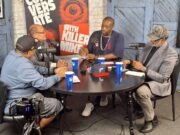
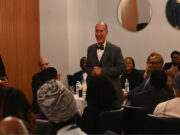
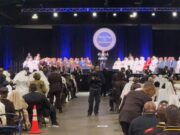




WASHINGTON, D.C—The National Reparations Network organized and held a major rally that brought together a diverse group of educators, artists, legislators, scholars, youth and faith leaders for an afternoon of resistance, unity, history and culture. It was also an event focused on remembrance and renewal.
“This is not just a gathering, it is a reckoning,” activist, actress and director Erika Alexander told the crowd via a recording. “We’re standing together—elders, freedom fighters, artists, educators, students, organizers, mothers, fathers, and dreamers from every corner of this nation.
We are here to say, we remember. We remember the unpaid debts, the stolen labor, the broken promises, and we are here to collect.”
“This rally is not just symbolic, it is strategic, it is a demand, and it is a declaration. A declaration that reparations is not just about money. It’s about justice. It’s about healing. It’s about truth. And it is about time. Let me tell you something.
The world is watching, and they will see us bold, Black, beautiful, and unbowed. They will hear us, not begging, but building, not waiting, but working, not asking permission, but taking our place.”
Ms. Alexander is also the co-director of the documentary, the “Big Payback.” The film features former Evanston, Illinois Alderwoman Robin Rue Simmons, who ushered in the first fully funded reparations legislation of its kind in the United States: Resolution 126-R-19. That bill devoted funds to local reparations for Black residents in Evanston, Illinois.

“The Big Payback” follows her as she leads the community on the uphill battle to obtain reparatory payments meant to correct historic systemic and systematic racism inflicted upon descendants of Black American slaves. The documentary also features the late Congresswoman Sheila Jackson Lee (D-Texas).
Ms. Alexander explained that the film, which debuted in 2023, is a blueprint for communities to design their own local reparations initiatives, from Evanston to other cities around the country.
The rally was hosted by the National Reparations Network and was endorsed by over 50 organizations. The Network includes organizations in diverse categories such as legacy reparations organizations including the National Coalition of Blacks for Reparations In America (N’COBRA)
21st-Century Black-led reparations organizations including the National African American Reparations Commission, state and local reparations commissions, task forces, Coalitions from California, New York, Illinois, Maryland, and Evanston, Illinois and participants from initiatives from institutions including the University of Virginia, Saint Louis University, Georgetown University, and Tulsa Descendants.
The May 17 rally featured keynote speakers, including historian Tony Browder; Omali Yeshitela, Chairman of the African People’s Socialist Party, and Attorney Adjoa Aiyetoro. The crowd also heard virtually from Dr. Maulana Karenga, the founder of Kwanzaa, and Dr. Benjamin Chavis, president and CEO of the National Newspaper Publishers Association.
Vocalist and D.C. activist Luci Murphy and her group, the One DC Black Workers Center Chorus, performed during the rally. She told The Final Call, “I’m here because I need reparations and my people need reparations for the centuries of abuse that we have suffered and for being stolen from Africa. This is our time.”
The demand for reparations for Black people in the United States is not a recent development or a new demand. It represents a persistent call for justice that spans centuries of resistance, resilience, and organized efforts.
From the appeals of those who were formerly enslaved to today’s legislative efforts, the U.S. reparations movement has consistently been about more than just financial compensation. It is a struggle for truth, accountability, healing, and transformation.
Attorney Nkechi Taifa, convener of the National Reparations Network and executive director of the Reparation Education Project, told the crowd, “We pay homage to ancestral pillars of the Reparations Movement, including:
Queen Mother Audley Moore and Dr. Imari Obadele—the mother and father of the modern reparations movement; Belinda Sutton Royal and Callie House, whose early demands for redress set the foundation; Queen Mother Dorothy Benton Lewis and ‘Reparations’ Ray Jenkins, who guided with wisdom and love.”
She also praised late Congressman John Conyers (D-Mich.), who introduced H.R. 40 decades ago in 1989 in the U.S. House of Representatives, which is the Commission to Study and Develop Reparation Proposals for African Americans Act.
After his death, Congresswoman Shiela Jackson Lee (D-Texas) took up the mantle as a sponsor of the bill. Congresswoman Ayanna Pressley (D-Mass.) reintroduced it on January 3, 2025, to the 119th Congress.
The Honorable Minister Louis Farrakhan, National Representative of the Most Honorable Elijah Muhammad, Eternal Leader of the Nation of Islam, has provided guidance and insight to members of reparations organizations over the years.
“Reparatory justice is not a ‘one day’ thing; it’s not a ‘one week’ thing,” Minister Farrakhan explained in a message he delivered at a national/international forum on “Revitalizing The Reparations Movement” held April 19, 2014, at the Emil Jones Convocation Center on the campus of Chicago State University in Chicago, Illinois.
“It is a lifelong struggle until the goal is achieved! But here is the problem: You know, Moses and Aaron had to go to Pharaoh, and naturally, Moses was a little terrified. (I mean, when you have to talk to ‘big bad White folks,’ you have to have something to go with!)
So, when Jehovah said to Moses, ‘Now I want you to go and deliver this Message to Pharaoh’—(like a CARICOM Reparations Commission “10-Point Plan”), but the first part of that Plan is ‘Let My People Go!’” Minister Farrakhan explained.
“Brothers and sisters, when you talk to ‘power’: You can’t go to ‘power’ just with ‘a cry’ for justice! You have to have power backing your cry; otherwise, you’ll get nothing!
You should never think that The Enemy is going to ‘give’ you the justice that you seek. We have been crying at his foot for too damn long; we have to have the power to force justice!…” Minister Farrakhan said.
