













WASHINGTON, D.C.—Is social media bad for teens’ mental health and well-being? According to a new study by the Pew Research Center, “Teens, Social Media and Mental Health,” released April 22.
Almost half of teenagers in the United States believe that social media has a predominantly negative impact on their peers, and a similar number report that they are reducing their use of these platforms.
This research comes after parents, educators, health care professionals and regulators have expressed concerns about the effects of increased use of social media. Many seem to be alarmed after a previous Pew report in December 2024 found that nearly half of U.S. teens said they’re online almost constantly.
Last year, then Surgeon General Vivek Murthy, long a proponent of mental health awareness, asked Congress to require a label on social media apps warning of risks to young people that is similar to the labels on alcohol and tobacco that say drinking and smoking can be hazardous to your health.
This new warning would say that social media use is a main contributor to depression, anxiety and other problems facing America’s teenagers.
“It is time to require a surgeon general’s warning label on social media platforms, stating that social media is associated with significant mental health harms for adolescents. A surgeon general’s warning label, which requires congressional action, would regularly remind parents and adolescents that social media has not been proved safe,”
Surgeon General Murthy wrote in a recent New York Times opinion piece. “Evidence from tobacco studies show that warning labels can increase awareness and change behavior.”
This seems to be an international concern. Australia passed the first law banning teens under 16 from social media or opening new accounts. The new law, set to be implemented in a year, mandates that social media platforms verify the ages of their younger users.
Failure to comply could result in penalties reaching nearly $50 million for social media and technology companies. Despite opposition from social media companies.
Which have labeled the law as a restriction on free speech, tech firms have also expressed concerns that preventing children from accessing social media might push them towards more obscure and less regulated areas of the internet.
In March, Republican Utah Governor Spencer Cox signed a landmark bill requiring app stores to verify users’ ages and share that data with app developers to protect teens from accessing age-inappropriate content online. However, the bill is receiving blowback from tech companies.
“While only a fraction of apps on the App Store may require age verification, all users would have to hand over their sensitive personally identifying information to us—regardless of whether they actually want to use one of these limited set of apps,” Apple, which has long made privacy central to its brand, said in a recent report. “That’s not in the interest of user safety or privacy.”
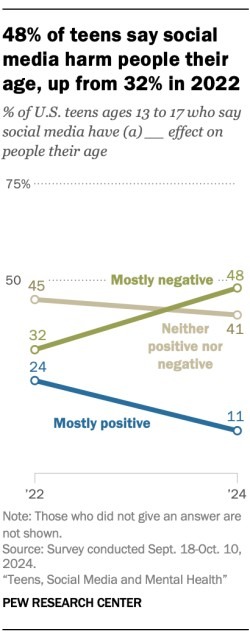
The new Pew study conducted last fall involved 1,391 American teenagers aged 13 to 17, and their parents. Among the teens surveyed, nearly half believe that social media has a “mostly negative” impact on individuals their age.
This is an increase from similar questions in a 2022 survey. Currently, only 11% of teenagers feel that social media is “mostly positive” for their peers.
“The overuse of social media in our society seems to be the main cause of depression among those in my age group,” a teen boy quoted in the report wrote. “People seem to let themselves be affected by the opinions of people they don’t know, and it wreaks havoc upon people’s states of mind.”
