







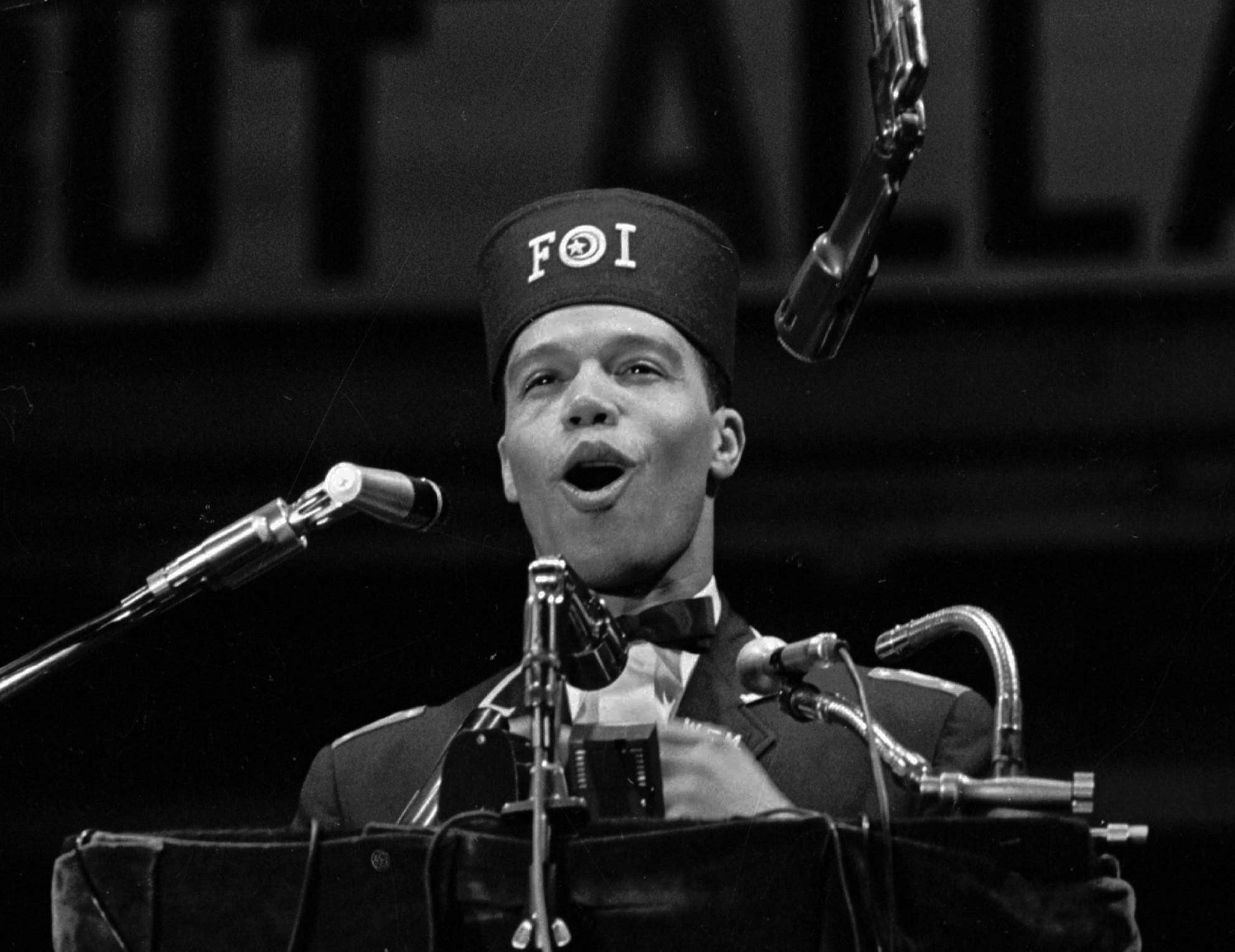

“If I was all the other ministers, I would take pattern after Him.”—The Most Honorable Elijah Muhammad upon listening to the Honorable Minister Louis Farrakhan’s radio broadcast lecture (1973 Table Talks)
The Nation of Islam’s annual Saviours’ Day convention has been famously dubbed the “Crowning Event of Black History Month.” It is without a doubt a special time for the registered membership of the Nation of Islam as well as the larger community of our people throughout Black America.
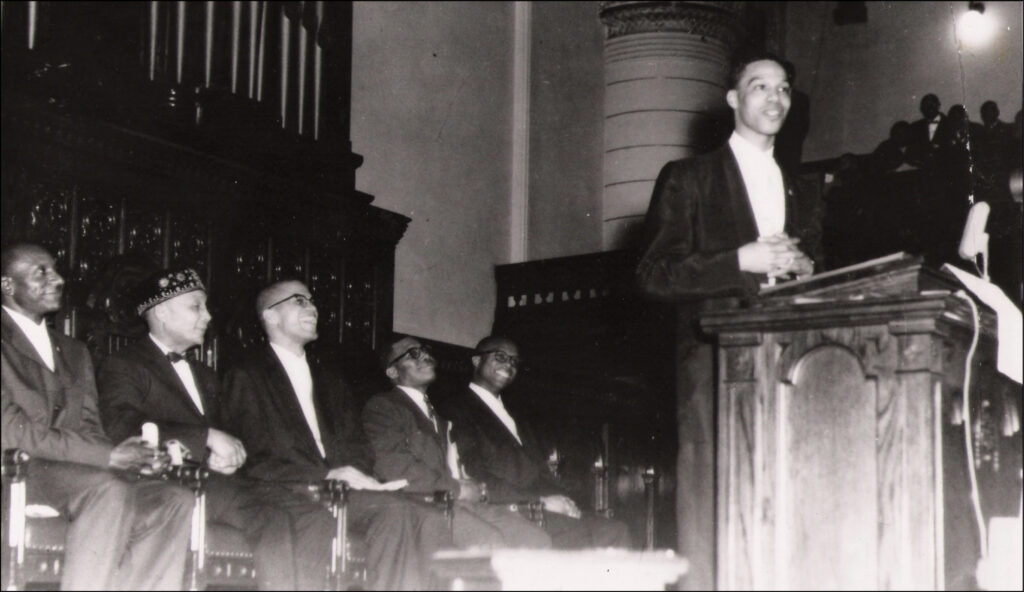
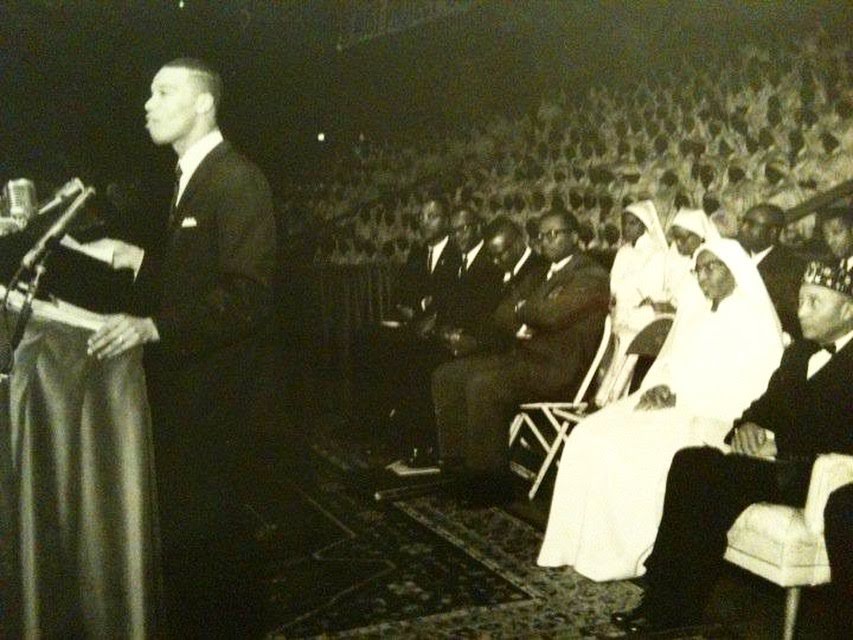
Saviours’ Day 2025 takes on added importance when we reflect that it is a spiritual birth anniversary for the Honorable Minister Louis Farrakhan. It was Saviours’ Day 1955 when the young Louis Eugene Walcott first heard his beloved leader and teacher, the Most Honorable Elijah Muhammad, speak live and in person at Saviours’ Day in Chicago.
As described by my dear brother and fellow member of the Nation of Islam Research Group, Cedric Muhammad, on page Roman Numeral 7 of the book “Closing The Gap: Inner Views of the Heart, Soul and Mind of The Honorable Minister Louis Farrakhan,” conducted and compiled by Minister Jabril Muhammad we read the following:
“The meeting between Master Fard Muhammad and the Honorable Elijah Muhammad in 1931 and the evolution of their relationship was part of a chain reaction of events that eventually included the attendance and participation of a young man—a brilliant and talented entertainer from Boston, Massachusetts, named Louis Eugene Walcott.
At a Nation of Islam event in February of 1955, celebrating the Birthday of Master Fard Muhammad. That annual event was called Saviour’s Day (it continues today as Saviours’ Day).
Although they did not physically meet in the usual sense of that word on that day (that would happen in 1957) the nature of the relationship between the Honorable Elijah Muhammad and the man to whom he would later give the last name ‘Farrakhan,’ was clearly defined.”
Motifs: The pattern of spiritual tandems
When studying the life of men and women of consequence, men and women of destiny, we must always choose the best possible lens, framework and context. The lens through which we fasten our eyes, moreover our minds, upon a thing is critical to arriving at the most accurate and comprehensive view of that thing.
And in as much as context is of this vital importance in looking at and studying “things,” it is exponentially more important the context or framework that forms the lens through which we view men and women of consequence.
Minister Farrakhan’s meeting with the Most Honorable Elijah Muhammad, when viewed through the lens of the Black struggle in America, is important for a variety of reasons.
A very important reason is the full flowering of their relationship over the years, which has seen Minister Farrakhan as a continuance of the work of the Most Honorable Elijah Muhammad in the aftermath of the Most Honorable Elijah Muhammad’s departure from among us.
Just think over the painful reality that has become a phenomenon wherein the rulers of America’s White power structure have always targeted our strongest Black leaders for assassination and the accompanying destruction of their movements.
And what this has meant is that the great ones among us hardly ever have any continuity to their work and mission once they are off the scene. We cannot point to any real successor to Marcus Garvey, Rev. Dr. Martin Luther King Jr., nor Kwame Ture, or any of our great national leaders.
Allah’s (God’s) intervention is responsible for the continuity of leadership within the Nation of Islam. For when we consider the spiritual lens and context of Minister Farrakhan’s spiritual birth anniversary.
We can look back and see how his joining the Nation was the inauguration of a relationship with the Most Honorable Elijah Muhammad as a spiritual tandem worker along the pathway of God for the uplift and deliverance of his people.
The idea of spiritual tandems is one of the recurring “plot elements” or motifs found in scripture.
Author Brian D. Estelle writes on the meaning of the word “motif” in his essay entitled “Motifs and Old Testament” by stating the following:
“… a motif as ‘a discernible pattern composed of individual units, either in a single work or in literature generally.’” He adds that it is basically like a “pattern.” The Oxford English Dictionary defines a motif as “a recurrent character, event, situation, or theme.”
This definition is helpful since it especially shows that a motif can be “in a more restrictive sense (a recurrent character, event, situation, or theme), as well as in a broader sense (a recurring event or situation).”
Collins Dictionary of the English Language defines the word tandem as:
“One behind another; in single file; a relationship between two persons or things involving cooperative action, mutual dependence, etc.”
The relationship of the Honorable Minister Louis Farrakhan and the Most Honorable Elijah Muhammad is that of a spiritual tandem, the like of which is seen as an important spiritual motif in both the Bible and the Holy Qur’an.
That Allah (God) would choose two servants to work in tandem towards bringing into fruition His divine plan of liberation for His people is seen in the spiritual tandems of Elijah and Elisha; Jesus and Paul; Moses and Aaron; Prophet Muhammad and Ali.
These spiritual tandems written of in the ancient sacred texts of Jews, Christians and Muslims have come alive and leaped off the pages of scripture to manifest powerfully in the Divine relationship between the Most Honorable Elijah Muhammad and the Honorable Minister Louis Farrakhan.
Space constraints won’t allow us to offer an analysis of just how each of these spiritual tandems from the scripture have manifested within the lives of Black America through the relationship between the Most Honorable Elijah Muhammad and the Honorable Minister Louis Farrakhan.
However, I will direct the reader to the relationship between Moses (Musa) and Aaron (Harun) as detailed within the sacred pages of the Holy Qur’an. In Surah 28:34-35 we read of Moses’ prayer to Allah that he would give to him his brother Aaron as a helper.
“And my brother, Aaron, he is more eloquent in speech than I, so send him with me as a helper to confirm me. Surely, I fear that they would reject me. He said: We will strengthen thine arm with thy brother, and We will give you both an authority, so that they shall not reach you. With Our signs, you two and those who follow you, will triumph.”
Compare the above passage of scripture—Moses’ prayer to Allah for a helper—with the pregnant words, spoken by the Most Honorable Elijah Muhammad in his 1954 Saviours’ Day address; words that upon examination actually comprise a dua (informal prayer) offered publicly by the Most Honorable Elijah Muhammad.
“We have been so greatly misunderstood that I desire that Allah send to me a little helper. For 22 years I have worked hard wherever I was or may be to try to get into your ears and into your hearts the truth that Allah has revealed to me.”
By comparison and through consideration of the role that Minister Farrakhan has functioned in relationship to the Most Honorable Elijah Muhammad—the eloquent confirmer of his message—we are able to see clearly how Minister Farrakhan’s coming into the Nation of Islam in Saviours’ Day 1955 was Allah (God) presenting to the Most Honorable Elijah Muhammad the answer to His prayer for a helper.
The pattern in practice: What does Minister Farrakhan mean to his people?
I would like to invite the reader of this article to pause and reflect on the importance of Minister Farrakhan’s spiritual birth anniversary, and to look at it within the larger context of what the life and work of Minister Farrakhan has meant to Black people in America.
In the 1970s, the Most Honorable Elijah Muhammad said that all His ministers should take a pattern after Minister Farrakhan. In 2025, I believe I am justified in stating that all within Black America, especially those in leadership positions, should study Minister Farrakhan’s life and pattern their lives and leadership after his noble and awe-inspiring example;
The example of a young man who didn’t wait until he became old and tired to give his life to God. No, Minister Farrakhan gave his youth to God, such that Allah (God) molded him and shaped him and put him through many trials and sufferings so that he might emerge as a Star of God; a Star without equal.
But don’t just take my word for it. Consider what many critics, admirers and objective observers have to say about the precious value to Black people that Minister Farrakhan’s life and ministry has provided. These are just some of the reactions to our Beloved Minister as he has traveled a 70-year journey along the pathway of Allah (God).
Black America’s premier leader
To a great extent, in other words, Farrakhan now is the Black leadership—the cutting edge, the storm center, the presence against which others are measured.— The National Review, 1985
“The only leadership that now exists in that community—the African American community—is Louis Farrakhan. Farrakhan can assemble 20,000 people several times a year …” —Abraham Foxman, 2013, former National Director of the ADL
“The appearance of Louis Farrakhan at Madison Square Garden on October 7 demonstrated, without doubt, that he is now America’s preeminent Black leader.”—Author Julius Lester, 1985
The litmus test: The standard by which other leaders are judged
“Smart and super articulate, Minister Farrakhan is perhaps the best living example of a Black man ready, willing and able to ‘tell it like it is’ regarding who is responsible for racism in this country. … Every Black person important enough to be interviewed is asked to condemn Minister Farrakhan—or any other truly outspoken Black leader.”—Professor Derrick Bell, 1993
Black America’s defense attorney
“The best of the legacy of Farrakhan is twofold. First, he has demonstrated a deep understanding of and shown an unswerving courage to publicly detail the lived reality of anti-Black racism.
There is simply no Black person in the world that has—over so many years—been as consistent, as unrestricted, and as forthright in defending the humanity of Black people throughout the world against its attackers.”—Professor Andre C Willis, 2012
The standard of the resurrection of Black manhood
“See, Minister Farrakhan is frightening to Whites, and I would surmise Blacks as well because he emphasizes the masculinity of Black America which has been crushed since slavery. Dr. Martin Luther King represented the feminine side and that is what has been permitted and what most White folks are now comfortable with.”—Economist Jude Wanniski, 2005
Courage to speak truth that others are afraid to speak
“Farrakhan says what so many Black people believe but have learned not to say in public”
—Journalist William Raspberry, 1990
Brother Demetric Muhammad is a Memphis-based author and student minister in the Nation of Islam and a member of the Nation of Islam Research Group. Follow him on X @BrotherDemetric. Read more at www.researchminister.com.
